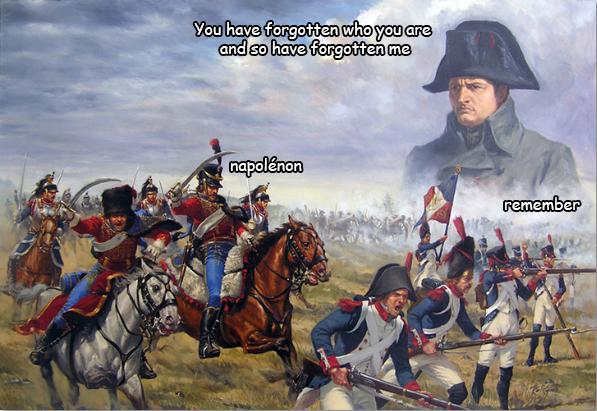
I know a lot of people have a cartoonish image of Napoleon, because of my English friends lol. So I would like to know what things people on this site know about Napoleon
he used a ruse to make it seem like he won in Africa when he actually lost. And used propaganda to shoot up the ranks which eventually led to a coup that put him in power.
he was exiled to an island in Britain with his most trusted companion.
He excelled in logistics
The French had a massive army and were already strong before Napoleon came to power.
His heir was a puppet ruler for a short while, and is considered Napoleon the II but he was mostly incompetent..
There was a Napoleon the 3rd, and he was the last emperor of France before switching to a more democratic system.
not bad, you want to talk about his campaign in Egypt? Do you know that at that time he was sent by the consulate? The French people welcomed her as a liberator, the revolution had created the anarchy, he restored order and grandeur, watching everything he did for France, the First Empire lasted only ten years, from 1804 to 1814. During this period, however short in the eyes of history (to which we can add the 5 years of consulate), France experienced a spectacular transformation: c 'it was there that the civil code, the penal code, the prefectures, high schools and universities, the baccalaureate, chambers of commerce, labor councils, the Court of Auditors, the Banque de France, were invented. the Paris Stock Exchange, the Legion of Honor, the even and odd numbering of streets... It is also there that the Arc de Triomphe, the Church of the Madeleine, the breakthrough of the rue de Rivoli, the bridges of Arts, Austerlitz and Iéna in Paris, or the Pont de Pierre in Bordeaux, the canals of Ourcq, Saint-Martin and Saint-Denis...
So many daring reforms and achievements, led by a head of state, Napoleon Bonaparte, who was however very little present in Paris: a true warlord, he devoted most of his time to his military campaigns and to territorial conquests. Very often he would be absent for weeks, or even months, to fight his battles.
And yet, without telephone, without Internet, and with very slow means of transport (it took almost a week for information to cross the country), France was able, in just ten years, to reform and modernize, and shine in the world.
oh yeah i remember you. You post questions on napoleon.
It's easy to bring on great change when you're an emperor. You skip legislation and put laws into action. The downside is you give too much power to one man.
yes haha, no, but there are many false things circulating about Napoleon, especially because of the image that the English made of him, But this little man who was born into a poor family in Ajaccio, who was humiliated when he arrived in France, and who has reached such heights of glory rarely seen in history, I find it grandiose, after yes I know that he was not an angel but he is not the devil either
the campaign i know very little about. I'm going to make an educational guess, he was most likely fighting Muslims. Because at that time they were a huge threat to the Christian world. France was highly devoted to the Vatican, more so than the country on the other side of the British Channel (Great Britain).
The campaign was not so much against Muslims, he even studied Islam and the Koran a lot, but it was mainly to be able to cut off the English trade, yes you are right people do not like it, me neither I am for one system as in France but at the time of Napoleon it was necessary, if there would have been a democratic system it would have been weak and led France to disaster
not so sure about that. Military leaders learn about their opponents. And reading the Koran would have better helped him understand his enemies. The French were very devote Christians and it was certainly a large reason. Trade of course too was a reason. English trade reached all ends of the globe. France did not like that, and the two nations would constantly fight each other over influence and control.
He made a lot of BAD decisions, and got a lot of people killed!! I am reading "Napolean's Buttons" a book about chemistry, really, but there is a chapter on the tin buttons, used on the uniforms, and how they broke, in the Russian Chill, causing, perhaps, his defeat!
Yes and The First Empire lasted only ten years, from 1804 to 1814. During this period, however short in the eyes of history (to which we can add the 5 years of consulate), France experienced a spectacular transformation: c 'it was there that the civil code, the penal code, the prefectures, high schools and universities, the baccalaureate, chambers of commerce, labor councils, the Court of Auditors, the Banque de France, were invented. the Paris Stock Exchange, the Legion of Honor, the even and odd numbering of streets... It is also there that the Arc de Triomphe, the Church of the Madeleine, the breakthrough of the rue de Rivoli, the bridges of Arts, Austerlitz and Iéna in Paris, or the Pont de Pierre in Bordeaux, the canals of Ourcq, Saint-Martin and Saint-Denis...
So many daring reforms and achievements, led by a head of state, Napoleon Bonaparte, who was however very little present in Paris: a true warlord, he devoted most of his time to his military campaigns and to territorial conquests. Very often he would be absent for weeks, or even months, to fight his battles.
And yet, without telephone, without Internet, and with very slow means of transport (it took almost a week for information to cross the country), France was able, in just ten years, to reform and modernize, and shine in the world.
Yes nice summary lol, but he did not conquer a large part of Europe because he was a monster, but because the English finance the wars against France so he was forced to defend and he has brought so many great things to France and to Europe. He is a man who started from nothing, he comes from a poor Corsican family, he arrived in France very young and he was treated like an immigrant, he was made fun of, and in the end he managed to reach heights and glory rarely seen in history
I don’t think the books refer to him as a monster. It was a time of imperialism, so everyone had to expand or defend what they had for preservation of the nation
oh the English called him a monster lol, but Napoleon had made France the master of the world and with the English it was the struggle for world domination, from the defeat of Waterloo the English became the first world power until that the United States take the place, in fact since Louis XIV the English and French fight for world domination
French General after the Revolution, I read an Arab local's account of his invasion of Egypt. He became Emperor, improved Paris created a new set of French laws. Greatest victory was at Austerlitz over the Russians and Austrians. The Arch de Triumph was built to honor that victory. Married twice, first to a French woman then an Austrian Princess. And everyone know what ultimately happened to him.
Yes and @codyccc The First Empire lasted only ten years, from 1804 to 1814. During this period, however short in the eyes of history (to which we can add the 5 years of consulate), France experienced a spectacular transformation: c 'it was there that the civil code, the penal code, the prefectures, high schools and universities, the baccalaureate, chambers of commerce, labor councils, the Court of Auditors, the Banque de France, were invented. the Paris Stock Exchange, the Legion of Honor, the even and odd numbering of streets... It is also there that the Arc de Triomphe, the Church of the Madeleine, the breakthrough of the rue de Rivoli, the bridges of Arts, Austerlitz and Iéna in Paris, or the Pont de Pierre in Bordeaux, the canals of Ourcq, Saint-Martin and Saint-Denis...
So many daring reforms and achievements, led by a head of state, Napoleon Bonaparte, who was however very little present in Paris: a true warlord, he devoted most of his time to his military campaigns and to territorial conquests. Very often he would be absent for weeks, or even months, to fight his battles.
And yet, without telephone, without Internet, and with very slow means of transport (it took almost a week for information to cross the country), France was able, in just ten years, to reform and modernize, and shine in the world.
People thought he was short, but he was actually average height for the period. He was measured in French Inches which were historically bigger than English inches. So though people thought he was like 5'2" he was more like 5'6" which was about the average in France at the time.
I know why he kept his hand in his vast all the time... he had flies yeah I forgot what led up to it but he was very hairy and caught flies I guess from his hourse
Yes and The First Empire lasted only ten years, from 1804 to 1814. During this period, however short in the eyes of history (to which we can add the 5 years of consulate), France experienced a spectacular transformation: c 'it was there that the civil code, the penal code, the prefectures, high schools and universities, the baccalaureate, chambers of commerce, labor councils, the Court of Auditors, the Banque de France, were invented. the Paris Stock Exchange, the Legion of Honor, the even and odd numbering of streets... It is also there that the Arc de Triomphe, the Church of the Madeleine, the breakthrough of the rue de Rivoli, the bridges of Arts, Austerlitz and Iéna in Paris, or the Pont de Pierre in Bordeaux, the canals of Ourcq, Saint-Martin and Saint-Denis...
So many daring reforms and achievements, led by a head of state, Napoleon Bonaparte, who was however very little present in Paris: a true warlord, he devoted most of his time to his military campaigns and to territorial conquests. Very often he would be absent for weeks, or even months, to fight his battles.
And yet, without telephone, without Internet, and with very slow means of transport (it took almost a week for information to cross the country), France was able, in just ten years, to reform and modernize, and shine in the world.
oh yes of course lol, I thought anyway that history lessons in the United States were mainly focused on the USA, but for me an American is always a little English lol
there I go mistaking English for American... Thanks for correction! I don't really know about history teaching in USA, it was just "maybe", right, lol O_O
He was a French general. He lost at Waterloo, to Wellington His navy lost the battle of Trafalgar, to Admiral Lord Nelson He died in exile on the island of Elba
Um, excuse me, but Wellington had already repulsed over 20 attacks by Napoleon, including an assault by the Old Guard, before the Prussians even showed up. Blucher was just in time to take credit, he really didn't do anything except aid in the pursuit and draw Grouchy away on a wild goose chase. Napoleon had already smashed the Prussians easily the day before. In fact, it was actually Ney who smashed them, a far less capable general than Napoleon.
Blucher was a nutcase who believed that he had been impregnated by an elephant, among other things. If he wasn't a crown prince, he would have been locked up in an asylum. I don't know why people insist on giving him credit for Waterloo. Just to try and take the shine off Wellington, I believe.
Sorry, but based on what? It was politically advantageous for Wellington to butter up the Prussians, but Napoleon had already exhausted his army against Wellington's lines and Wellington had a wooded area behind him that he could have retreated to and held out in indefinitely, assuming it should have been necessary to retreat, which was highly doubtful. The French couldn't even dislodge Wellington from his first line of defense, let alone force him back to a secondary position.
The Prussians could have arrived three days or three weeks later and Napoleon would still be stuck there, unable to march to Brussels or even to retreat without Wellington attacking in the rear. He had Napoleon's nuts in a vice.
@Bananaman177 England is proud of the victory at Waterloo. This denomination, which sounds so British, was moreover imposed by Wellington against the advice of Blücher who would have liked it to be called "Battle of the Belle-Alliance", from the name of a place where the two victors had briefly crossed paths at the end of the fighting. The English general-in-chief gained the reputation of the general who defeated Napoleon in a pitched battle, and what a battle! This version does not seem less forged for national use than the thesis of the “glorious defeat” by the French. The merits of a general and troops who fought with remarkable professionalism and courage cannot of course be disputed. But the glory should be better shared with the Prussian allies. That of Wellington lies in the tactical choice to hold out at all costs while waiting for Blücher. The "victor" declared moreover honestly that he had fought a battle "without maneuver". In his dispatch to Minister of War Bathurst, June 19, we read: "I must do justice to Marshal Blücher and the Prussian army, by attributing the happy result of this terrible day to the help they gave me. have given about. "
The Prussian intervention was decisive, only two days after the defeat of Ligny. And first of all by forcing Napoleon to send forces to meet the first corps arriving on his right, which relieved the Anglo-Dutch system at a critical moment. Later, the irruption of the rest of the Prussians came at a key moment, when the French reserves were exhausted. At that time, three quarters of the Allied front was held by Prussian troops. It was again these who took charge of the pursuit of the vanquished. This made the French officer Lemonnier-Delafosse write: “Extraordinary battle, the only one where we saw two vanquished, the English first, the French then. A battle that the Prussians alone won ”(Military Memories). Despite this exaggeration, the arrival of Blücher's army was therefore really decisive.
@codyccc The First Empire lasted only ten years, from 1804 to 1814. During this period, however short in the eyes of history (to which we can add the 5 years of consulate), France experienced a spectacular transformation: c 'it was there that the civil code, the penal code, the prefectures, high schools and universities, the baccalaureate, chambers of commerce, labor councils, the Court of Auditors, the Banque de France, were invented. the Paris Stock Exchange, the Legion of Honor, the even and odd numbering of streets... It is also there that the Arc de Triomphe, the Church of the Madeleine, the breakthrough of the rue de Rivoli, the bridges of Arts, Austerlitz and Iéna in Paris, or the Pont de Pierre in Bordeaux, the canals of Ourcq, Saint-Martin and Saint-Denis...
So many daring reforms and achievements, led by a head of state, Napoleon Bonaparte, who was however very little present in Paris: a true warlord, he devoted most of his time to his military campaigns and to territorial conquests. Very often he would be absent for weeks, or even months, to fight his battles.
And yet, without telephone, without Internet, and with very slow means of transport (it took almost a week for information to cross the country), France was able, in just ten years, to reform and modernize, and shine in the world.
It starts from his will, there have been governments before him and none have done as much as him, and he is the one who has to control all his projects because he is a man who likes to have control over everything, and not if it corresponds what he wanted he wrote himself the text of the law that wanted to see applied, and if he was busy in the war it is because of the English who finance the wars against France so he had to defend himself
Yes and The First Empire lasted only ten years, from 1804 to 1814. During this period, however short in the eyes of history (to which we can add the 5 years of consulate), France experienced a spectacular transformation: c 'it was there that the civil code, the penal code, the prefectures, high schools and universities, the baccalaureate, chambers of commerce, labor councils, the Court of Auditors, the Banque de France, were invented. the Paris Stock Exchange, the Legion of Honor, the even and odd numbering of streets... It is also there that the Arc de Triomphe, the Church of the Madeleine, the breakthrough of the rue de Rivoli, the bridges of Arts, Austerlitz and Iéna in Paris, or the Pont de Pierre in Bordeaux, the canals of Ourcq, Saint-Martin and Saint-Denis...
So many daring reforms and achievements, led by a head of state, Napoleon Bonaparte, who was however very little present in Paris: a true warlord, he devoted most of his time to his military campaigns and to territorial conquests. Very often he would be absent for weeks, or even months, to fight his battles.
And yet, without telephone, without Internet, and with very slow means of transport (it took almost a week for information to cross the country), France was able, in just ten years, to reform and modernize, and shine in the world.
He was an officer for the French Monarchy and after the French Revolution he maneuvered his way into power. then he went to war with the rest of Europe
The one of the greatest commanders and statesmen ever, and he was a French statesman and military leader who became famous as an artillery commander during the French Revolution
Exactly, he started from nothing to achieve a glory rarely seen in history and he brought a lot of good things for France and Europe, he made France the master of the world alas he has a tragic end
No, the French people also love him very much, and he has brought so many great things to France and to Europe. He is a man who started from nothing, he comes from a poor Corsican family, he arrived in France very young and he was treated like an immigrant, he was made fun of, and in the end he managed to reach heights and glory rarely seen in history
because there were a lot of hypocrite and traitors, to people to whom he gave everything, their glory etc, and when he lost in Waterloo they started to speak against him, after I don't think that was an angel lol
It depends lol, for today's criteria he was small but for the before he was average, if it was a great man military stratege , the defeat of russia does not change that because it is not even a defeat of the armies
That and a lot of other defeats. He had some new uses for artillery during the early campaigns but started losing significantly later on. Like big time.
Napoleon and he won more battles than he lost, and the difference between victory and defeat and enormous, and in general France won more wars than she lost.
That may be, but when it comes to accomplishments, he doesn’t have a lot. He expanded French borders with conquered territory but couldn’t hold onto it. I’d say he’s like Hitler and the blitzkreig. Brilliant moves at the beginning, but ultimately failed. For the betterment of humanity.
No Maybe it's sure , It is another subject, but the comparison with Hitler is ridiculous, moreover her is military strategy is still studied today by the biggest military schools in the world, oh you mean his achievements? He has achieved so many huge things for France and Europe
The First Empire lasted only ten years, from 1804 to 1814. During this period, however short in the eyes of history (to which we can add the 5 years of consulate), France experienced a spectacular transformation: c 'it was there that the civil code, the penal code, the prefectures, high schools and universities, the baccalaureate, chambers of commerce, labor councils, the Court of Auditors, the Banque de France, were invented. the Paris Stock Exchange, the Legion of Honor, the even and odd numbering of streets... It is also there that the Arc de Triomphe, the Church of the Madeleine, the breakthrough of the rue de Rivoli, the bridges of Arts, Austerlitz and Iéna in Paris, or the Pont de Pierre in Bordeaux, the canals of Ourcq, Saint-Martin and Saint-Denis...
So many daring reforms and achievements, led by a head of state, Napoleon Bonaparte, who was however very little present in Paris: a true warlord, he devoted most of his time to his military campaigns and to territorial conquests. Very often he would be absent for weeks, or even months, to fight his battles.
And yet, without telephone, without Internet, and with very slow means of transport (it took almost a week for information to cross the country), France was able, in just ten years, to reform and modernize, and shine in the world.
in my previous post I made a list of everything Napoleon did outside of the military, oh but admit that you were false, at the beginning you told me that he had a lot of defeat, when it was wrong, afterwards you wanted to make up for it by talking to me about France in general, telling me that France had lost more war than it had won and it was still false. But Napoleon, unlike Hitler, was not animated by the same ideology and Napoleon and recognized in the world as one of the greatest stratagems in history by the military themselves and I am not talking just about the simple soldier. but I understand you bring out all the English propaganda 😊😉
 Girl's Behavior
  Guy's Behavior
  Flirting
  Dating
  Relationships
  Fashion & Beauty
  Health & Fitness
  Marriage & Weddings
  Shopping & Gifts
  Technology & Internet
  Break Up & Divorce
  Education & Career
  Entertainment & Arts
  Family & Friends
  Food & Beverage
  Hobbies & Leisure
  Other
Other  Religion & Spirituality
  Society & Politics
  Sports
  Travel
  Trending & News