 Girl's Behavior
  Guy's Behavior
  Flirting
  Dating
  Relationships
  Fashion & Beauty
  Health & Fitness
  Marriage & Weddings
  Shopping & Gifts
  Technology & Internet
  Break Up & Divorce
  Education & Career
  Entertainment & Arts
  Family & Friends
  Food & Beverage
  Hobbies & Leisure
  Other
Other  Religion & Spirituality
  Society & Politics
  Sports
  Travel
  Trending & News

No, this isn't a continuation; that's how they named the game. (Previous entry is here Lessons In Video Game History- The Ultima Saga, Part 7- Ultima VII! and contains links to all prior entries.)
Now, I said last time that this was "the turn of the tide", and I stand by that- unfortunately, the way the tide turns isn't always good. Electronic Arts is routinely voted "Worst company in America" is competitions that include the likes of Blackrock; it's NOT well thought of. And it has very much earned that reputation- it's destroyed more good companies, and run more good IPs into the ground, than any other out there, regardless of industry. That they should take down a series as high-riding and well-regarded as Ultima- well, it'd be easy to believe with the EA of TODAY, but this was thirty years ago. Were they really as bad back then? No- the EA of 1998, six years later, saw the success of Wing Commander: Prophecy, but decided that multiplayer was the way of the future, and that the single-player side would be abandoned (where it still is, a quarter of a century later), and decided, as a gesture of compensation, to release the expansion pack online- free. A 150-megabyte download over a 56K line wasn't exactly "easily accessible", but compared to what they'd do TODAY, it was almost saintly. Would they show at least SOME level of kindness to a series that stood to make them a small fortune?

The first major goal in The Black Gate (Ultima VII part one) was the pursuit of the two high-ranking Fellowship members, Elizabeth and Abraham. Hardly damning evidence, but then you need to take into account the required destruction of the blackrock generators, screwing up the connection to the Ethereal Void and destroying people's ability to manipulate magic in enjoyable and creative ways- generators that took the forms of a square, a circle, and a triangle. This is AFTER the game where the avatar-of-evil pirate captain is named after the founder of EA, and the game where "Electronic Arts" is treated as a swear. There was NO love lost between these two companies. Origin's leadership assumed EA would be, if not respectful, at least professional, and not let petty rivalries stand in the way of making a profit. Did it work? Well, let's take a look:
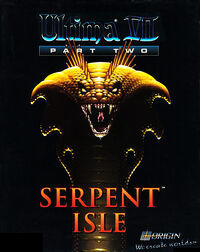
So we start off eighteen months after the previous game ended. The destruction of the moongates left us stranded in Britannia, but that lets us oversee the dismantling of the Fellowship and the pursuit of Batlin (who escaped at the end of the last game). Eventually, a clue is found: a magical scroll from the Guardian, telling Batlin what to do in case his plan is thwarted. Batlin is to follow Gwenno, Iolo's wife, through the recently discovered pillar gates leading to the mysterious Serpent Isle. Gwenno had been hired by the Fellowship to lead an expedition through the gate and explore whatever might be on the other side, bringing with them a mysterious black obelisk. Having no communication with Britannia, she would be unaware of the Fellowship's true intentions, and powerful either as an ally OR a hostage. With knowledge of our target's location, and a special motivation to ensure his rapid capture, we're off through the pillars to Serpent Isle!
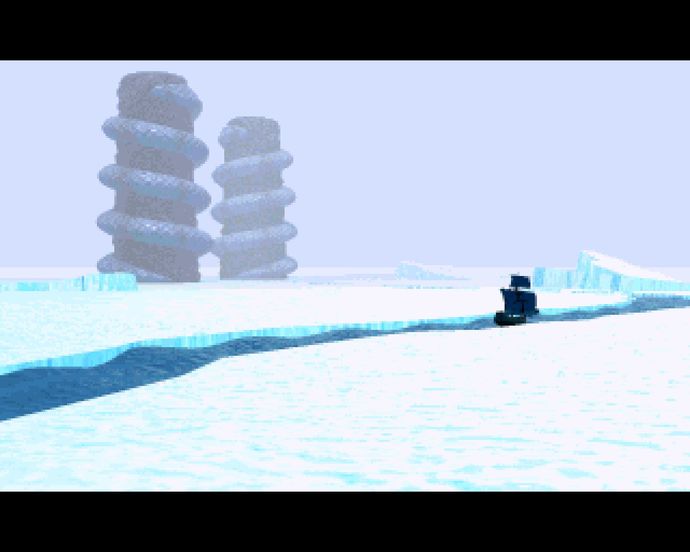
Now, unlike all the previous games, we're not newly teleported into Britannia this time, so we're not starting out broke and unmagiced, with fourth-rate equipment. No, this time we have a full suit of magic armor and weapons, several powerful items gained during our previous adventure, and a spellbook with spells all the way to level NINE:
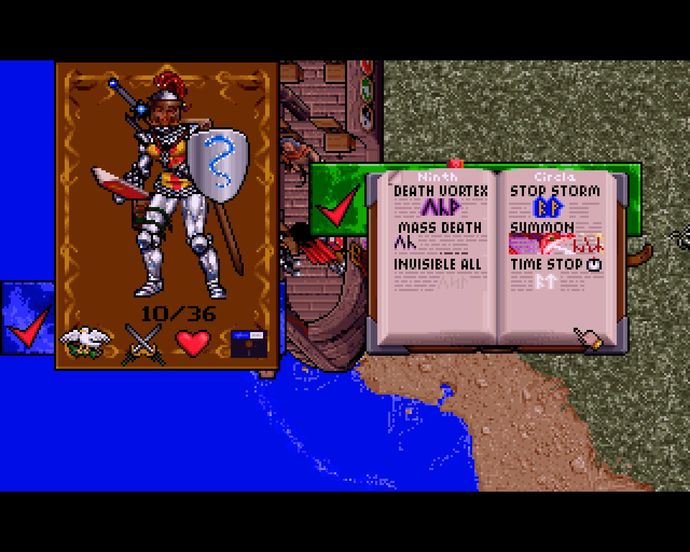
As you can kind of see from that picture, however, things didn't quite go to plan: we sailed into a storm as soon as we passed the gates, and then we crashed here- more or less intact, but with our ship several yards inland, sideways, in the middle of a nasty thunderstorm. And just how nasty is soon discovered: barely have we left the ship when bolts of scarlet lightning touch down, and whatever they strike vanishes a burst of light. We dash for the cover of a nearby cave, but long before we reach it, we're alone: all three of our companions have been hit and vanished. Then a xanthic bolt strikes US, and suddenly half our equipment is gone- replaced with strange, seemingly random objects. We stagger southwards, desperate for shelter, when a stranger in monk robes teleports in front of us, claiming that our presence here and now fulfills a prophecy about the end of the world. Then another monk shows up and warns her not to tell us anything, lest her doing so jeopardize the prophecy and doom everyone. They fight.
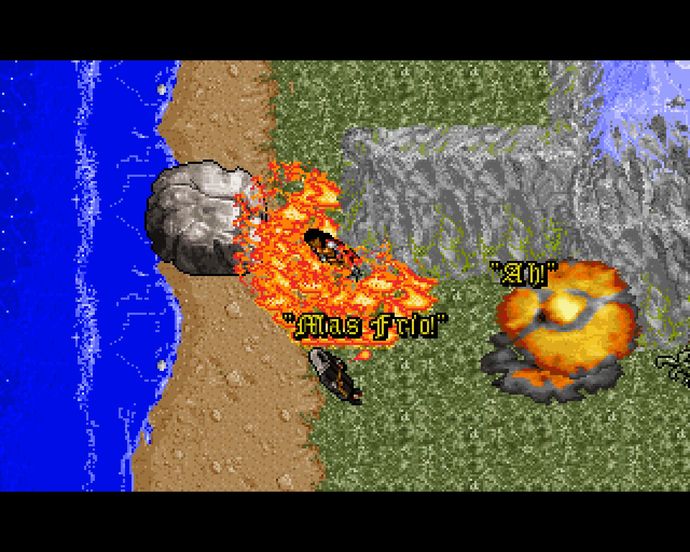
Our first interlocutor, who's been warning us about the importance of keeping our friends by our side, wins, driving the other off. He pauses just long enough to warn us to BEWARE our companions, for they'll bring us ruin and misery. The first says that she's wounded and must flee, and advises us not to stick around, but to make for the nearby city along the coast. Then she, too, teleports away, leaving us stunned and baffled by a VERY busy few minutes. Taking stock, we discover that while we've lost our spellbook and weapons, we still have our magic armor, leggings and shield, and have gained a mighty... um... hunk of pumice.
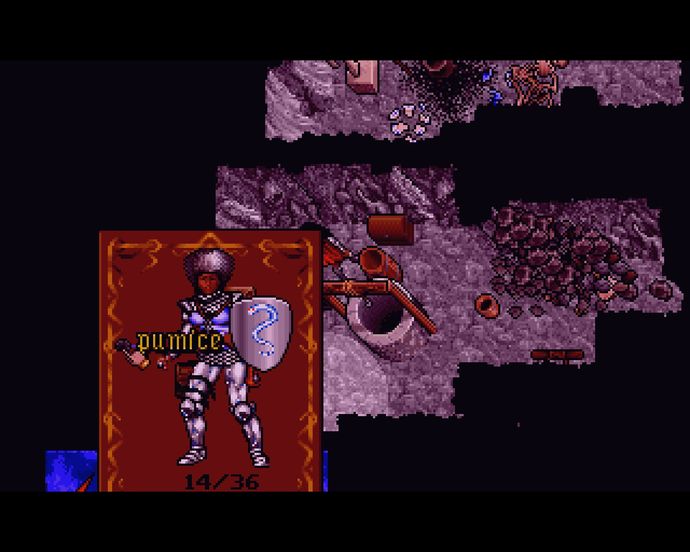
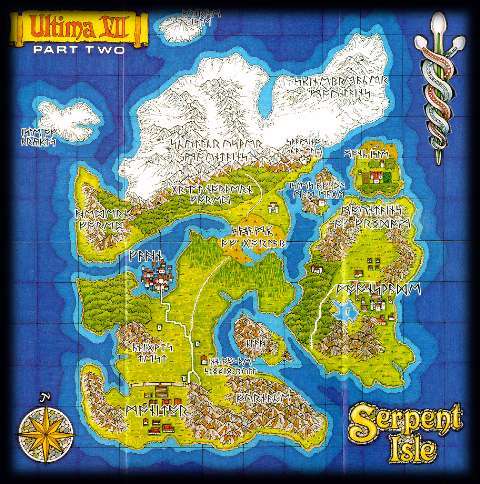
So we're off to kind of a rough start, but there's lots of cool places this could go. Although neither of the monks mention it, the first expedition landed (more properly, at a dock before the storms began) and made peaceful contact, so the idea that they can communicate easily with us makes sense- although not just for that reason. See, we arrive in the city and learn that this island isn't a new place to us, but a very, very old one. Here's a map of Serpent Isle:
And here's a map of the Lands of Danger and Despair, from all the way back in Ultima I:
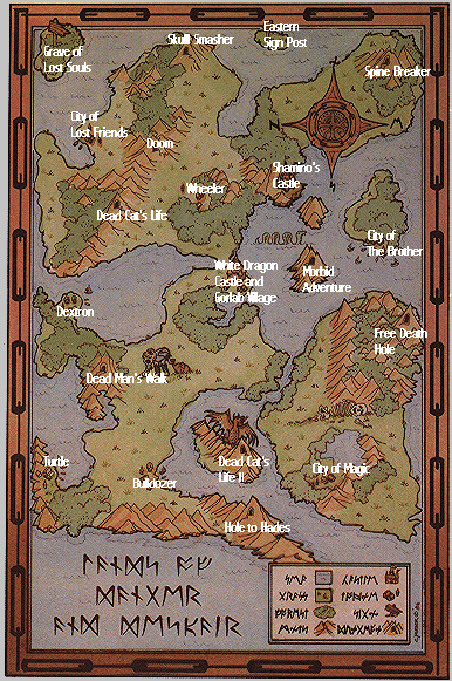
Now we know what happened! They WEREN'T destroyed, simply blasted into another dimension! After the initial sundering, the civilization collapsed- not right away, but for complex and tragic reasons I won't spoil. Then three of the Void Serpents came to the people and taught them about virtues- not Britannian virtues, but their own set- and brought stability. All was dandy, until Exodus kidnapped the Great Earth Serpent to guard his castle in Ultima III. With his moderating influence gone, the others (and their followers among the people, now calling themselves "Ophidians") fell to fighting, and by the time you freed the Serpent, the damage was already done. The survivors fled through a moongate-equivalent system, looking for a new world to live in.
After Exodus was defeated and the quest of the Avatar declared, many people fled the gathering power of the newly self-crowned Lord British, ruler of Britannia. It's an understandable thing; how often do the GOOD GUYS rename the country after themselves? The pillar gates had just been rediscovered (and would be lost again shortly thereafter), providing a place to run to. And the prospect of an immortal (or functionally so) king, forcing everyone to cling to HIS ideals of "virtue" and "rightness"? Hell, I'd consider running, too. As it turns out, LB's not that bad (up until the last game, anyway; my personal headcanon is that he was affected just like other mages), but then again, that's coming from someone who has a whole other world to return to. It's an interesting contrast to his earlier, universally beloved- save for the corrupted Blackthorn (more on him later)- image. Especially since the memory of him is still held up as some kind of bogeyman, to terrify people into obedience.
There are SO many interesting things that you could do in that setting, with those details. How did they screw it up?
Well, that's the thing: they didn't (aside from holding on to the old names of DUNGEONS when cities were built in the same locations; even in a place that calls ITSELF "the lands of danger and despair", you're not going to see people moving to cities called "skullcrusher" or "spinebreaker"). The game actually FIXED some of the problems that The Black Gate had: there's a keyring now, which holds ALL your keys; no more digging through your backpack to find the one specific one you're looking for. There's still no real quest log, but the big list of stuff that got swapped with the transportation lightning is actually written out and handed to you. You can sell stuff in stores again; no more needing to scrimp and scrape for every penny. Food... well, that still sucks. Minor quality-of-life changes can only do so much.
The game IS much more linear; no more zooming around on a boat (or magic carpet) sequence-breaking all the livelong day, but that's not wholly bad- it means the story can be tighter and more elaborate, since it doesn't have to be written around being experienced in any order. It IS a change from the direction the series had been taking since II, however, and it means that you'll need to make the story GOOD, since you have less to fall back on. And this is where the trouble starts; for the the depth the more complex story added, and the deeper, more scripted interactions with the NPCs, a lot of the story consistency kind of falls apart.
That initial teleport storm? Shamino's only a few hundred yards to the south, and Dupre we meet up with shortly thereafter, but Iolo's been thrown in prison because he was teleported into the middle of a funeral, which his presence naturally disrupted. But why would he be? The people of this town KNOW about teleport storms; it's the whole reason they've shut down their docks! Nor is it simply a case of "they're angry because it happened during a funeral", since they constantly insist it was his "evil enchantments" that brought him there.
Why does no one seem to care about the "false coin" spell, that duplicates money? The newly created stuff is supposed to "vanish after 24 hours", but it doesn't. The three different currencies (four, if you count gold) are an interesting idea, but in practice, it just leads to minor headaches, as converting between them isn't very efficient. Every game since IV has made less and less of the importance of the Virtues (from a gameplay perspective, I mean), but this is flat-out STEALING, and nobody seems to care! Sure, the merchants wouldn't know, but in prior games, your companions would complain if you acted unlike the Avatar, and eventually leave, or even attack you! VI had a "transmute lead to gold" spell, but that was essentially a JOKE, since the cost of the nugget of gold you'd get was equal to the cost of the reagents for the spell itself. This quite legitimately destroying the local economy. And it's not a secret; the spell is sold openly. Yes, the local mages DO think themselves superior (mostly, anyway) to the normal population, but not to THAT extent!
There are other problems, story-wise, but I'll get to them later. Now I'll talk about balance: there is none. Now, you might think that's a cute little joke, about the plot disruptions being caused by the lack of the Earth Serpent throwing off the BALANCE between order and chaos, or the great IMBALANCE that's threatening to destroy not only this, but potentially ALL worlds, but no, I mean in gameplay terms. Fairly early on, you can stumble upon the ring of reagents:
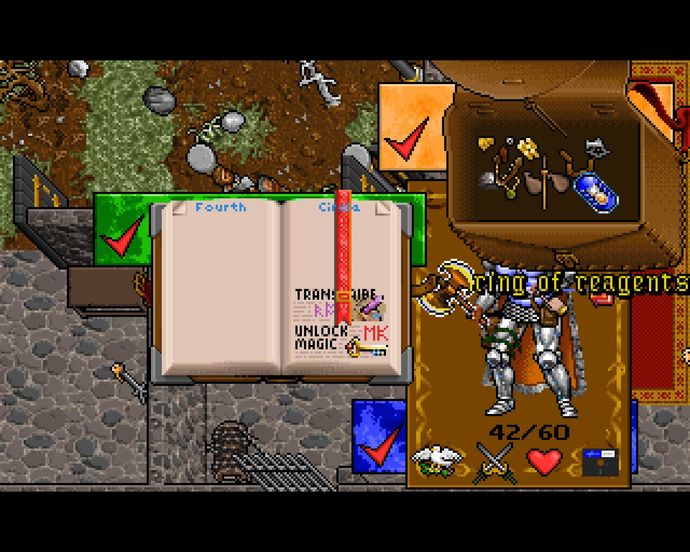
which is the single most unbalancing item in the whole SERIES (so far, at least). See, ever since IV, the big check on spellcasting hasn't been mana, but money- you need to buy reagents to cast your spells. There've been a few places where certain ones could be harvested for free, but these places were out of the way, and/or dangerous, and the amount harvestable was limited, at least at any given time. The ring removes that restriction- no more reagents required! Now, the only limit is your MP; we're back to Ultima III-style casting. That might not sound so bad, but in THAT game, classes were strictly limited in what they could do; sure, your wizard could Dag Mentar a whole battle away, but you'd then have a nigh-useless burden to carry around while the rest of your party actually contributed meaningfully, until his MP recharged. By contrast, a ring-equipped Avatar with an only slightly upgraded intelligence of 24 can toss out THREE Mass Deaths, and have recovered their MP in a matter of in-game MINUTES. Essentially, any challenge after you get it is entirely self-imposed.
All right, even *I* am seeing that this isn't making a compelling case for what this game's real problems are, so it's time to go into full spoiler mode. This is the one and only warning I'll give.
***********************************************************************************************
Spoiler Alert!
***********************************************************************************************
We finally catch up with Batlin in the ruins of the Order city of Spinebreaker. We've since learned that the Ophidian people (who came to power after the events of Ultima I sundered Sosaria) split their society between those who held to order as a guidepost and those who held to chaos, with the Great Earth Serpent (and his representative, the Great Hierophant) mediating between them. Then Exodus abducted the Serpent and the Hierophant was assassinated, with no clear successor, and no guidance from the serpent, and civil war broke out.
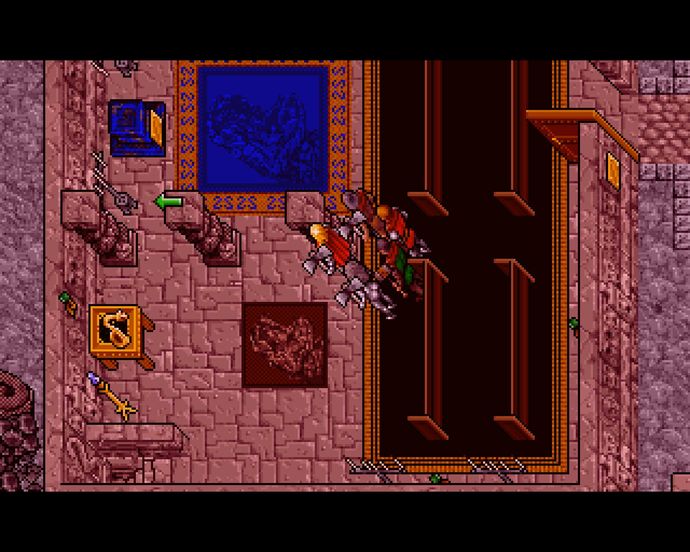
And JUST before we finally reach Batlin, we're confronted by an Order automaton, who says we can't pass until we can prove our affiliation by identifying which book a particular passage comes from. Okay, fair enough; the game wants to make sure you've read the books of the libraries you've passed through, since otherwise, you wouldn't understand what was going on. But *the game gets it wrong*! It claims the answer is in the incorrect book! And the book it IS in, it gives a rather detailed answer to, demonstrating that this wasn't a simple input error. Plus, getting access to that book requires several unalterable changes that weren't made when we arrived, so Batlin couldn't've done it himself. But we'll get to that later.
Officially, the reason Batlin is here is to open the Ophidian Wall of Lights, their gateway to the Ethereal Void, which the Ophidians used to commune with the Serpents (and flee through, once they realized their war had destroyed their civilization). This will allow the Guardian to come through and conquer this world, then piggyback off it to attack Britannia. WHY, exactly, Britannia is so important is... not mentioned. The frequent implications that it was the Guardian himself who killed the last Hierophant and sparked off the war that destroyed the Ophidians is... never explained. Perhaps you're starting to see the problem: HUGE chunks of this game's plot were cut, with mere bits and pieces left to hint at them- and confuse what WAS still there.
What Batlin does instead is to betray the Guardian- opening the Wall and entering the Void to seize power for himself. When he discovers that he's used the wrong artifact, attempting to open the wrong Wall, he screams out to the Guardian for help- but is ignored. He's killed by the fragmentary pieces of the Chaos Serpent, torn apart in the civil war. They then flee, and take possession of the nearest vulnerable humans- our three companions. Who promptly use their newfound powers and evil motivations to tear the three cities of Serpent Isle apart. But all they do is slaughter everyone- nothing to do with the elaborate rules and goals of the corrupted Chaos virtues they embody, and thus nothing but evil because evil, with NONE of the understanding of complex values that've been the guidepost of the series for THE PAST SIX GAMES.
*********************************************************************************************
END OF SPOILERS
*********************************************************************************************
It's all over the unused lines of the game's code, though; clearly, a LOT of effort went into making this even bigger and more elaborate than the Black Gate was, in scope if not in scale- it would've been the story-heavy counterpart the openness-heavy game the first one was. But it was horrifically rushed- not only is the damage limited to horrible mass killing, but with only two exceptions, the surviving NPCs DON'T EVEN ACKNOWLEDGE their cities being destroyed, and everyone they knew slaughtered, except what the plot directly mandates. Wrongs left to be righted, harms left to be undone, comparisons of value systems to be made, and complications of adopting them to be explored... and all left to rot, in the name of getting the game out the door for a Christmas release- which it didn't even MAKE. And it wasn't even REMOVED properly! See this doorway?
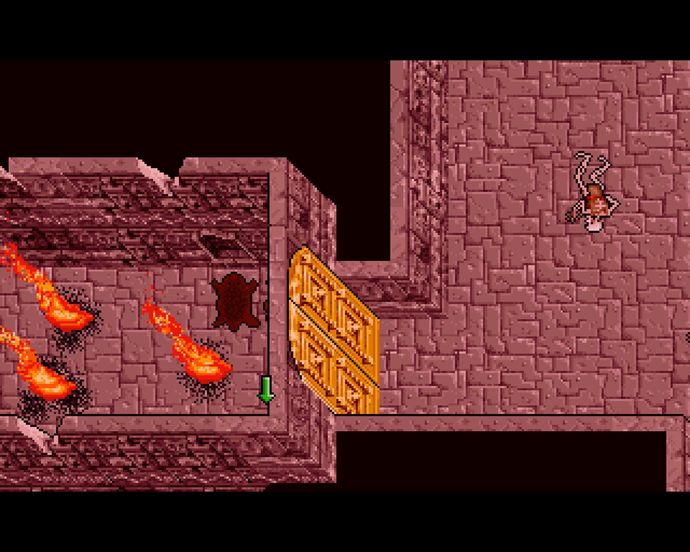
This great golden giant pair of doors, leading past a room blasted with war damage, and fires that are STILL burning? Want to know what's beyond it? What happened to the person that skeleton used to be? What's in this hidden section of the city? So do I. There's no key, spells don't work on it, and if you DO cheat your way past it, you find a note indicating there was even MORE intrigue and complexity to the war... and then a set of stairs that lead into an empty patch of ocean. Bleugh.
Serpent Isle is probably the most painful of the Ultimas to play, simply because there was so much potential for something so much BETTER than what we got- and the hints of so much of it still peek through here and there. It had ambitions, and dreams of greatness, and they were watered down in the name of making a quick buck.
Was this what the partnership with EA would inevitably lead to, or just a horribly mismanaged one-off, caused by drastically conflicting values between the developer and their new owner? Was EA truly so blind that they'd throw out everything deep an interesting enough to attract devoted attention in a game whose creator they'd just purchased?
Find out next time, in Part Nine- NOOOOOOOO!











What Girls & Guys Said
Opinion
0Opinion
Share the first opinion in your gender
and earn 1 more Xper point!