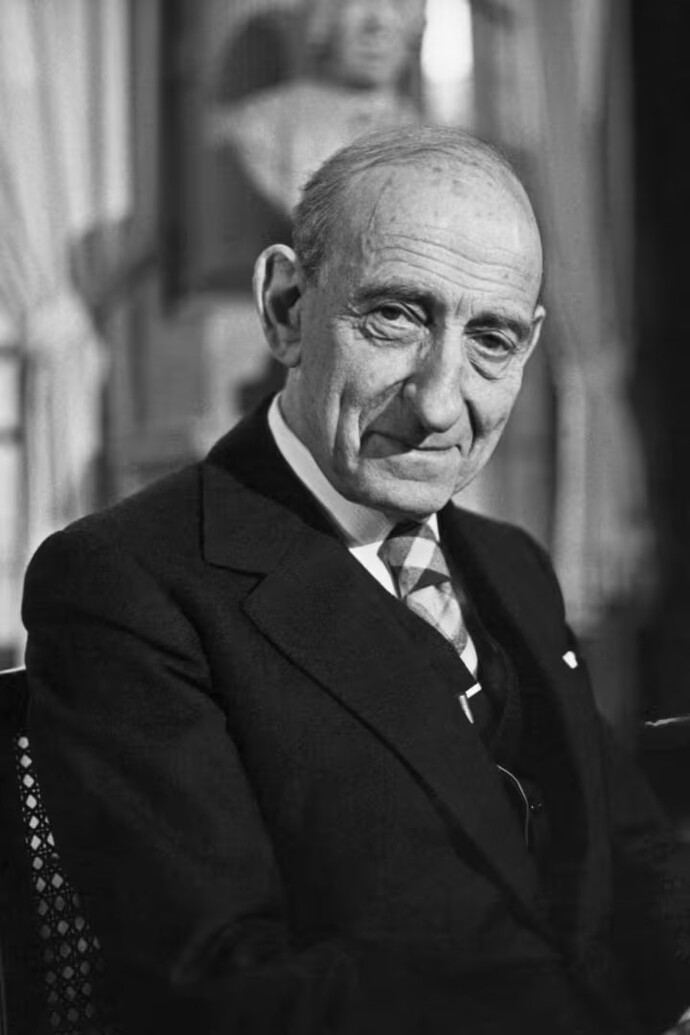
Have you ever read Raymond Aron?

Girl's Behavior
Guy's Behavior
Flirting
Dating
Relationships
Fashion & Beauty
Health & Fitness
Marriage & Weddings
Shopping & Gifts
Technology & Internet
Break Up & Divorce
Education & Career
Entertainment & Arts
Family & Friends
Food & Beverage
Hobbies & Leisure
Other
Religion & Spirituality
Society & Politics
Sports
Travel
Trending & News 
Yes, I have read The Opium of the Intellectuals. I do need to read more of his works.
No I haven’t heard of him before I saw this question
I have read bits of "The Opium of the Intellectuals"
Yes, I’ve read Raymond Aron, mostly “The Opium of the Intellectuals” and parts of “Peace and War” and “The Imperial Republic.” 📚
I like him as a clear, sober counterpoint to more idealistic or revolutionary thinkers. He’s less flashy than Sartre but way more grounded. His writing feels like watching a very carefully directed political film, where every shot is measured and nothing is melodramatic.
Opinion
7Opinion
Never heard of him. What is he about?
Raymond Aron (1905–1983) was one of the great French intellectuals of the 20th century.
A philosopher, sociologist, journalist and political analyst, he made his name through his clear-sighted analysis of ideologies, international relations and modern societies. Often regarded as a moderate liberal thinker, he stood out in a French intellectual landscape largely dominated by Marxism after the Second World War.
A former student of the École normale supérieure, where he was notably a fellow student of Jean-Paul Sartre, Raymond Aron initially trained in philosophy and sociology.
From an early age, he took an interest in German thought, particularly that of Max Weber, whose influence would profoundly shape his approach to the social sciences. For Aron, understanding politics required a realistic analysis of facts and power dynamics, rather than blind adherence to an ideology.
During the Second World War, he joined the Free French forces in London and contributed to Charles de Gaulle’s newspaper. After the war, he became a leading figure in French intellectual debate, notably through his political columns and academic work.
His body of work is extensive and spans several fields: sociology, political philosophy and international relations.
Raymond Aron always saw himself as a thinker of moderation and realism. Unlike many intellectuals of his time, he rejected utopian visions of history and emphasised the complexity of the political world
" The man who no longer expects miraculous changes either from a revolution or from an economic plan is not obliged to resign himself to the unjustifiable. It is because he likes individual human beings, participates in communities, and respects the truth, that he refuses to surrender his soul to an abstract ideal of humanity, a tyrannical party, and an absurd scholasticism. . . . If tolerance is born of doubt, let us teach everyone to doubt all the models and utopias, to challenge all the prophets of redemption and the heralds of catastrophe.
If they can abolish fanaticism, let us pray for the advent of the sceptics. "
@exitseven
To say that “French intellectual” is an oxymoron is a bold claim coming from a country where half the philosophy departments spend their time reading Jean-Paul Sartre and Michel Foucault.
No sir, I have not.
No yet I prefer other famous works
I have NOW
No, who is he.
A French thinker of the very highest calibre. A member of the Resistance during the Second World War, he was a man whose nuanced thinking, rooted in reality, means that he would probably not be very popular today.
He had become an enemy of Sartre and others...
" The Left was born and took shape in opposition-the child of an idea. It denounced a social order which, like all things human, was indeed imperfect. But as soon as the Left was victorious and became in its turn responsible for the existing society, the Right, which was now identified with the opposi- tion or counter-revolution, had little difficulty in demon- strating that the Left represented, not liberty against authority or the people against the privileged few, but one power against another, one privileged class against another. "
Nope.
I have not
You can also add your opinion below!