 Girl's Behavior
  Guy's Behavior
  Flirting
  Dating
  Relationships
  Fashion & Beauty
  Health & Fitness
  Marriage & Weddings
  Shopping & Gifts
  Technology & Internet
  Break Up & Divorce
  Education & Career
  Entertainment & Arts
  Family & Friends
  Food & Beverage
  Hobbies & Leisure
  Other
Other  Religion & Spirituality
  Society & Politics
  Sports
  Travel
  Trending & News

I’m going to attempt to explain a somewhat legendary probability problem which @ChetAtkins asked about today:
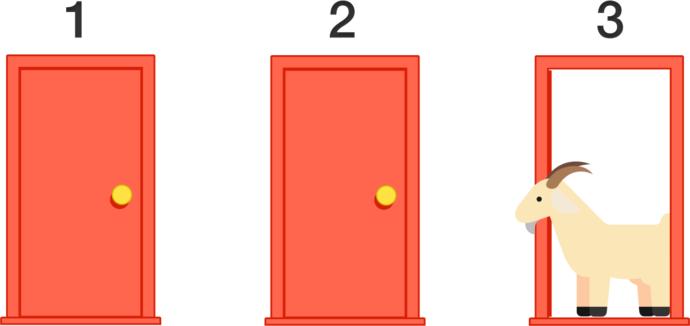
The game show problem with three doors and one good prize.
There are plenty of explanations of the answer online and you can read them and nod but I think they often don’t highlight what specifically means the correct answer is correct. So I’m going to hopefully illustrate it with not one, but three different games where we can see what change to the game is critical.
Variant 1 (as described by Chet):
“So there are three doors to choose from. Behind two of the doors are goats, and behind the other door is a brand new car. You pick door number one. The game show host then tells you that you can change your mind a choose another door if you want. He doesn't tell you that you picked the wrong door, he just throws out the offer? What would you do?”
The player in this situation has a 1/3 chance of guessing correctly. The reason for this is not just because there are three doors - it’s because we believe the game has an even chance of placing the prize behind each. The player makes a guess and has a 1/3 chance of being correct. They are asked if they want to change their guess. It doesn’t matter probability wise what they do as each door still has a 1/3 chance of being correct.
Variant 2:
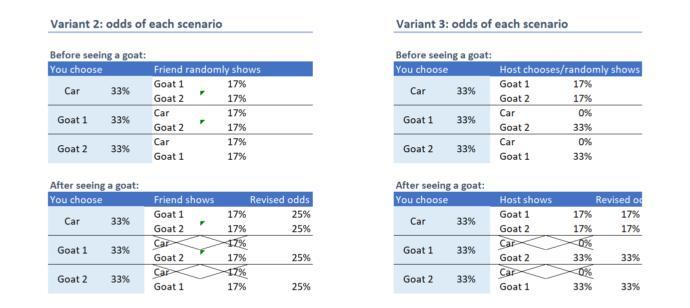
After choosing a door, let’s assume a friend of the player picks one of the two remaining doors to open. They don’t know what’s behind any door. The door they choose has a goat. Should the player now switch?
In this case the remaining doors improve to having a 1/2 chance of being correct but neither is better than the other. The friend didn’t know any extra information. We ruled out one door at random. It’s important that the friend might have picked the “car” door but didn’t, either by chance or because the original player chose the car door.
Variant 3 (the classic problem and actual game show play):
In this version after the player picks a door, the host, who knows where the car is, opens one of the remaining doors and shows a goat. Should the player now switch?
The answer is yes. I will describe the numbers and then hammer on “why”. Let’s look at how often a “switch always” strategy wins.
- 1/3 of the time the player guessed correctly to begin with. The host shows a random goat. The player switches and loses.
- 2/3 of the time the players first guess was wrong. The host -never- shows the car and -always- shows which of the other two doors is a goat. In this case switching results in winning.
So switch always wins 2/3 of the time. The key here is that 1/3 of the time the player loses, but 2/3 of the time the host effectively tells the player the answer. This is different from variant 2, because in variant 2 we can’t tell if the friend who randomly showed a goat simply got lucky.
The critical difference is that the host -often- but not always is actually providing new information that changes the odds, as opposed to purely ruling out one choice.





















Most Helpful Opinions