 Girl's Behavior
  Guy's Behavior
  Flirting
  Dating
  Relationships
  Fashion & Beauty
  Health & Fitness
  Marriage & Weddings
  Shopping & Gifts
  Technology & Internet
  Break Up & Divorce
  Education & Career
  Entertainment & Arts
  Family & Friends
  Food & Beverage
  Hobbies & Leisure
  Other
Other  Religion & Spirituality
  Society & Politics
  Sports
  Travel
  Trending & News

https://www.daysoftheyear.com/days/free-trade-day/
MAY 8th, 2017.
Economics is a complex social science and its central themes– supply, demand, taxation – are discussed and disputed by commentators with allegiances to many different theoretical perspectives. Free Trade Day is one such perspective in modern economic debate. Advocates of the Free Trade movement argue in favour of an international trading environment that operates without taxes or trade barriers. In turn, supporters of Free Trade relate the absence of trade barriers to economic benefits such as lower prices for consumers and growth opportunities for producers.
Professional economists study the impact of trade and taxation policies in depth in an attempt to understand the drivers of growth and prosperity. For those of us who are not professional economists, learning to see the bigger picture of world markets can be much more challenging. If you are in the latter category, Free Trade Day could be a good starting point to learn more about an important school of economic thought.
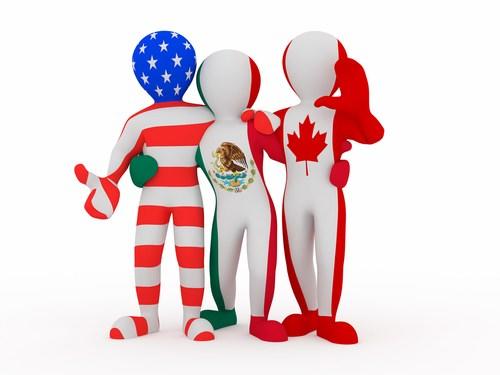
------
NAFTA: https://en.wikipedia.org/wiki/North_American_Free_Trade_Agreement
Following diplomatic negotiations dating back to 1990 among the three nations, U.S. President George H. W. Bush, Canadian Prime Minister Brian Mulroney and Mexican President Carlos Salinas signed the agreement in their respective capitals on December 17, 1992.[6] The signed agreement was then ratified by each nation's legislative or parliamentary branch.
The earlier Canada–United States Free Trade Agreement had been controversial and divisive in Canada, and the 1988 Canadian election involved discussion on the issue. In that election, more Canadians voted for anti-free trade parties (the Liberals and the New Democrats) but the split caused more seats in parliament to be won by the pro-free trade Progressive Conservatives (PCs). Mulroney and the PCs had a parliamentary majority and were easily able to pass the 1987 Canada-U.S. FTA and NAFTA bills. However, he was replaced as Conservative leader and prime minister by Kim Campbell. Campbell led the PC party into the 1993 election where they were decimated by the Liberal Party under Jean Chrétien, who had campaigned on a promise to renegotiate or abrogate NAFTA; however, Chrétien subsequently negotiated two supplemental agreements with the new U.S. president. In the U.S., Bush, who had worked to "fast track" the signing prior to the end of his term, ran out of time and had to pass the required ratification and signing of the implementation law to incoming president Bill Clinton. Prior to sending it to the United States Senate Clinton added two side agreements, The North American Agreement on Labor Cooperation (NAALC) and the North American Agreement on Environmental Cooperation (NAAEC), to protect workers and the environment, plus allay the concerns of many House members. It also required U.S. partners to adhere to environmental practices and regulations similar to its own.[citation needed]
After much consideration and emotional discussion, the House of Representatives passed the North American Free Trade Agreement Implementation Act on November 17, 1993, 234–200. The agreement's supporters included 132 Republicans and 102 Democrats. The bill passed the Senate on November 20, 1993, 61–38.[7] Senate supporters were 34 Republicans and 27 Democrats. Clinton signed it into law on December 8, 1993; the agreement went into effect on January 1, 1994.[8][9] Clinton, while signing the NAFTA bill, stated that "NAFTA means jobs. American jobs, and good-paying American jobs. If I didn't believe that, I wouldn't support this agreement."[10]
This has been around for years, and by some measure, has been successful, with exception to one fly, or many flies in the ointment.
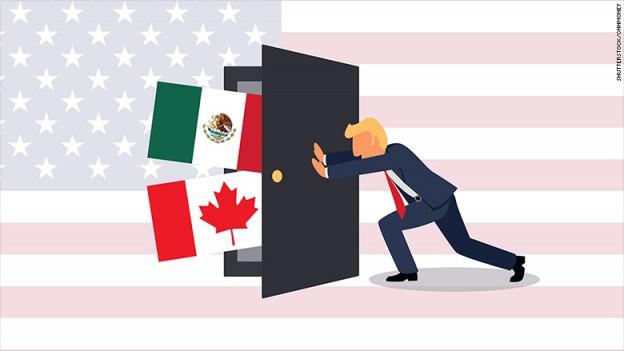
If something isn't broken to some, why fix it?












What Girls & Guys Said
Opinion
1Opinion
I'm one of those who advocates free trade. It's a fundamental essence of the free market since the ultimate protection against monopolies has to extend across a nation's borders.
Those on the protectionist side often cite unfair competition, and the competition can certainly be unfair when crossing domestic borders. Foreign competitors don't have to deal with the same regulations, can pay their workers less, and may even receive government subsidization. Yet I'm also in favor of deregulating the industry so that people can compete more easily at home.
Even in the most unfair scenarios, favoring protectionism comes at the cost of every single consumer who certainly outnumbers those who want government protection. If everything costs more as a result, everyone loses.
As Mart Laar said to his special interest groups, "Find a way to compete and sell your product or die." Most survived and became more competitive than ever. That tough love treatment is a fundamental necessity as I see it if we want to see the free market working optimally.
Another thing is that the side effects of protectionism are often undermined. For example, when there were protectionist arguments in favor of importing tariffs on imported cars from Japan in the US, the argument was to protect automobile manufacturers back at home from losing jobs.
However, what they failed to mention is that such tariffs would likely cost American farmers their jobs, e. g., since Japan was a big customer of goods produced from American agriculture.
So not only would such tariffs punish every American consumer who wants an affordable Japanese car, it would have also potentially extracted a heavy cost for the likes of American farmers, and all to protect some American car companies from having to face stiff competition.
It's hardly ever a decent trade-off as I see it to favor protectionism, and especially not for long.
The free market thrives from maximum competition, not minimum competition.
The thing about protectionism is that I think people tend to want to reach for it the more their nation lacks economic freedom. If a country imposes minimum wage laws at $15/hour, obviously they are crippled against foreign competition unless they can replace human labor with a much cheaper alternative. With more economic freedom, then the ability to compete at home without solely relying on radical innovation is restored.
Share the first opinion in your gender
and earn 1 more Xper point!