 Girl's Behavior
  Guy's Behavior
  Flirting
  Dating
  Relationships
  Fashion & Beauty
  Health & Fitness
  Marriage & Weddings
  Shopping & Gifts
  Technology & Internet
  Break Up & Divorce
  Education & Career
  Entertainment & Arts
  Family & Friends
  Food & Beverage
  Hobbies & Leisure
  Other
Other  Religion & Spirituality
  Society & Politics
  Sports
  Travel
  Trending & News

Overall, the distinction was a small one. It has been said that the United Kingdom acquired the empire "in a fit of absent mindedness." As to France, its' empire was born in some measure out of simple strategic competition with its continental rivals, although post-revolution, ideology played a part.
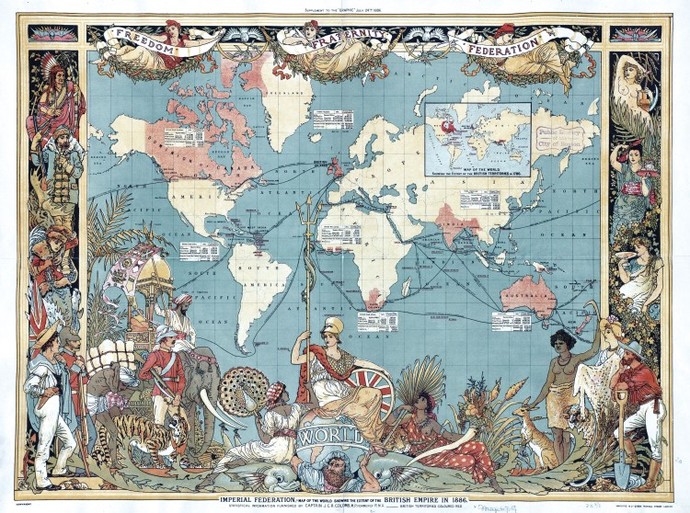
In terms of the British, they were an island nation and a maritime power. If they were to expand trade, acquire more food supplies and raw materials, they would have to reach beyond their island. So they began, following on the heels mostly of Spain and Portugal, exploring the world.
What they found was a vacuum. Vast territories with small and often comparatively primitive populations. So colonization and settlement began. In the enlightened age in which the world now exists - please note the sarcasm as Ukraine can attest - such things are frowned upon. However, at the time, it seemed a perfectly logical extension. Establish settlements and trading outposts and these would be legally part of the Crown.
The rest, as they say, is history. In the particulars, it varied. What the British found in North America in the 1600s was vast empty spaces. What they found in India was rivalries and an Indian leadership that sought Britain as an insurance policy against rival Indian states.
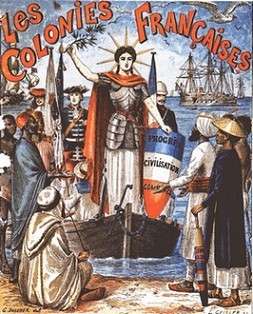
As to France, faced as it was with various continental rivals, plus not always happy relations with the UK - and recall at one point France occupied parts of the British Isles - empire was a strategic asset. It gave to France at the diplomatic level prestige, at the economic level raw materials and foodstuffs to feed a growing population and industrializing economy, and somewhat more debatably at the military level empire provided the French with strategic depth.
All of these were factors at work and in that sense to speak of ambition and intent is somewhat aside the point. The states of Europe as a whole, and France and the UK in particular, acquired and expanded their empires in response to the circumstances in which they found themselves and consistent with the overriding moral principles extant at that period in history.
The British Empire grew larger because the UK - or initially England - as a maritime power/island nation, was obliged to enter the wider world outside of Europe first, and found, not surprisingly, a vacuum. The industrial revolution came to Europe first, and with it modern science and growing populations, and so Europe went into the wider world.
The UK, as an island nation, both because it somewhat protected from continental rivals by the ocean, and because it needed to find more resources and trading partners, went further in territorial terms. Yet it never really had anything to rival France on the continent at the height of the reign of Louis XIV or Napoleon. The difference being that as France grew stronger, it produced a backlash among the rival states of Europe that made the French continental empire shorter lived - even as the colonial empire was sustained.
Which was the most "imperialist"? It depends on the moment in history you are looking at and what the specific circumstances were. Which the more "ambitious." Both and neither. Each responded to the circumstances they found themselves in and the sensibilities of the era in which they thrived, with perhaps a slight tilt to France which, post-revolution, believed it was espousing a new doctrine that would bring the world into conformance with natural law.
I fully agree with what you have just written. However, let me add a few details.
As you rightly point out, England being an island nation is seen in the obligation to develop and protect itself from all external threats to develop a navy and to spread on other continents to provide itself with raw materials, for its trade etc.
As for France, it arrived rather late in the game, if I may say so, compared to Spain, Portugal etc. France launched itself in the colonial conquest because seeing the other nations of Europe doing it, it did not want to be overtaken, and then having an empire and a navy became also essential for France for economic reasons, trade and strategic. In any case, France could not abandon the sea because France opens on the Atlantic Ocean and on three seas: the Mediterranean Sea, the North Sea and the English Channel.
France is bordered by more than 4,000 kilometers of coastline.
The one who will give all the colonial scope to France is Louis XIV, so under Louis XIV France will expand in North America (Louisiana is actually the name given to the name of Louis XIV), the Caribbean, India, and also slightly in Africa. Consequently Colbert, minister of Louis XIV, will endow France with the first navy in the world, both in number and quality. France will become a competitor for the English and the Dutch.
The problem with this is that the Dutch and the English, who were both in a commercial war, decided to combine their forces to bring down the French maritime and land power.
At the end of the war of the Spanish succession (treaty of utrecht 1713) the French navy did not exist anymore, and England acquired important geostrategic advantages from this date. Holland is already beginning to weaken.
Cont.
The fact is that in spite of the catastrophe of the war of the Spanish succession, France will rise again rather quickly so well that the French trade will make practically equal game with England until the war of seven years and by the positioning of its empire will be in direct competition with England for the commercial, colonial and maritime domination.
The seven years war will make France lose its first empire and will give England an enormous advantage since it will practically eliminate the only rival left. Interestingly, the English strategy of colonization of India was directly inspired by Dupleix.
On that will come the French revolution and Napoleon, who will try to compensate the loss of this empire by a European empire, trying to close the continent to the United Kingdom.
It is quite surprising that by chance France and England are also in competition on the continent. France had wanted to extend the French borders to Belgium and the left bank of the Rhine for reasons of protection. The problem is that England could not accept this for its trade and national security.
In the end, France and the United Kingdom found themselves rivals on the continent and on the seas.
England was clever enough to coalesce all the countries of the continent against France on the continent.
In the end I don't believe that the English and the French did all this out of imperialism or to dominate the world. All this was done at the beginning for vital reasons for England and then it became also some part for France, and the chance made that the strategic interests of the two countries found themselves in competition, what ended up leading to the domination of England on the world in 1815. But this was not the objective at the beginning.
Cont.
I am passionate about this rivalry that there was between France and the United Kingdom from the reign of Louis XIV until Napoleon, what historians call a second Hundred Years War and they explain that France and England fought for world domination. I don't think that's true or only partially, because the basis was just to defend interests that were in rivalry, which effectively gave world domination in the end. But neither the French nor the English have said we are doing all this for the domination of the globe.
End
Don't disagree with your general thrust, but I would quibble with a point or two.
My biggest quibble is this: "England was clever enough to coalesce all the countries of the continent against France on the continent."
Yes, to some degree it was shrewd British diplomacy. Yet by the same token, when France was seeking to dominate the continent, the other states of Europe were bound to seek out an ally that they could employ against France. One who also, with a small army and as an island, would not likely later to dominate them.
This was mutual interests at work, not simply some grand plan. Also, I have to say that you tend to attribute noble motives to the French side and bad motives to the other.
This is mistaken. Nations pursue their national interests out of self-interest. France was not forced to defend its national interests, it pursued them. Sometimes effectively, sometimes not.
What you outlined = and outlined very well, I might add - was the ups and downs that are an inevitable part of nations pursuing their national interests.
I really wrote that France had only good intentions and that England was bad?
That's not what I wanted to write my writing to screw up at some point. I just wanted to say that neither France nor England was good or bad but just defending their interests.
A question that has nothing to do with this topic. Are the analyzes of Joseph S. Nye and Mr Fareed Zakaria valid?
Anyway always a pleasure to talk to you.
I hope you are well and your family too. Take care of yourself.
Thanks - and same to you. As to your question, I am not sure what you mean by "valid." Both are serious scholars but I don't often agree with them - especially Zakaria.
My suggestion to you is to read them, but critically and with a skeptical eye.
As to your point about France and the UK, we agree. As far as what you wrote above, that is what confused me. At one point you seemed to say that they were both pursuing their interests, whereas in the next you made it sound more like a good guy vs. bad guy dichotomy.
Oh well. There goes that French-English translation again.
Anyhow, great chatting and all the best to you and yours'.
The big difference is that the United Kingdom exercised economic and commercial hegemony.
France exercised military domination which caused more misfortune than British domination.
All the conquests of Charlemagne, Louis XIV and Napoleon were made in violence, it is for this reason that the other nations preferred British domination.
@Mikemyth561 While I tend to be very Anglophile, I am not sure that analysis quite stands up to scrutiny. Events like the Sepoy Rebellion, the Boer War, the American Revolution, the various Mideast conflicts pre-Balfour Declaration and the like did not lack for war and bloodshed.
To be sure, the British empire began in large measure as a commercial undertaking. Hence, the empire was acquired "in a fit of absent mindedness." However, the British were not shy about using force to build and maintain the empire.
Some really great points and fully agree pretty much across the board.
The big bit that is missing for the continent side of things is Religion.
It was not just the need to contain France and Spain but to protect Non Catholics.
Also the other bit was dynastic succession (religion played a part, also it was complicated as fuck).
And yes Britain is very protective of Belgium and Netherlands…
@ChrisMaster69 Don't disagree. However, to some extent, the expansion of empires would have happened regardless of religion and dynastic factors.
There are periods of history when conflict takes on an ideological dimension, and other periods when realpolitik is more to the fore. However, strategic interests are defined by geography, economics, demographics, and other such factors and tend to overlay both the ideological and realpolitik conflicts.
This is what both @julie4 and I were pointing to. Indeed, your point about British interest in the Low Countries - Netherlands, Belgium and also, to some degree, Luxembourg - makes that case. The British are interested in that region because it marks the narrowest point of the English Channel and thus the most expeditious invasion route from the continent to the British Isles.
So whatever the age and the character of international relations, that British interest was consistent. Strategic interests overlay conflict, both ideological and realpolitik.
@nightdrot I don't disagree with you, the British like other nations used military power however it was not constant.
France always had recourse to its military power, which caused misfortune and suffering. Think back to the suffering caused by the looting of the Napoleonic army or the massacre of the Palatinate in Germany and the cities bombarded by Louis XIV. It is not for nothing that Bismarck will choose Versailles.
In the end you will find that the other European nations preferred British domination to French domination.
@Mikemyth561 Define "constant."
Did the British use military power to help sustain the Indian empire? Yup. Did the French use military power to stop Germany from taking over Czechoslovakia in 1938? Nope.
Circumstance, geopolitics and in some cases ideology all played their part. You can point to periods when France used military power to sustain its position. Then you can point to periods when it should have used military power and didn't.
Bad things to follow.
@nightdrot I did not say that the British had never used their military power.
I'm not Anti-French but the problem is that the French consider themselves superior to other nations and they always criticize what they call the "Anglo-Saxons" although I'm not sure what they mean say using this term.
They forget that they caused a lot of suffering and that without us they would speak German.
@nightdrot The difference is that the UK ruled the world and the US still rules it. In these circumstances it is normal to have had politicians who thought that his Nation was superior.
@Mikemyth561 That does not really answer the question. Nationalism was born of the Enlightenment and gained its first real expression in the aftermath of the French revolution. That peoples think that their country is the best or the greatest or what have you is not unusual. I cannot say that it was something peculiar to France.
Mikemyth561, Well yes I am proud to be French, because I think we have a great culture and history. Do I consider France to be superior to other nations? No.
We have bads things in the world, as you like to remind us, but we have also done good things. Our nation has had great thinkers, writers, scientists, etc. who have brought good things to humanity. (Of course other nations have done the exact same thing, it's not reserved for France, just like bad things are not reserved for France.)
If you see so many questions about France on my profile, I do this in a spirit of cultural exchange and to get the opinion of foreigners on certain things that are done in my country. But I'm not doing this with the idea of trying to demonstrate France's superiority.
Is there a minority of arrogant, chauvinistic French people who think they are superior? Unfortunately yes. But there are such people in all countries.
I have exchanged a lot with Anglo-Saxons here, and the vast majority of them show respect for France, for example @nightdrot who is my favorite interlocutor here, always talking about my country with respect, even on subjects like the two world wars 😅. And I personally respect and admire what the British and Americans have achieved throughout history.
Mike the love of his is not the hatred of others.
I think every person should be patriotic but at the same time be curious about other cultures and nations that have also made their contributions to the world. For the rest, you will always find minorities in each nation who believe themselves superior to the others.
Between France and the U. K the French, the British didn’t really want to build an imperialist system but they did and had more territory then the French but was it intended no the French and Spanish how do way more ambition to be imperialistic then the British. Now the most imperialistic country of all time is China, especially during the Yuan Dynasty which technically wasn’t a Han Chinese dynasty they of course were Mongolian but they managed to conquer all the way to what is now known as Vienna the largest territory was the Mongolian

Britain. But America is by far more imperial, its empire larger and more powerful.
America is basically the roman empire 2.0.

Both were terrible but the uk is king of imperialism. They massacred people from india to America to Sudan to Australia.









Opinion
16Opinion
Both pale in comparison to the Belgians, Portuguese and Spanish.
Did you know that the Belgians had the highest kill rate of any empire? - even the Nazi's didn't kill as many as King Leopold II did Congolese men and women ball park estimates are around the 30 million people mark.
I think the UK was more imperialist then France because as I understand they had a more powerful navy and adapted to industrialism much quicker.
France tried to keep and ended up having the second largest overseas empire.
Although as I understand colonialism was more profitable for the British, while other European powers lost money to imperialism.
Well, the second colonial empire was, from a purely economic point of view, unprofitable.
But do not forget that for the first French colonial empire, French trade was on an equal footing with English trade despite the Treaty of Utrecht (1713) France will recover fairly quickly. It will be necessary to wait for the seven years war to see England take a decisive advantage.
UK and Spain.
France was in it primarily for trade, not colonization.
what about french indochina though?
@Still-alive The French weren't interested in moving people there wholesale. That's unlike what the British did in Anglo-North America or the Spaniards in Latin America.
Yeah it's true haha 🤣 What is incomprehensible is that the peasants pay a lot of taxes in France and lived miserably, if they had decided to go to the colonies they would have lived better, but they still preferred to stay in France.
and England, which economically lived better than France, the English left anyway to populate the colonies. normally it should have been the opposite it seems more logical lol
The English who originally left did so for religious freedom and/or to escape religious persecution.
Examples:
The Pilgrims founded Massachusetts; they were Separatist Puritans which was a minority sect of the Church of England. (Separatists felt that the Church of England was too corrupt to save and decided to separate from it. Non-separatists felt that the church could still be reformed and remained in the church to do so.)
Rhode Island was founded by Roger Williams as a haven for Baptists, Quakers, Jews and other religious minorities in Massachusetts and elsewhere. He originated the idea of "separation of church and state" which would become paramount in American culture.
William Penn was an English Quaker leader and advocate of religious freedom who oversaw the founding of Pennsylvania as a refuge for Quakers and other religious minorities of Europe.
Lord Baltimore was a Catholic who founded Maryland as a place for Catholics to worship freely.
United Kingdom. You can even see it today as English people are very opinionated, which is the relic of the past, when they were most important in the world. French people are not like this from my experience.
Portugal?
But of your choices England had a point where the "sun never sets on the British empire." It certainly had more real estate.
By intent, they were equal.
By ability, well... history speaks for itself.
😉

Well France has been more faggoty.. Now before this gets deleted, (Well technically faggoty isn't an actual word.) The UK conquered much more. What did France get? Canada?
Whew. What did France get. 🙄
About half of America that they sold to the US government. Also, since you appear to have a very poor understanding of world history:
Africa
Edit
French Algeria
French Protectorate in Morocco
French Protectorate of Tunisia
French West Africa
French Mauritania
French Senegal
French Guinea
French Ivory Coast
French Niger
French Upper Volta
French Dahomey
French Togoland
French Sudan
French Equatorial Africa
French Gabon
French Congo
Ubangui-Shari
French Chad
French Cameroon
French Madagascar
Seychelles
Île de France (Mauritius)
Comoros
Mayotte
Réunion
Kerguelen
Île Saint-Paul
Amsterdam Island
Crozet Islands
Bassas da India
Europa Island
Juan de Nova Island
Glorioso Islands
Tromelin
French Somalia
French domains of St Helena
Asia
Edit
French mandate of Syria
Greater Lebanon
French India
French Indochina
French Cochinchina
Tonkin
Annam
French protectorate of Cambodia
French protectorate of Laos
China enclaves
French concession in Tianjin
Shanghai French Concession
Guangzhouwan
The Caribbean
Edit
Commonwealth of Dominica
Saint Lucia
Grenada
Saint-Domingue
Trinidad and Tobago
Virgin Islands
Martinica
Guadeloupe
Saint Barthélemy
Saint Martin
South America
Edit
France Antarctique
French Guiana
Equinoctial France
North America
Edit
New France
Acadia
United States
Canada
Louisiana
Saint Pierre and Miquelon
Oceania
Edit
New Caledonia
French Polynesia
Wallis and Futuna
Clipperton Island
Vanuatu
@Agagagagaga Edit? Asia? France acquired the entirety of Asia? Lol, get the fuck out of here! Do you have a fine understanding of wikipedia?
Well dingus it’s easier to copy and paste than to type it all out. If you had to brain cells to rub together you’d realize that it lists each territory France acquired in that continent. Sadly I couldn’t go back and edit the “edit.” But really you just proved my point. You clearly know nothing about world history of geography.
THEY SOLD HALF OF AMERICA TO THE UNITED STATES. “Der what’d France ever have? Canada?” 🙄🙄🙄
Ever heard of French Indochina? Probably not because you’re ignorant—but that’s Vietnam. It was a French colony for a loooong time before the US got involved and beaten there.
How silly of me! I forgot! You’re uneducated and don’t know about world history! And here I am talking about a war in Southeast Asia. Oh that’s a continent by the way.
@Agagagagaga You literally typed Asia! Not certain parts, countries, etc. Also dingus? That is the dumbest insult I've ever seen! Anyway, what does the au fracias still have?
Ambitious? France. Successful? Britain.
Of course China also conquered huge areas.

Both they both had Empires the UK still kinda does.
True.
Though it didn’t go well Marie Antoinnette.
I haven’t counted the colonies. I think Brits have the “biggest” empire distinction. But France had a lot in Indochina.
United Kingdom at one time owned 25% of the world. More than Roman's, Huns, ottomans.

I would say United Kingdom.
Equals I would say

france england and usa
The United States.
United kingdom
The UK...

England was

You can also add your opinion below!