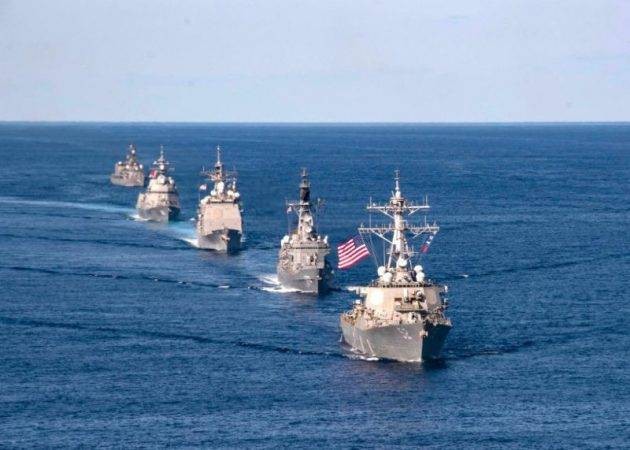
The best way to study this question would be to read Halford Makinder - author of "The Heartland Theory" as against the work of Alfred Thayer Mahan - author of "“The Influence of Sea Power upon History, 1660–1783.” These two are the strategists who most influenced the Western approach to the military arts.
That said, in once sense, in brief, it can be said it has been the ability of maritime powers to shield behind oceans - or at least the English Channel in the case of the United Kingdom - against the armies of the continental powers. The maritime powers have then built up navies that allow them to, in effect, access the resources of the world outside and around the continents and over time build alliances against which the continental powers exhaust themselves over time,
That, of course, greatly oversimplifies a lot of history, but it can be broadly said that is how history has played out. This with one big giant caveat.
Specifically, while the land powers have been able to occupy enormous amounts of territory, population and natural resources, they have never succeeded in defeating all the land powers that can challenge them for control of the land. The result is that the dominant land powers, caught between maritime powers that they cannot reach for lack of naval assets, and land powers which can gradually wear them down, exhaust themselves by what amounts to a prolonged war on two fronts.
Interestingly, for the first time in history, the West may be facing what amounts to a untied "heartland" power and the maritime powers, if it came to that, might be defeated. Specifically Russia and China.
Historically, Russia and China have been rivals and thus counteract each other and give a crucial advantage to the Western maritime powers. However, recent Western diplomacy has been inept and is driving China and Russia together.
China and Russia have huge territories and populations. China has a massive manufacturing economy that requires raw materials and foodstuffs to sustain it and its' population. Russia, once the world's second largest economy but now only 11th, is nonetheless a huge supplier of raw materials - see also oil, coal, natural gas in particular - and foodstuffs.
Thus the Chinese and Russian economies complement each other and each is a natural market for the other. Add in their numerically large territories and it is a very real danger that the West - specifically a maritime power like the USA - could not defeat them.
In this then Western diplomacy needs to take extreme care. It may be that for the first time since the Mongol hoards, the world is facing a potential autocratic land alliance that it could not defeat. Makinder would, in effect, defeat Mahan.
Of course, nuclear weapons throw a kink in all this. Such weapons likely would not mean victory for anyone and, in that sense, render both Mahan and Makinder null and void.
That said, the answer to the question is that, at least since the fall of the Mongol Empire in the 13th century, the maritime powers have been able to prevail because the continental powers have, in effect, not been able to reach them. The land powers thus overstretch themselves and are, in due course, defeated.
Of course, this is all a broad, if reasonable, generalization. Best to look at specific cases for the real and most useful lessons to answer the question.
You will find this answer VERY unsatisfactory, but it depends on context.
Spykman's ideas worked very well during the Cold War - an ideological contest with the added bonus of nuclear annihilation thrown into the mix. Suffice to say, "containment" - of which Spykman is said to be sort of the founder of the concept - worked very well.
However, it is not likely it would have worked well in WWII. For the USA against Japan, Makinder was right. For the UK against Nazi Germany, Mahan wins the day.
All three men explained foreign and military policy through a certain prism. Continental hegemon, maritime power, containment.
For France - you know, the home of those wild Rap fans - Makinder offers the soundest strategic format from which to operate. For the UK, Mahan. Oddly, because of its' size, the USA can shift between the two.
As to Spykman, that more depends, as I say, on context.
Anyhow, I hope that helps at least a little. Happy to discuss it further if you like - as soon as you are done listening to your Rap music for the day.
Oh you know, I'm never disappointed by your answers.
I'm afraid this time it's me who's going to disappoint you, my thoughts on the subject aren't very deep.
I think sea power remains essential for trade and control of trade routes, power projection, submarine cables.
I also believe that an essentially continental power like China, which invests enormously in its navy, means a great deal about the importance of maritime power.
And being a land power is also essential for different reasons.
In short, I'd say that both are essential, and I'd say that the only power that could afford to totally abandon its sea power without this having any insidious effect on its power was the Mongol Empire.
For France, I'd say the difficulty is twofold: because the kings of France conquered territories with a coastline, France is of course a continental power, but not landlocked, because we have a coastline on the English Channel, the North Sea, the Atlantic and the Mediterranean.
This often lost France because we often wanted to ensure our security on the continent, and at the same time through our dominance on the continent build a powerful navy that would allow us to compete and actually defeat the UK overseas. Even Napoleon wanted to use continental resources to build a navy that would surpass the UK. But in the end we failed on both counts, maritime and continental.
Actually, you are not wrong. However, in reality, Mahan and Makinder are not mutually exclusive.
China is expanding its' navy because Taiwan is not only an irredentist question for China. It also is a "break" in the strategic American defense perimeter running from Japan and South Korea in the north to Australia and New Zealand in the south.
The USA is a maritime power and must be confronted at that level. However, the resources of any nation are not unlimited. The more China invests in naval power, the less is left to secure what is to China more important to its' survival, i. e. land power.
China is only able to do this because A) its main strategic rival - Russia - has been weakened in the post-Cold War era. B) Because the Ukraine War has allowed the China and Russia to form a de facto alliance and thus become a continental hegemon.
In effect, China can be challenged nowhere on land and therefore has been freed up to challenge the USA and the West a sea. This why, as I have written elsewhere, the USA has no interest in Ukraine winning the war - a weakened Russia would be driven further into China's arms - but it does have an interest in Ukraine not losing the war. Because if Russia wins, the West would face a disruption in Europe at the very moment it is facing the Chinese threat.
As to France, by the way, the world is round. At no point will a sea power not confront land, and a land power not face the sea.
In truth, France is a continental power and the only reason she did not prevail is because she failed to eliminate the threat from land at he same time it bumped up against the sea. France faced Russia and the UK in a two front war.
The good news for China at the moment is that it is a land power facing no land rival of note. Thus it is freed up to confront a maritime power or powers.
Oh, and by the way, rumor has it the Chinese are also huge rap fans. A land power and rap... who could ask for anything more?
You see China is a good country, a country that loves rap can not be bad.
I'm thinking it might have been smart if America's political leaders had tried to get closer to Russia after the Cold War. You know, the way the US got closer to China during the Cold War.
But with nuclear weapons, aren't all these strategies obsolete?
As far as US - Russian relations, they were for a time improving. In this I have to say that Mr. Trump, although I am no fan although I am a Republican, was reasonably effective.
That said, nations have inherent interests rooted in their geography, economy, population, demographics, history, culture and a host of other factors. Those interests tend to transcend momentary changes in the immediate geopolitical situation.
Suffice to say, the USA and Russia/USSR got along during certain periods, but their overall interests tend to conflict. Recall what DeTocqueville wrote about the USA and Russia - in the 18th century no less!!:
“There are at the present time two great nations in the world, which started from different points, but seem to tend towards the same end. I allude to the Russians and the Americans. Both of them have grown up unnoticed; and whilst the attention of mankind was directed elsewhere, they have suddenly placed themselves in the front rank among the nations, and the world learned their existence and their greatness at almost the same time.
All other nations seem to have nearly reached their natural limits, and they have only to maintain their power; but these are still in the act of growth. All the others have stopped, or continue to advance with extreme difficulty; these alone are proceeding with ease and celerity along a path to which no limit can be perceived. The American struggles against the obstacles which nature opposes to him; the adversaries of the Russian are men. The former combats the wilderness and savage life; the latter, civilization with all its arms. The conquests of the American are therefore gained with the ploughshare; those of the Russian by the sword. The Anglo-American relies upon personal interest to accomplish his ends, and gives free scope to the unguided strength and common sense of the people; the Russian centres all the authority of society in a single arm. The principal instrument of the former is freedom; of the latter, servitude. Their starting-point is different, and their courses are not the same; yet each of them seems marked out by the will of Heaven to sway the destinies of half the globe.”
P. S. As to nuclear weapons, no they have not rendered all this obsolete. What they have done is raise the stakes in the event of miscalculation or failure.
For Tocqueville you're slightly mistaken, it's the 19th century. I'm not making the remark for You , because I know you know it, but for the people who read us.
As for nuclear weapons, I think they've made it virtually impossible for great powers to wage war against each other, because no one can win.
As to nuclear weapons, they have made war between the great powers less likely, but not impossible. See how close they came in the Cuban Missile Crisis. See even now the aforementioned potential conflict over Taiwan.
Never underestimate the human capacity for miscalculation and error. Human beings are not perfect and what may see a perfectly rational idea may prove, in the moment, ephemeral.
I would like to have your opinion, there is the former French ambassador to the United States who incidentally is a great fan of Kissinger with whom he discussed several times, he has even dedicated a book has just said this
"The debate in Vilnius is only superficially about Ukraine's entry into NATO. The real subject, which no one dares to raise, is the real reason for the American refusal to avoid it: Washington's desire to keep open the option of negotiating with Russia. "
As I noted before, the USA does not have an interest in Ukraine winning the war. It has only an interest in Ukraine not losing the war. This because if Russia is defeated outright, it - NOT a natural ally of China (they even fought a brief border war back when both were communist) - will be thrown into China's arms.
That would not serve the USA - or the West generally - well at all. So leaving the door open to Russia is not an end in itself, but part of a strategy.
Now of course, the flip side is that the USA cannot throw Ukraine to the wolves. Not so much because Ukraine is strategically important. (It is not as can be seen by the fact that the USA lived most of its' history with Ukraine under Russian/Soviet rule to no ill effects.)
Rather because if the USA is thought to be abandoning its' security commitments to Europe - especially the new NATO members of eastern Europe - the whole edifice will come crashing down. Not that the Europeans will leave NATO formally.
Rather, they will begin to cut their own deals with Russia while living under the NATO shield. Thus undermining the US position is Europe even as the USA, effectively, subsidizes that undermining.
In that sense, I agree with the French ambassador. Who, by the way, I am told is a huge fan of Rap.
Nightdrot, what would the US losing, to a united Russia and China, look like to both you and the US in general? You've mentioned a couple of times the US would not win against them both united.
I'm also curious as to whether you see Truman doctrine as relevant to our times?
It is very dated, in that in 1947 Europe was a pile of rubble (but isn't now). Attempts to turn countries into democracies has had limited success outside of Europe.
In terms of containment of authoritarian regimes, it does still seem relevant to me. But is the game worth the candle for the US?
@RavVid Forgive me, I am not sure that I follow what you wrote.
That said, from what I can glean, no, the Truman Doctrine likely would not work. World War II and the Cold War were ideological contests. Truman sought to, in effect, confine and stigmatize that ideology on the assumption that it would - as it indeed did - gradually reveal the flaws in the opposing ideology.
The current international arena more resembles pre-WWI. It is not a contest of ideologies. It is, rather, about the balance of power and spheres of influence.
It has been said of China that it is now less interested in Marx in theory than Lenin in practice. In fact, China is exploiting American free market ideology, for example, to enhance the dependence of the American economy on Chinese supply chains.
If China - a manufacturing economy and consumer of food and raw materials of continental size - were to link up with Russia - a producer of food and raw materials and a consumer of manufactured goods - the USA would be facing a continental sized alliance with a huge economy and almost unlimited manpower. It is hard to imagine, among the other great powers of the world, an alliance that could offset that.
The nature of the regimes is not unimportant, but it is not critical. Hope that helps.
I think the number 1 point is that maritime powers are generally richer and there is a symbiotic relationship between commercial trade and naval power. In addition I would suggest there are aspects that are needed with navies that could beneficially impact on other areas within the nation
Navy and commerce symbiotic
Alfred the great (~700's) did build a navy against the vikings but for a long period of time sovereigns depended on commercial ships to double as a navy. The English Cinque Ports had feudal obligations in return for liberties. So there was dual use of vessels for commerce and naval. Naval power was a factor of commerce power and if there was commerce power the country was richer. There is a whole value chain you could split into. Manifestly there has to be goods to trade etc.
In addition sea transport is easier and more efficient than draught animals pulling heavy dray wagons of goods between cities. Easier = cheaper transport = cheaper goods & mercantile advantage.
There was a grey area of privateering between straight naval and straight commerce not to mention outright piracy.
Technology.
Ships are machines. Commercial shipbuilding would be beneficial for naval building vice versa.
Spain and Portugal were the first to develop ocean going ships. There were advantages to the more technological advanced by the 1400's. I may not be remembering well but the Phoenicians had some level of mass production making ships out of standard parts. The Venetians certainly did.
So I am suggesting technological advances in one area would have a benefit on other areas of a countries endeavors. I might be drawing a long bow.
Operational factors.
Ships are machines operated by men and particularly for sailing ships good organisation matters a lot. During the Napoleonic wars, British crews could fire three times faster than French crews. This carried through to the army as well. British soldiers could get off 3 rounds to the French 2. Even in WWI the German troops got something like one live round to practice with a year whilst the British troops practiced the 'mad minute' - as many aimed shots the trooper could fire in a minute.
I am arguing if your sailing ship is being blown onto a lee shore you'd better have a very well trained crew that does what it is ordered to in as short as time as possible and further this discipline could transfer to the army and other areas. Certainly the live fire navy tradition did.
Logistics.
The blockade of Brest showed extremely well developed logistics capabilities by the British enabling replenishment of water and food at sea over extremely long periods. There were blockades of Brest over the period of 1793 to 1815.
Power Projection.
Brest blockades showed how well power could be effectively projected at a distance with consequence and it enabled the transportation of the army. In addition French and British logistics at Crimea would have been better than Russian logistics because sea transport is easier than land transport.
(McKinder was concerned railways would turn the tables on naval power and developed his Heartland geopol theory in response to this possibility)
I am using Britain for example only. We could mention the Dutch, Genoa, Venetians. And the Romans who copied the Phoenicians and developed on shore training of crews for efficiency. From memory Rome had rapid response vessels on the Rhine to counter German incursions.
I quite agree with you. Did you know that France under Louis XIV will have the first navy in the world, and that the English and Dutch will be forced to align their forces at sea to defeat this navy.
I believe I did. It was a bum deal for the Dutch though because they lost their position. It is hard to imagine Dutch English wars now but there were three of them.
Prior to cars, and especially trains, ships gave you a way of moving HUGE amounts of supplies and/or people VERY quickly- armies were tied a human's marching speed, and limited by their fatigue; with wind or oars (and later coal), ships could move faster, and almost forever. They can mount and move bigger ballistas (later guns) and launchers of Greek Fire (for the Byzantines) than humans alone can carry. The implications of force projection for these are pretty obvious; the ability to get lots of firepower and equipment where it needs to be very quickly will not only improve a nation's ability to win wars, but also to get what it wants without them- greater power means greater intimidation, after all.
You know who did read Mahan's book? Kaiser Wilhelm. It's what inspired him to start the massive fleet build-up to compete with the English. Jackie Fisher, worried by this, pushed for the building the Dreadnought, to send the message to the Germans that the balance of power critical to peace in Europe depended on England remaining the best in naval terms- Tripitz and Wilhelm both ignored the message, instead drooling over the massive guns and powerful engines, and to build up even faster. That's a big part of what inspired England to declare that Germany attacking Belgium and Holland (which both had ports less than two hours' steaming time from England) an act of war, and well, you know how THAT turned out!
Uhm... somebody said "recently"... when was the last time the navy won a war? You can't seize ground without troops on the ground and troops can't safely do that without air power.
Afghanistan, Iraq (both times), Panama, Grenada (for the U. S.)
Pretty much every latin American insurrection.
Nearly every part of the former British Empire that rebelled.
Russia and Ukraine (whoever wins) isn't doing it with a navy.
Syrian conflict.
The rise and fall of ISIS.
I've been shot at in three countries and never said "Well I'm sure glad the navy was here" Don't get me wrong, force projection is great, softening up hard targets with big guns is great. I love my brothers and sisters in all branches but there has never in recent times been a battle that was turned because the navy was there. Aircraft carriers are a phenomenal asset to have in the region, only a part of which is their combat ability.
From warhistory. com
"Currently, the only operational ship in the US Navy to have sunk another vessel is the 220-year-old USS Constitution, a wooden-hulled three-masted heavy frigate that was constructed in 1794. This has been the case since 2015 when the US Navy retired their only other ship in service to have sunk another vessel; the USS Simpson. The actions which saw Simpson sink another ship occurred in 1988, during the Iran–Iraq War."
There's a REASON the USS Constitution escorts new ships out to sea. It's the old man on the block that's got the history to do something about something. The "new navy" is for training exercises and being a rapid reaction uber.
When the British Empire beat the French Empire during the 7 years war and the Napoleonic wars both empires were maritime powers roughly equal.
Persia was also a maritime power probably more so than the Greeks at the time. The Greeks won because of the quality of their infantry and tactics.
If you want to talk about why the British Empire won various wars thanks to its navy was because it was able to control maritime trade and project power anywhere on the globe. The ability to project power wins wars as seen in WW1 where the British Empire was able to put an army in the field in France to fight the Germans and was able to blockade the German navy and stop their trade which kept Germany Austria and Turkey short on strategic war materials they needed to win. It allowed the British Empire to invade the Ottoman empire in Turkey and take most of the Ottoman territory from then robbing them of resources.
Then look at Japan in WW2. As a maritime power they were able to invade multiple island nations to obtain the resources it needed and project power into China. It was maritime power that finished.
In WW2 it was the same with the Germans blockading German& Italian maritime trade for resources they needed. While the British empire were able to supply themselves with everything the needed to fight. Later the US military was able to project power globally on a scale never seen before as a maritime power fighting the Japanese in the Pacific. Supplying Britain, invading North Africa, scilly, Italy, Northern France and Southern France and Supplying vast armies as well as supply the 8th airforce in England. And of course Supplying the Soviet Union with everything they needed.
That's why maritime countries win wars because they can control trade and supply and project force anywhere.
One of the most effective war tactics has always been to starve out your enemy. This can take orders of magnitude more people to accomplish on land vs at sea.
You can stop all import and export, crippling the economy, causing general chaos and distain. The enemy becomes weaker by the day as they grow more detached from the outside world. It's similar to suffocating a candle by putting the lid on.
Logistical and force projection capabilities. Having the ability to move your troops and supplies rapidly gives you a huge advantage over those who can't, or can't do so as effectively.
This is also why air superiority is critical, and why island nations have a major defensive advantage.
I am simply stunned, or perhaps I should say 'in awe' of this historical discussion, as to whether '... maritime powers often win wars?
I think I will have a glass of wine, and sit and ponder all of this, since it does seem to have a great deal of intrinsic social value, from a military perspective, of course.
18.6K opinions shared on Society & Politics topic.
Because they have access to all the resources and can block their enemies from importing.
There’s a reason Britain controlled all the markets until WW2 when FDR creatively used LendLease to switch the pound for the dollar as the global standard.
@goaded I tried and it’s only worse on Wall Street. Larger banks, more derivates and less regulation. I think ironically we’re more self regulating. Just look at the California bank crisis. I was so glad they didn’t get bailed out. But lots of tech companies lost millions. As they should.
Because when you have a strong naval force, you can often successfully cut off large import of product that would otherwise need to arrive by ship as opposed to plane. When warships are patrolling the waters, it can be nearly impossible to move goods
You can also find examples where this wasn't the case. If you're talking about a multi-theater conflict or where a naval blockade could successfully be employed, then yes the greater maritime power has the advantage.
I disagree lol. The navy retains its major role as a fair already for its economic and strategic importance.
In fact, 90 percent of the world's trade goes by ship, and let's not forget the submarine cables.
Air supremacy is important, as are other factors today, and we can see that we need to master several areas. However, for example, aviation is actually very vulnerable to the defense system.
Let's also consider the nuclear deterrent component: nuclear deterrence by the navy makes it much harder for an adversary to face up to the threat of nuclear attack.
I see your points. However, ''Pearl Harbour'', ''Scapa Flow'', the end of Tirpitz, Gneisenau, Bismarck; HMS Sheffield (thanks to a French Exocet missile :) ) -and others- suggest it differently. Also to ''win'' the Iraq war (s) it was the air forces that did the murdering (and the ... ''winning'') As for trading and transport I fully agree with you - I rather referred to ''winning wars'' :)
For point of reference the Persia had a navy the equal of Greece. It was their solders the vast majority of which who were far less prepared for battle. Navel battles of that day were really just boarding actions for the most part.
I suppose in navy warfare it is easier to move supplies and military capacity around to defend of attack. I have studied military history but am no means an expert on the subject so perhaps there is more of a complex explanation.
If you’re talking about conventional warfar perhaps. But the independence movements in the European colonies did force the British, and the Portuguese out eventually.
Control the seas and you control the ports. Ports are important and if you blockade them you can really gain an advantage and choke off a country's supplies.
 Girl's Behavior
  Guy's Behavior
  Flirting
  Dating
  Relationships
  Fashion & Beauty
  Health & Fitness
  Marriage & Weddings
  Shopping & Gifts
  Technology & Internet
  Break Up & Divorce
  Education & Career
  Entertainment & Arts
  Family & Friends
  Food & Beverage
  Hobbies & Leisure
  Other
Other  Religion & Spirituality
  Society & Politics
  Sports
  Travel
  Trending & News