Yes. And I would add that in an age where pirating and privateering were only distinguished by retrospective Letters of Marque, this guy ought to know what he was talking about.
Privateers were distinguished from mere pirates by being highly successful pirates :)
The intent of a royal charter to establish an American colony was really to provide a pirate/privateering base. If you count ship seizure as mining he would have got 20%.
Still he was pushing it to sack a Spanish outpost under James I. Possibly he was expecting the same nod and a wink he would have got from Elizabeth I.
It shows he understood force projection onto land as well.
Almost. at first, it was true. But there are wars and pirates and storms and goods that spoil en route… so the Dutch started buying ports.
It is my understanding that the Dutch own a sizable portion of many major ports throughout the world.
the Dutch influence the economy of the world.
0
0 Reply
Anonymous
(18-24)
+1 y
Well I mean I agree for his time that the one with the best navy/ships controlled the sea and therefore commerce and wealth but I don't think it applies as much anymore since a lot of industry transport is through air as well
While that quote was probably true for a direct to consumer world - these days indirect profiteering far exceeds any direct methods.
I. e. I give you 50 for a watermelon and you keep 50, but today, I give you 50 for a watermelon and a credit card company keeps 1.5% of sale and you get 49.
It's truer today than it was then. In Raleigh's time countries were close to being self-sufficient but that's no longer true. We're totally dependent on world trade, as Brexit proved to us stupid Englanders.
Because the sea is not that relevant anymore. Walter Raleigh died over 400 years ago - in fact, he was executed. His comments may have been relevant during the reign of Queen Elizabeth I in the late 1500s and early 1600s. His comment was probably made in the context of England's defeat of the Spanish Armada at that time because, after that, England began extensive colonization of North America which Spain never did beyond Mexico and, originally, Florida.
Now, the control of the flow of commerce is done differently and by many modes of transport. The sea is still important, but so are these other modes of transporting economic value.
Actually, though, information is probably just as important if not more so.
Yes, because nuclear weapons are transported by missiles and electromagnetism requires almost nothing.
The native North and South Americans who lived here in pre-Colombian times survived for millennia without sea trade because, for survival, it was irrelevant. And it still is. It is only relevant because our societies are built on "needing" things from other lands, but, as the native Americans showed, are not actually needed for survival.
No. In today's world, Walter's sentence is obsolete and should be revised. His sentence is built around a concept that has been irrelevant for over 100 years. The people of Hiroshima and Nagasaki can explain why as can your ancestors who were defeated by the Germans in WW2 without any appreciable navy being involved.
No, it's not true, because to win the war the navy was more than necessary. What's more, you seem to be mixing things up.
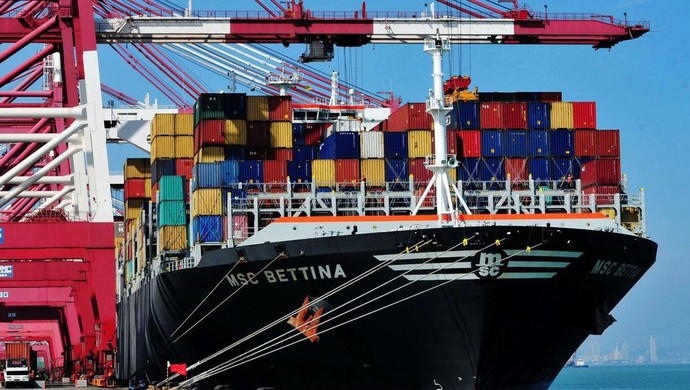
Today, trade is essentially maritime, at 80%. The nation that controls this trade by sea, against international flows. And look at the nation that has a military base on the world's main trade routes: the USA. And being able to control supplies is absolutely essential in the event of war.
Let's also look at why, beyond security issues, the USA and China are in rivalry in the Indo-Pacific. China mainly wants to be able to ensure the security of its supplies, while the USA wants to be able to penetrate the region at all times. Soon, international trade will be taking place in the Indo-Pacific region.
What's more, the navy, with all its components (especially submarines), is essential for nuclear deterrence.
The air force is important, but not essential to nuclear deterrence.
This is your quote from Walter Raleigh: "He who commands the sea commands commerce; he who commands commerce commands the wealth of the world, and therefore the world itself."
Logically, it is parsed like this - a sequence of 3 implications, leading to 2 hypothetical syllogisms the second of which is the true implication of his statement.
Let's parse...
ORGINAL: "He who commands the sea commands commerce; he who commands commerce commands the wealth of the world, and therefore the world itself."
1. 1st Implication:
"He who commands the sea commands commerce" which we will write as: COMMAND_SEA ⇒ COMMAND_COMMERCE
2. 2nd Implication
"he who commands commerce commands the wealth of the world" which we will write as: COMMAND_COMMERCE ⇒ COMMAND_WEALTH_OF_WORLD
3. 3rd Implication
"he who commands... the wealth of the world, and... [commands] the world itself." which we will write as: COMMAND_WEALTH_OF_WORLD ⇒ COMMAND_WORLD
So, now we are ready to put into place the logic... 1. PREMISE 1 (P1): COMMAND_SEA ⇒ COMMAND_COMMERCE 2. PREMISE 2 (P2): COMMAND_COMMERCE ⇒ COMMAND_WEALTH_OF_WORLD 3. PREMISE 3 (P3): COMMAND_WEALTH_OF_WORLD ⇒ COMMAND_WORLD 4. COMMAND_SEA ⇒ COMMAND_WEALTH_OF_WORLD; Hypothetical Syllogism 1,2 5. COMMAND_SEA ⇒ COMMAND_WORLD; Hypothetical Syllogism 4,3
In lay English terms: "If you command the sea, then you command the world."
Rephrasing back to Raleigh and eliminating the middlemen... "He who commands the sea commands the world itself."
That is now false. And it was always false. It just wasn't false in the world of Western Europe and the Americas 400+ years ago.
No, today's leading world power, the USA, "controls" world trade by controlling its main trade routes. Understand the nuance, it doesn't mean that the nation that controls trade is the nation that exports the most.
From the 18th to the early 20th century, the power that controlled the main trade routes was also the world's leading power.
The only real exception to this was the Mongol Empire.

 Girl's Behavior
  Guy's Behavior
  Flirting
  Dating
  Relationships
  Fashion & Beauty
  Health & Fitness
  Marriage & Weddings
  Shopping & Gifts
  Technology & Internet
  Break Up & Divorce
  Education & Career
  Entertainment & Arts
  Family & Friends
  Food & Beverage
  Hobbies & Leisure
  Other
Other  Religion & Spirituality
  Society & Politics
  Sports
  Travel
  Trending & News