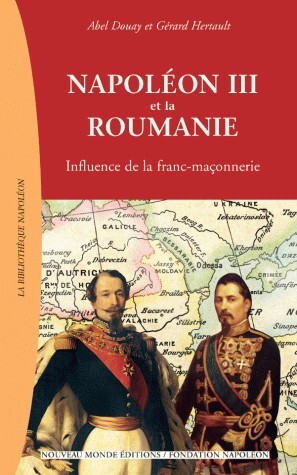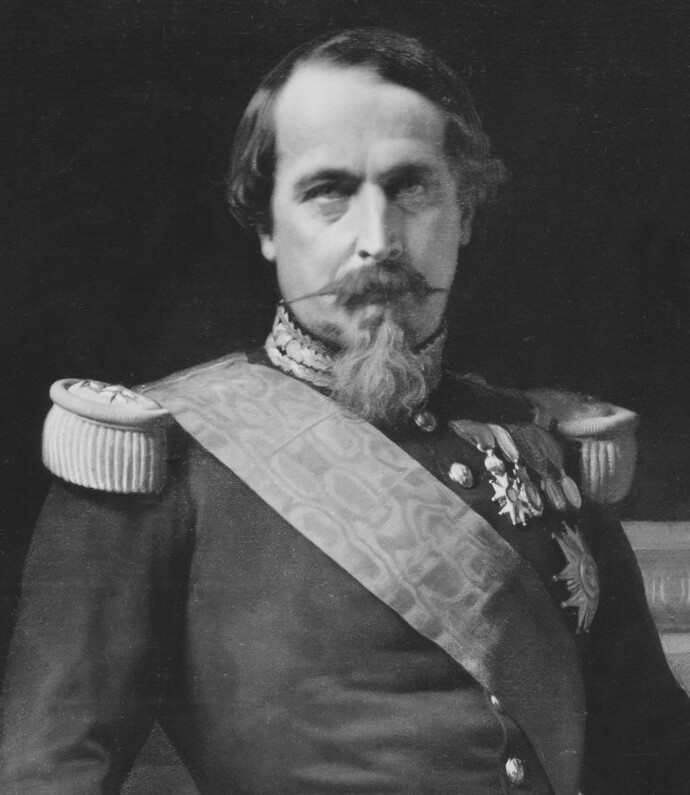
Is Napoleon III one of the most underrated leaders in Europe?

Girl's Behavior
Guy's Behavior
Flirting
Dating
Relationships
Fashion & Beauty
Health & Fitness
Marriage & Weddings
Shopping & Gifts
Technology & Internet
Break Up & Divorce
Education & Career
Entertainment & Arts
Family & Friends
Food & Beverage
Hobbies & Leisure
Other
Religion & Spirituality
Society & Politics
Sports
Travel
Trending & News 
I think so but being captured on the battle field didn't do his legacy much good.
I don't actually know if he just wanted to be present or if he made command decisions.
It was possibly just a tech issue. France's chassepots were better than Prussia's needle rifles but Prussia had mobile steel cannons.
I suppose technically Napoleon was responsible for ensuring France's army had good kit. He did that with chassepots but it turned out mobile steel cannons were better to have.
I don't think it can be chalked up as a failing on his part.
See m'y answer at Kostas
" He doubled France’s GDP and tripled its commercial exports. On the social front, the regime introduced significant reforms, even if they remained tightly controlled. The 1864 law legalized the right to strike, putting an end to the offense of coalition, while early forms of worker organization were tolerated.
The government also encouraged mutual aid societies and established a pension system for civil servants as early as 1853. In addition, the first workers’ housing developments were built to improve living conditions. These changes led to a real improvement in the standard of living of the working classes, with a notable increase in real wages over the period.
In the field of education and culture, major reforms were carried out under the leadership of Victor Duruy, promoting the expansion of education—particularly for girls—and introducing the primary school certificate. At the same time, Napoléon III showed a personal interest in science and history, supporting the work of Louis Pasteur and founding the Musée d'Archéologie nationale, thereby helping to structure scientific and archaeological research.
Finally, on the international stage, his actions contributed to the emergence of modern humanitarian law through his support for the creation of the Croix-Rouge and the Geneva Convention of 1864.
He also backed major global projects such as the construction of the Canal de Suez. Domestically, he firmly established universal male suffrage as a lasting feature of French political life. "
Probably since the only one that was cared about is the dictator who had a foolish idea to attack and rule everything.
This guy way more reasonable and tried to establish decorum, less of a dictator, and worked on improving France than looking outwards.
I think he's actually a case of a great dictator, whereas Napoleon was just a guy begging to lose and didn't mind the countless deaths it would take for that, like trying to prove a point rather than a true goal of direction that would keep France stable. This one had that direction.
A simple Google search would've told you that
Opinion
13Opinion
From what I've read, Napoleon III is typically rated quite high.
He commissioned a grand reconstruction of Paris, led France's industrialization, and was the longest-reigning French head of state (22 years) since the French Revolution.
He doubled the size of the French colonial empire, allied with Britain to defeat Russia in the Crimean War, and assisted with Italian Unification, while keeping the Papal States (today's Vatican City) independent.
Well he improved the French economy somewhat with urban renewal, conquest wise he certainly wasn't Napoleon I. His invasion of Korea was a disaster, his invasion of Mexico had some initial successes until the Mexicans sent Maximilian back in a box, and ultimately the Prussians came and deposed him.
See m'y answer at Kostas
" He doubled France’s GDP and tripled its commercial exports. On the social front, the regime introduced significant reforms, even if they remained tightly controlled. The 1864 law legalized the right to strike, putting an end to the offense of coalition, while early forms of worker organization were tolerated. The government also encouraged mutual aid societies and established a pension system for civil servants as early as 1853. In addition, the first workers’ housing developments were built to improve living conditions. These changes led to a real improvement in the standard of living of the working classes, with a notable increase in real wages over the period.
In the field of education and culture, major reforms were carried out under the leadership of Victor Duruy, promoting the expansion of education—particularly for girls—and introducing the primary school certificate. At the same time, Napoléon III showed a personal interest in science and history, supporting the work of Louis Pasteur and founding the Musée d'Archéologie nationale, thereby helping to structure scientific and archaeological research.
Finally, on the international stage, his actions contributed to the emergence of modern humanitarian law through his support for the creation of the Croix-Rouge and the Geneva Convention of 1864. He also backed major global projects such as the construction of the Canal de Suez. Domestically, he firmly established universal male suffrage as a lasting feature of French political life. "
No, one of the most underrated was both Henry the 8th, Kaiser Franz of Austria, and Elizabeth The First and Elizabeth the Second.
Even when The Queen died, Charles the III presently reigning, is an extraordinary wonder and joy 👑 heartfelt joy
After all, King Charles III is at the top of the food chain as King of Australia (and other Realms) 👍😋👑
I would say so.
He is very overshadowed by his uncle even though his reign lasted longer and led to arguably bigger legacy then Napoleon I with the redesign of Paris and ending the centuries long rivalry with England.
See m'y answer at Kostas
" He doubled France’s GDP and tripled its commercial exports. On the social front, the regime introduced significant reforms, even if they remained tightly controlled. The 1864 law legalized the right to strike, putting an end to the offense of coalition, while early forms of worker organization were tolerated. The government also encouraged mutual aid societies and established a pension system for civil servants as early as 1853. In addition, the first workers’ housing developments were built to improve living conditions. These changes led to a real improvement in the standard of living of the working classes, with a notable increase in real wages over the period.
In the field of education and culture, major reforms were carried out under the leadership of Victor Duruy, promoting the expansion of education—particularly for girls—and introducing the primary school certificate. At the same time, Napoléon III showed a personal interest in science and history, supporting the work of Louis Pasteur and founding the Musée d'Archéologie nationale, thereby helping to structure scientific and archaeological research.
Finally, on the international stage, his actions contributed to the emergence of modern humanitarian law through his support for the creation of the Croix-Rouge and the Geneva Convention of 1864. He also backed major global projects such as the construction of the Canal de Suez. Domestically, he firmly established universal male suffrage as a lasting feature of French political life. "
Sure, why not? The only thing I know about him is he was one of Napoleon Bonaparte's relatives and has a fort named after him on Les Saintes. I'm certain he's done something noteworthy and underrated
www.google.com/search
OH NICE...
He doubled France’s GDP and tripled its commercial exports. On the social front, the regime introduced significant reforms, even if they remained tightly controlled. The 1864 law legalized the right to strike, putting an end to the offense of coalition, while early forms of worker organization were tolerated. The government also encouraged mutual aid societies and established a pension system for civil servants as early as 1853. In addition, the first workers’ housing developments were built to improve living conditions. These changes led to a real improvement in the standard of living of the working classes, with a notable increase in real wages over the period.
In the field of education and culture, major reforms were carried out under the leadership of Victor Duruy, promoting the expansion of education—particularly for girls—and introducing the primary school certificate. At the same time, Napoléon III showed a personal interest in science and history, supporting the work of Louis Pasteur and founding the Musée d'Archéologie nationale, thereby helping to structure scientific and archaeological research.
Finally, on the international stage, his actions contributed to the emergence of modern humanitarian law through his support for the creation of the Croix-Rouge and the Geneva Convention of 1864. He also backed major global projects such as the construction of the Canal de Suez. Domestically, he firmly established universal male suffrage as a lasting feature of French political life.
Sounds like a great guy. Only MALE sufferage?
That's sexist😂 Who gave it to women?
“We in the Western world understood nothing of the matter,” he would say. “We ruined everything by treating women too well. We elevated them to our own level. The peoples of the East showed far greater sense and clarity: they declared women to be the rightful property of men—and indeed, nature had made them our slaves. It is only through our own folly that they dare to pretend to rule over us. They exploit whatever advantage they possess to seduce and govern us. For every one who inspires something noble in us, there are a hundred who lead us into foolishness.”
“Woman,” he continued, “is given to man in order to bear children. Yet a single woman cannot suffice for a man in this regard. She cannot fulfill her role when she is pregnant; nor when she is nursing; nor when she is ill; she ceases to be his wife when she can no longer bear him children. Man, whom nature does not hinder by age or by any of these inconveniences, must therefore have several wives, and so on.”
“And what, ladies, have you to complain of? Have we not at least acknowledged that you possess a soul? You know that some philosophers have hesitated even on that point. And now you would claim equality? That is madness. Woman is our property; we are not hers. For she gives us children, whereas man gives her none. She is therefore his property, just as the fruit tree belongs to the gardener.”
Damn🤣
I think most of the world had these views back then though
youtube.com/shorts/TNUEoI0tREc?si=iNyi2YpwTErcVcBZ
The entire existance of my country is because of him!
He is one of the grates liders of France!
And one of the grates leaders who care for Romania to be created!
VIV LA FRANCE!
MERCIE FRANTCE! = MERCIE FRANTA!!!
@julie07
or... as we know him in Mexico
Emperor Pound Cake... lol
The sole fact that he was elected to be a king when Frenchmen in overall very hostile to the monarchy is impressive. But Prussians later showed him.
He could've been a fantastic leader. Instead, here we are, stuck with a failing republic.
no, he wasn’t
I always liked Napoleon XIV.
Since I never heard of him, I'd say yes.
Well, he had to face Otto von Bismarck.
You can also add your opinion below!