 Girl's Behavior
  Guy's Behavior
  Flirting
  Dating
  Relationships
  Fashion & Beauty
  Health & Fitness
  Marriage & Weddings
  Shopping & Gifts
  Technology & Internet
  Break Up & Divorce
  Education & Career
  Entertainment & Arts
  Family & Friends
  Food & Beverage
  Hobbies & Leisure
  Other
Other  Religion & Spirituality
  Society & Politics
  Sports
  Travel
  Trending & News

In November 2024, BLS reported that there were 168 million people in the labor force, including 7.1 million unemployed people.10 BLS does not count people in jails and prisons—either in the labor force or among the subset of the unemployed.
Vera’s expanded unemployment measure provides an important corrective to standard measures of unemployment by incorporating incarcerated people. Vera’s measure augments official numbers with the
vera. orgsubset of incarcerated adults in jail or prison who are of working age (18 to 64 years old).15 This measure demonstrates how incarceration has a profound effect on the economy, excluding large swaths of the population from the labor force.
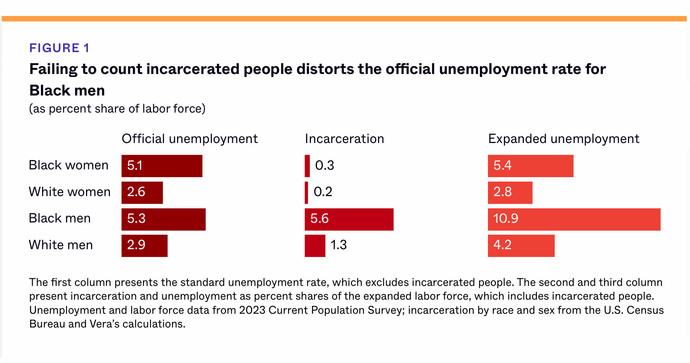
Comparing standard and expanded metrics at the national level reveals just how much information the standard metric conceals. The official national unemployment rate in April 2023 was 3.4 percent, the lowest it had been in 50 years.16 However, when adding in the 1.8 million people held in local jails and state and federal prisons at that time, the expanded unemployment rate in the same month and year was more than a third higher, at 4.7 percent.
This difference is substantial, but the data by race reveals an even greater divergence between the metrics. Using the standard definition of unemployment, which does not include incarcerated people, the national unemployment rate in April 2023 was 5.2 percent for Black people and 2.7 percent for white people. This means that the national Black-white unemployment ratio was 1.9: Black people were nearly twice as likely to be unemployed as their white counterparts. However, the effects of individual racism and systemic bias mean that, in almost every jurisdiction, Black people are incarcerated at higher rates than white people.17 As a result, when incarcerated people are counted among the unemployed, this disparity ratio rises 22 percent—Black people are in fact 2.3 times as likely to be unemployed as white people.
























Most Helpful Opinions