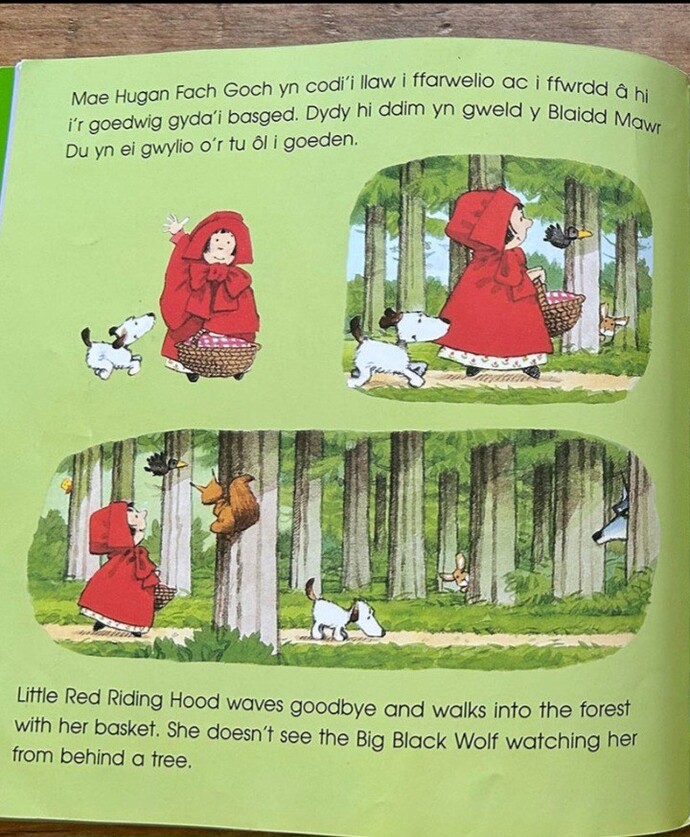
When researching my previous question on little red riding hood I noticed something interesting. In the English version the wolf is referred to as "The big bad wolf" but in the welsh version it's "The big black wolf". It would be interesting to see how he's portrayed in different languages.
But it got me thinking. Did we leave out the "bad" Part because the wolf isn't actually bad? After all he's a predator just trying to get a meal, that doesn't make him bad.
Thoughts
In Little red riding hood was the wolf actually bad?
In the traditional versions of Little Red Riding Hood, the wolf is portrayed as a deceitful and predatory villain who symbolizes real-world dangers. While he is "bad" in the sense of being an active, goal-driven antagonist, modern literary and psychological analyses suggest he is a complex symbol representing instinct, predatory men, or the "darker" side of human nature rather than just a simple monster.
The Wolf as a Traditional Villain In both the Charles Perrault (1697) and Brothers Grimm (1812) versions, the wolf’s actions are consistently malevolent: Deception: He pretends to be friendly to gain information about Little Red Riding Hood’s destination. Violence: He devours the grandmother and, in many versions, Little Red Riding Hood as well. Impersonation: He uses the grandmother’s clothes to manipulate the girl's trust. Greed: His downfall is often attributed to his greed; he is not satisfied with eating the girl in the woods and instead plans a more elaborate trap to consume both her and her grandmother. Wingless Dreamer +3
Symbolic Interpretations Beyond his literal role as a predator, the wolf serves several symbolic purposes: Predatory Men: In Perrault's original moral, the wolf is a metaphor for "gentle" or charming men who follow young women into their homes. These "gentle wolves" are described as the most dangerous because they use kindness to hide their predatory intent. The "Id" or Instinct: Some psychological analyses view the wolf as a representative of the "id"—humanity’s basic animal instincts, specifically predatory desires or repressed sexual energy. Magnified Fears: The wolf can symbolize the magnification of a child's fears when they first encounter the harsh realities and dangers of the adult world.
Alternative and Modern Perspectives Modern retellings sometimes challenge the wolf's "badness" or reinterpret his role: The Wolf's Point of View: Some stories, such as Toby Forward's The Wolf's Story, present the wolf's perspective, portraying him as a misunderstood figure who was actually trying to help the grandmother before a series of accidents occurred. A Manifestation of the Protagonist: Jungian interpretations may see the wolf not as an external threat, but as a reflection of the protagonist's own latent power or aggression that she must eventually integrate as she matures. Subverted Archetypes: In modern media like Shrek, the wolf is depicted as a harmless, friendly character who "vibes" with other fairytale outcasts. Ecological Scapegoat: Some critiques argue that casting the wolf as a perpetual villain in folklore has contributed to the historical demonization and near-extinction of real-world wolves.
512 opinions shared on Entertainment & Arts topic.
First off, this kid knowingly went into the wolf’s domain. She did so without being armed, not even a.380 pistol. But you know who is big and bad? The parents. Maybe they just didn’t like Red. They could be charged with murder of the grandmother and attempted murder of Red. They knew the danger and willfully ignored it, at the very least this is gross negligence.
In the most basic terms, the wolf is simply trying to eat. Genetics has made him big so he needs to eat more and as such larger mammals are on the menu. Additionally, his being black has no bearing in the legality or morality of the events at grandmother’s house. It was called out to appeal to our worst instincts.
Humans are predators too so this is just predator on predator violence. Let’s not be so self-righteous in the future and learn to check our own Speciesism. And let’s finally place the bulk of the blame where it clearly exists, on the mother.
Yep. He's only "bad" in respect to us. When he injures a human or something humans wish to eat. If he eats wild rabbits no one's trying to get, he's simply being his natural, predator self.
And wolves stop deer, and other populations from overrunning the environment. They perform part of the balance of nature. They were wiped out in US, but then deer and other populations were too destructive so they were reintroduced!
But remember, the story is simply a fairy tale. Sort of warning children to steer clear of wolves... And that IS a good warning.
In what manner had grandmother been eaten by Mr. Wolf? Did grandma then gladly and freely invite Mr. Wolf into her inner sanctum for further repast? Unanswered questions abound! Maybe grandma likes Mr. Wolf being around to do some more eating!
In most classic versions, the wolf is definitely written as “bad” 😈
He lies to Red, deliberately tricks her, eats Grandma, and plans to eat Red too. That goes beyond a neutral predator acting on instinct. It’s given human-style malice and cunning, like a villain in a crime movie.
The “big black wolf” phrasing is more descriptive, but the story’s moral framing still treats him as dangerous and wrong.
809 opinions shared on Entertainment & Arts topic.
The wolf was the protagonist, in my opinion. I think it only became the “bad” wolf because the victims were female. So they had to create a woodsman to save them, making him the “hero”. If the victim was a little boy, he’d have been eaten and rightfully so. Then the story would become a cautionary tale. Like “The Boy Who Cried Wolf”.
First let's keep in mind that a wolf cannot be good or bad, considering it's only acting in order to survive.
In the French version it's: "Le grand méchant loup", the big bad wolf. I guess that in the Welsh version "black" must also refer to something bad, maybe more explicitely than in other languages?
In the welsh three little pigs he's referred to as the "nasty old wolf" so I'm not sure why its different here. Perhaps its because "drwg" (bad) Looks/sounds a lot like the English word drug. Could also just be the words flow better
Amusing, the "nasty old wolf". That must be some hint to someone rather old and vicious. Maybe such tales are adapted to the community feelings. In any case the words flow may have had an influence, considering for instance rhymes helping tellers to remember the correct text.
I don't speak Welsh, but if I'm not mistaken "drwg" is pronounced "droog", which reminds me of a Russian word, друг (dryg) also pronounced "droog" and meaning "friend"... ;0)
There is more in fairy tales than generally admitted or guessed. The same tale might have different hidden meanings depending on the traditions and values of particular communities and languages.
541 opinions shared on Entertainment & Arts topic.
In the song "Little Red Riding Hood", performed by "Sam the Sham and the Pharos's", He is desperately trying to convince Riding Hood that he is a GOOD wolf, by wearing a "sheep suit" and acting nicely to her, until he can gain her trust, and then eventually take off his "sheep suit", thus proving that this particular wolf is actually good.
He’s not bad, but he is a predator in the literal sense of the word. But no, there’s no moral badness to him, though he is more cunning than most wolves. And more of a lone wolf as well.
0
0 Reply
Anonymous
(30-35)
6 mo
ah yes, women now prefer the wolf
like how they prefer the bad boys, the pirates, the vampires and the bear
 Girl's Behavior
  Guy's Behavior
  Flirting
  Dating
  Relationships
  Fashion & Beauty
  Health & Fitness
  Marriage & Weddings
  Shopping & Gifts
  Technology & Internet
  Break Up & Divorce
  Education & Career
  Entertainment & Arts
  Family & Friends
  Food & Beverage
  Hobbies & Leisure
  Other
Other  Religion & Spirituality
  Society & Politics
  Sports
  Travel
  Trending & News