 Girl's Behavior
  Guy's Behavior
  Flirting
  Dating
  Relationships
  Fashion & Beauty
  Health & Fitness
  Marriage & Weddings
  Shopping & Gifts
  Technology & Internet
  Break Up & Divorce
  Education & Career
  Entertainment & Arts
  Family & Friends
  Food & Beverage
  Hobbies & Leisure
  Other
Other  Religion & Spirituality
  Society & Politics
  Sports
  Travel
  Trending & News

Hello fellow G@ggers!
I wrote this paper for my social policy class and wanted to share it.
The Cost of Convenience
Plastic is detrimental to our entire ecosystem. Plastic pollutes the ocean, negatively affects marine life and other animals, and it is hazardous to human health. According to Ellen MacArthur Foundation and the World Economic Forum,“by 2050 there will be more plastic in the ocean than fish” (WEF).This opinion piece focuses on the costs of our everyday conveniences, specifically regarding single use plastic. In the following paragraphs I will discuss three ways that people opt for convenience over the long-term health of the planet. I will give three examples of single-use plastic. I will address opposing arguments for banning the use of said plastic. Lastly, I will provide alternatives.
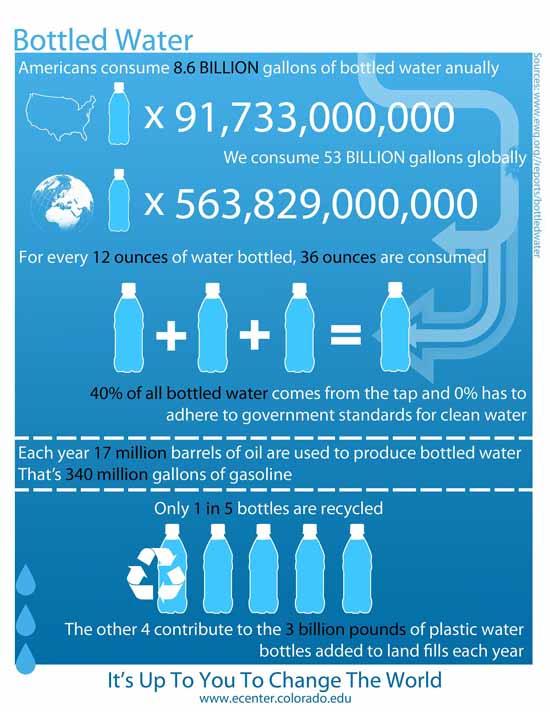
The first way people opt for convenience is by buying plastic water bottles. Water bottles fill grocery stores aisle after aisle. In spring of last year, the Beverage Marketing Corporation found that Americans drink more bottled water than any other packaged beverage. “Americans used about 50 billion plastic water bottles last year. However, the U.S.’s recycling rate for plastic is only 23 percent, which means 38 billion water bottles – more than $1 billion worth of plastic – are wasted each year3” (BTB, 2018).
Alternatives to plastic water bottles include drinking tap water and using a glass bottle, metal canteen, or paper cups. Someone may argue that plastic bottles are cheap and easy, that glass is breakable, or that metal gets hot. Sometimes people may not be able to find a water fountain. Some may not like the taste of the public water supply. These concerns are understandable. However, consider this graphic produced by the University of Colorado at Boulder:
Our reliance on plastic containers for food, is problematic as well. In the grocery store there is fresh produce and produce that is proportioned in plastic containers. Instead of purchasing prepackaged vegetables or fruit, buy a head of lettuce or a whole watermelon to wash and cut up at home. Whole Foods has cardboard to go containers next to the salad bar. If you are getting food off the salad bar put it in a cardboard to go container. I understand that this is not always feasible. Sometimes it is easier to buy things portioned in containers. Kitchen facilities may not be available when traveling. There may not be enough counter space when hosting a party. Even so, I argue for people to be mindful. Stop and think before putting the prepackaged food in your cart. Ask yourself if there is an alternative. Once you establish that habit of mind, your actions begin to follow suit.
The problem of plastic straws has begun to be addressed. Plastic straws contain BPA and can’t be recycled. In the USA alone, 500 million straws are used every day (Langone, 2018).
In 2015, a group of marine biologists in Costa Rica found an endangered sea turtle species with a 10-12 cm plastic straw lodged in its nostril. The biologists used a swiss army knife to dislodge the straw, and then released the turtle back in to the ocean. “The most recent study estimated that green sea turtles are 50 per cent more likely to ingest some form of plastic than they were thirty years ago” (BTB, 2018).
I understand that parents may worry that their child will spill the to-go cup in the car without a lid and straw. However, kids can use a spill-safe container from home. Also, paper straws, metal or glass straws, and straws made from bamboo are viable alternatives.
So next time you’re at the grocery store ask yourself if you need to buy that twenty-four-pack case of water bottles. When possible, purchase fresh fruit and vegetables instead of produce that is proportioned in plastic containers. When you are eating out at a restaurant tell the waiter to hold the straw. I assure you that choosing convenience does not only negatively impact our planet, but it will also be our downfall. So, remember to be mindful and use alternatives to single-use plastic when possible.
References
Keely Lockhart. (2018). Plastic straw removed from turtle's nose by marine biologists in heartbreaking video. Retrieved from https://www.telegraph.co.uk/news/2016/03/22/plastic-straw-removed-from-turtles-nose-by-marine-biologists-in/
Bottled Water Facts | Ban the Bottle (BTB). (2018). Retrieved from https://www.banthebottle.net/bottled-water-facts/
More Plastic than Fish in the Ocean by 2050: Report Offers Blueprint for Change. (2018). Retrieved from https://www.weforum.org/press/2016/01/more-plastic-than-fish-in-the-ocean-by-2050-report-offers-blueprint-for-change/
Langone, A. (2018). http://time.com. Retrieved from http://time.com/money/5343736/how-many-plastic-straws-used-every-day/
Thanks for reading!




























Most Helpful Opinions