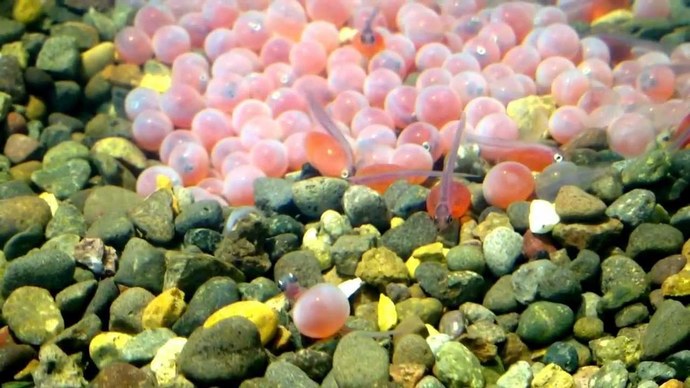
Will fish eggs hatch if frozen for years or decades and then released in streams and lakes?


Girl's Behavior
Guy's Behavior
Flirting
Dating
Relationships
Fashion & Beauty
Health & Fitness
Marriage & Weddings
Shopping & Gifts
Technology & Internet
Break Up & Divorce
Education & Career
Entertainment & Arts
Family & Friends
Food & Beverage
Hobbies & Leisure
Other
Religion & Spirituality
Society & Politics
Sports
Travel
Trending & News 
Yes, you can freeze roe (fish eggs) and they would generally last a few months.
However, on board a spacecraft, if the frozen roe is exposed to the vacuum of space thus removing all atmosphere, then, when brought back into the spacecraft, the container has only an inert gas like argon, the roe should be immune to any bacteria.
This should be tested first though on Earth using a high powered vacuum to remove the atmosphere. In fact, really, the entire process should be able to be done on Earth although it might be easier in orbit.
I forgot to mention something...
The container for the roe, while in vacuum, should be bathed in radiation or extreme heat to first kill anything. Maybe in a high argon atmosphere instead of a vacuum. Then, once the container is brought down to very cold temperatures while in a high-pressure argon environment, the frozen roe is put into the container and sealed.
You want "positive pressure" so no outside air (with microbes) can seep into the container.
You want argon because it is a plentiful inert gas so there will be no chemical reactions with the container or with any microbes.
If vacuum or oxygen is a problem, it seems to me that in space, they could be placed in air tight containers with a pressurized earth type atmosphere.
If we can colonize planets on other star systems, humans and other species can survive even if earth has a life extinction disaster such as being hit with a 100 mile diameter asteroid or comet. Some life would survive an asteroid or comet up to 10 miles long, which I understand is the upper limit of the size of the dinosaur asteroid. In fact, since we would know a couple of years in advance, we may be able to alter its course. However, a 100 mile long or diameter comet or asteroid would probably be too massive.
Thank you for the followup. I didn't see your followup until after I replied.
Have you ever seen the 1971 movie "The Andromeda Strain"?
It's an important movie related to this question because it discusses decontamination in an important way.
For instance...
https://www.youtube.com/watch?v=d1vw7E7uE3E
What is important is, to preserve something that really means to prevent its decay from microbes.
For aerobic bacteria, they need oxygen, so remove that, and they can't do anything - that's one reason for the argon. For anaerobic bacteria, oxygen prevents them from growing. Still, argon is good because it is chemically inert. But, it's best to just kill everything you can first and that's where decontamination comes in: sufficient heat or radiation can destroy anything - even viruses. This is why UV radiation can and has been used to purify air to kill off viruses.
So, the bottom line is that you first want to kill as much as you can that will cause spoiling of what you want to preserve. Then, you want to move what you want to preserve into an environment that prevents or slows the growth of whatever can spoil what you want to preserve. That's what freezing does because lower temperatures slow all chemical reactions. Argon removes oxygen and many organic chemical reactions involve oxygen...
You should download for free this classic book from 1964... It's a report from Stephen H. Dole of The Rand Corporation called "Habitable Planets For Man". It's a classic in the field and I've read it multiple times at my college library.
www.rand.org/pubs/commercial_books/CB179-1.html
You can download the PDF:
www.rand.org/.../RAND_CB179-1.pdf
But, if you click on the Read Online button, it opens the PDF in a reader for you.
======
Wikipedia article:
en.wikipedia.org/wiki/Habitable_Planets_for_Man
Habitable Planets for Man examines and estimates the probabilities of finding planets habitable to man, where they might be found, and the number there may be in our own galaxy. The author presents in detail the characteristics of a planet that can provide an acceptable environment for humankind, itemizes the stars nearest the earth most likely to possess habitable planets, and discusses how to search for habitable planets. Interestingly for our time, he also gives an appraisal of the earth as a planet and describes how its habitability would be changed if some of its basic properties were altered. This is a reprint of an edition originally published in 1964.
Source: Publisher
Thank you for the Wikipedia link, Embryo_space_colonization. That was most interesting.
I have never seen "The Andromeda Strain" so I Googled and read the Wikipedia article and I watched the decontamination video. I don’t know if people can be decontaminated by radiation on the inside with killing them.
I also read the Rand and Wikipedia “Habitable Planets for Man” articles and I downloaded the book ( 176 page PDF file). Thank you for the link. I will start reading it after I post this.
Another two books that might interest you, both by late great Princeton physicist Gerard K. O'Neill who founded The Space Studies Institute and the L5 Society, now part of the National Space Society.
https://ssi.org/
https://en.wikipedia.org/wiki/L5_Society
en.wikipedia.org/wiki/National_Space_Society
https://space.nss.org/
First is his 1977 book:
"The High Frontier: Human Colonies in Space".
en.wikipedia.org/.../The_High_Frontier:_Human_Colonies_in_Space
However, his later book, published in 1981, had a big impact on me:
"2081: A Hopeful View of the Human Future"
en.wikipedia.org/.../2081:_A_Hopeful_View_of_the_Human_Future
This really should be read.
Hey if literal frogs can become frozen solid for winter months an come back to life during the spring I am open to a lot of things Lol
Frogs can survive below freezing temperatures because they produce a type of antifreeze. But if it gets to cold they die. www.livescience.com/...s-survive-being-frozen.html
Opinion
0Opinion
The only opinion from guys was selected the Most Helpful Opinion, but you can still contribute by sharing an opinion!
You can also add your opinion below!
Most Helpful Opinions