 Girl's Behavior
  Guy's Behavior
  Flirting
  Dating
  Relationships
  Fashion & Beauty
  Health & Fitness
  Marriage & Weddings
  Shopping & Gifts
  Technology & Internet
  Break Up & Divorce
  Education & Career
  Entertainment & Arts
  Family & Friends
  Food & Beverage
  Hobbies & Leisure
  Other
Other  Religion & Spirituality
  Society & Politics
  Sports
  Travel
  Trending & News

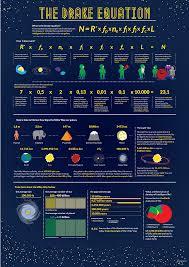
@theflash675 and I were talking on this site a little bit after my response to a question, "Do You Believe In Aliens". I brought up the Drake Equation supporting the hypothesis that it is likely life exists somewhere outside our planet. In response he brought up the Fermi Paradox and that gave me the idea to write a little about my thoughts on it.
What is it?
The fermi paradox refers to an apparent contradiction between the probability estimates for extra-terrestrial life and the fact that we haven't yet discovered any. The argument, or paradox tends to go something like this: There are estimated to be around 300 sextillion stars in the universe. Scientists estimate that there are several hundred billion stars in our Milky Way galaxy itself, and we know that some number of these have earth like planets. If some of these earth like planets are within the right distance of a suitable star then it's possible that some life could originate on one of these planets as well. In fact it's highly improbable that only earth would have life based on these estimates. Many of these stars and planets are far older than our own, so it's also possible that life originated earlier and thus intelligent life arrived first and could have developed interstellar travel.
Thus they conclude that it's strange we haven't seen any alien life despite the fact that we're actively looking for them both through space travel, and with radio waves that we sent out around a century ago.
I personally don't find this "paradox" compelling in the slightest. I have quite a few reasons why, and because they're all connected, but I'll try to separate them into four categories. These categories are going to be Time, Difficulty of life, Size of universe, and large number of planets and galaxies.
TIME & LIFE
I think this is the biggest issue so I will address it first.
The oldest fossils we have yet found are approximately three and a half billion years old. We have to remember that the most advanced forms of life on this planet were microscopic and microbial for the first 80% of the history of life on this planet, multicellular life didn't appear until six hundred million years ago,, and they didn't even move to the land until three hundred million years ago. then out of the billions of species that evolved there has only been one that has had the capability to communicate with radio waves and they only got this capability within the last century. Thus anyone capable of having received our first radio waves would have to necessarily be within a hundred light years of us. Not only would they have to be within a hundred light years of us, but they'd also have exist at the same time. If they were too far before us they may have simply left their planet, or perhaps destroyed themselves or their planet in a manner in which only sophisticated creatures like us appear to be able to do. Not to mention that on our planet alone had five major extinction events each of which killed off 70-90% of all species that existed at that time.
So, even if life were to exist on a planet near enough to us to have received our earliest radiowaves they would still not likely be more than small unicellular creatures. Even if they happened to be multicellular they would have to beat all the odds to become a species that had the ability to use radiowaves at cosmically the exact same time as us. This is highly improbable.
Distance
Next we'll look at the staggering distance of our universe. Many supporters of the Fermi Paradox think that if there was life somewhere in the universe that they would have necessarily taken over the universe, or in some manner visited us so that we were aware of their existmience. Likewise I think those who would find this problematic are not aware of the vastness of our universe. Even at the slow pace of currently envisioned interstellar travel, the Milky Way galaxy could be completely traversed in at fastest a few million years. Again, if they happened to pass by us they would have had to pass by within an incredibly small frame of time for us to have any idea of their existence. If they came from another galaxy? Even worse.
Number of Planets
Thus far we've visited two asteroids, two planets, and two moons. This may sound like a lot to some people, but this is due to a lack of an understanding of how massive our universe is. Our Milky Way galaxy alone has a minimum of a hundred billion planets. We haven't even scratched the surface of any of these, but then when we look at other galaxies we're talking about an incalculable amount of planets that we could never know. 
Conclusion
There is no reason to think that we would have or should have met any other life within our own solar system, much less our galaxy. MUCH LESS any in our universe.
PS my apologies for the time delay and disconnected train of thought. I had to stop writing because I had to take my work kids camping for a week. I just came back and finished it up. Hopefully it still makes enough sense. I also posted this in religion and spirituality because the Fermi Paradox is typically brought up in creationist arguments.

































Most Helpful Opinions