https://www.npr.org/sections/money/2012/07/05/156232075/the-farmer-and-the-commerce-clause

Girl's Behavior
Guy's Behavior
Flirting
Dating
Relationships
Fashion & Beauty
Health & Fitness
Marriage & Weddings
Shopping & Gifts
Technology & Internet
Break Up & Divorce
Education & Career
Entertainment & Arts
Family & Friends
Food & Beverage
Hobbies & Leisure
Other
Religion & Spirituality
Society & Politics
Sports
Travel
Trending & News 
The farmer can sell it intrastate. I guess he didn't have enough in-state customers.
The Federal Government has the power to regulate interstate (and international) commerce. That is fundamental to how the US functions and is a HUGE reason why we even have a Constitution instead of the Articles of Confederation.
If you want to understand WHY we have a federation under the Constitution and no longer a confederation under the Articles of Confederation, read Article I, Section 8 of the US Constitution which enumerates the powers of Congress. In particular, Article 1, Section 8, Clause 4 is the Commerce Clause:
=====
To regulate Commerce with foreign Nations, and among the several States, and with the Indian Tribes;
=====
This power was given to Congress by the Founding Fathers as a way to unify the country and prevent interstate squabbles such as interstate tariffs. Such interstate tariffs produce friction, animosity, and the possibility of inter-state war. In other words, they have a disuniting influence.
So, the Commerce Clause, and many others, were added to let Congress "be the adult in the room" and keep us unified. Congress and the Supreme Court are like the parents while states are like kids.
Even to this day, this is still occurring - almost every year, there is a SCOTUS case in which one state is suing the other...
Bottom-line... Did that suck for the farmer? Yes. The farmer's SCOTUS case, Wickard v. Filburn, was almost decided 80 years ago... and it was decided UNANIMOUSLY.
Sadly for him, that's part of the price of living in the USA under the Constitution. We all must pay prices like that at some point. It may suck for us, but it is for the greater good (usually - Congress and the SCOTUS are made up of imperfect people).
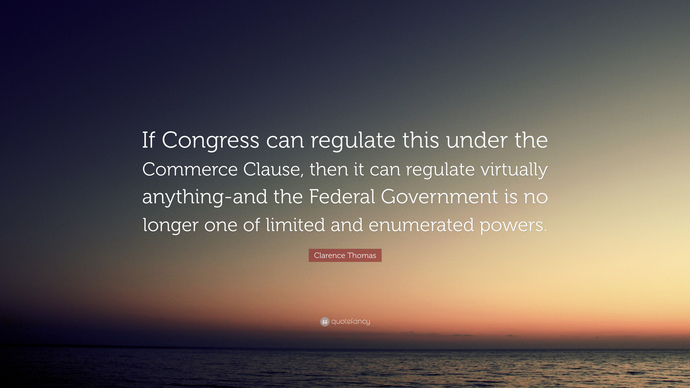
OK, meanwhile, Justice Clarence Thomas wasn't even born when that case was decided, so the graphic you show has nothing to do with the farmer's case. Thomas said that in his dissenting opinion in the 2005 SCOTUS case Gonzales v. Raich.
This is what Justice Thomas's. com website says:
===
The Supreme Court returned to the scope of Congress’ commerce power a decade later in Gonzales v. Raich (2005), which addressed whether the federal drug laws could regulate two Californians growing their own marijuana for medical use. Over Justice Thomas’ dissent, the Court held that Congress’ commerce power extends to the intrastate cultivation and use of medical marijuana. Justice Thomas responded that “[i]f Congress can regulate this under the Commerce Clause, then it can regulate virtually anything—and the Federal Government is no longer one of limited and enumerated powers.” Justice Thomas maintained that the Commerce Clause does not permit Congress “to exercise police power of the sort reserved to the States in order to eliminate even the intrastate possession and use of marijuana.” For Justice Thomas, there are limits on Congress’ Commerce Clause authority because “the Framers understood” that “[t]here is a danger to concentrating too much, as well as too little, power in the Federal Government.”
===
Prima facie, I'd agree with Justice Thomas.
However, that case was decided 6-3 and even Scalia concurring with the majority.
If Scalia did that, there must be something to it...
This is the US Supreme Court opinion in this case.
https://www.supremecourt.gov/opinions/04pdf/03-1454.pdf
Here's what Scalia said in his concurring opinion...
- - - - - - - -
Unlike the power to regulate activities that have a substantial effect on interstate commerce, the power to enact laws enabling effective regulation of interstate commerce can only be exercised in conjunction with congressional regulation of an interstate market, and it extends only to those measures necessary to make the interstate regulation effective.
...
Congress may regulate noneconomic intrastate activities only where the failure to do so “could. . . undercut” its regulation of interstate commerce.
...
Congress may not regulate certain “purely local” activity within the States based solely on the attenuated effect that such activity may have in the interstate market. But those [earlier SCOTUS] decisions do not declare noneconomic intrastate activities to be categorically beyond the reach of the Federal Government.
...
The application of these principles to the case before us is straightforward. In the CSA [Controlled Substances Act], Congress has undertaken to extinguish the interstate market in Schedule I controlled substances, including marijuana. The Commerce Clause unquestionably permits this. The power to regulate interstate commerce “extends not only to those regulations which aid, foster and protect the commerce, but embraces those which prohibit it.”
...
That simple possession is a noneconomic activity is immaterial to whether it can be prohibited as a necessary part of a larger regulation. Rather, Congress’s authority to enact all of these prohibitions of intrastate controlled-substance activities depends only upon whether they are appropriate means of achieving the legitimate end of eradicating Schedule I substances from interstate commerce.
By this measure, I think the regulation must be sustained. Not only is it impossible to distinguish “controlled substances manufactured and distributed intrastate” from “controlled substances manufactured and distributed interstate,” but it hardly makes sense to speak in such terms. Drugs like marijuana are fungible commodities. As the Court explains, marijuana that is grown at home and possessed for personal use is never more than an instant from the interstate market—and this is so whether or not the possession is for medicinal use or lawful use under the laws of a particular State.
- - - - - - - -
===========
In other words, what Scalia is saying is this:
1. Congress can establish law on noneconomic activities... That includes growing weed including weed used allegedly for personal medical use.
2. However, let's be real, weed grown for personal medical use could just as easily be sold... both in-state and out-of-state.
3. Since Congress is trying to get drug abuse under control, it has the power to make growing weed illegal - medical use or not, sold interstate or intrastate or not at all.
===========
Still, I also have a tendency to want to side a bit with Thomas on this one...
The reality is that national governments SHOULD be able to control what is or is not sold within their borders because, in the modern era and going forward, borders are increasingly irrelevant.
For instance, suppose the Commerce Clause had "power to regular interstate airflow" but not intrastate airflow... That's ridiculous, because intrastate airflow becomes interstate airflow. For example, if my company in Texas pollutes the air in Texas, then the EPA couldn't regulate it if the air only stayed in Texas. But, the reality is that air goes right over into Arkansas and pollutes Arkansas and is why the EPA has jurisdiction over that.
Well, weed isn't much different than air or a lot of other commodities. There really is no difference between intrastate and interstate, so, as far as I am concerned, the Commerce Clause should be expanded to include all commerce and that would render Thomas' dissent moot.
SCOTUS though in this case isn't going that far, but they do recognize the nature of the weed business.
Yes, if you believe like Hamilton, you would believe that. It is obvious to me that you know so much more I do and perhaps more than I ever will know. Even so, I prefer Jefferson to Hamilton.
Wow, you're really smart for a 13 year old. You should become an attorney or constitutional professor. I had to look the Commerce Clause up to remind me. I think it just gives the federal government a say in regulation of commerce and waterways. Like when Washington state wanted to ban coal mined in another state from being exported from their ports in Seattle, the government said they couldn't stop it because of the CC. I'm not sure what should take precedence, state or federal rights in the case of commerce I think the best interests of the entire nation as a whole over any individual state should prevail.
@mark000h @IsoUser Thank you, but I can't take credit for knowing this. I'm being home-schooled and learned about it from my parents and others that occasionally teach and/or suggest lessons.
Opinion
3Opinion
I'll be perfectly honest and am the first to ask why should any farmers be limited on the amount of crops he or she can grow for prophet with the exception of Tobacco and Marijuana unless farm is designated as such a producer? In any event God bless you for being so intelligent and resourceful.
Our Supreme Court lost touch with the American people we had five supreme court judges who there in corporate America, not the American people
@baserunner611 I believe one problem with the Supreme Court is they are part of Federal government. They are appointed and confirmed by the president and congress who are also part of the Federal government. Therefore, their loyalty lies more with the federal government than the states.
Okay 😔, by part of Congress senate not house of representatives.
It not wrong with federal government, people make mistakes, American people correct it
Corporate farmland is not American farmers it foreign corporate and New York wall street brokers no farmers
You been 13 years old, love ❤️ voice
Give hell, it only way change for the better
@baserunner611 I'm feel certain there are a few farmers that own farmland but I don't doubt that farmland is close to 80% to 90% corporate. However, in 1942, at the time of that Supreme Court ruling, most farmland was owned by farmers or rented from them by tenant farmers.
Okay thank you
I don't know most of the constitution but based on the US Supreme ruling, those clauses shouldn't be in the constitution.
Absolutely, those clauses should be removed. That would help prevent the federal government from being an evil dictatorship which mostly the case in the last several decades.
You can also add your opinion below!

Most Helpful Opinions