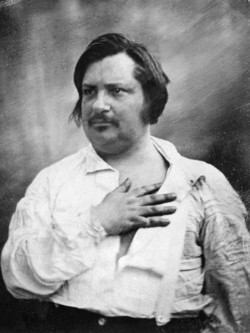
The press, once a calling, has become a mere instrument of parties; from an instrument, it has degenerated into a trade—and like all trades, it is without faith or law. Every newspaper is, as Blondet observes, a shop in which words are sold to the public in whatever hue it desires. Were there a journal for the hunchbacked, it would prove morning and evening the beauty, the virtue, and the necessity of hunchbacks. A newspaper is no longer made to enlighten, but to flatter opinion. Thus, in time, all journals will become cowardly, hypocritical, infamous, deceitful, murderous; they will kill ideas, systems, and men—and by that very means, they will prosper.
They will enjoy the peculiar privilege of all rational beings: evil will be done, yet no one will be held accountable. I shall be Vignon, you will be Lousteau, you Blondet, you Finot—Aristides, Platos, Catos, men of Plutarch; we shall all remain innocent, able to wash our hands of every infamy. Napoleon gave the reason for this moral—or immoral—phenomenon, as you prefer, in a sublime remark drawn from his reflections on the Convention: Collective crimes implicate no one. The press may indulge in the most atrocious conduct, and yet no individual will feel personally stained
Text written in 1837
How should we read Balzac’s harsh critique of newspapers today?
28.1K opinions shared on Society & Politics topic.
he was definitely ahead of his time. I used to get two newspapers. A local newspaper and a big city newspaper. After a while I only got one. Then I only got the Sunday paper, Finally I gave up on them.
Especially with media barons such as Rupert Murdoch buying and merging so many newspapers, meaning they aren't the voice of the voiceless, but often today mirror the dictates of their rich, often right-wing bosses.
 Girl's Behavior
  Guy's Behavior
  Flirting
  Dating
  Relationships
  Fashion & Beauty
  Health & Fitness
  Marriage & Weddings
  Shopping & Gifts
  Technology & Internet
  Break Up & Divorce
  Education & Career
  Entertainment & Arts
  Family & Friends
  Food & Beverage
  Hobbies & Leisure
  Other
Other  Religion & Spirituality
  Society & Politics
  Sports
  Travel
  Trending & News