is there something a Black college can't do that others can't that i possibly dont know of?
5.7K opinions shared on Society & Politics topic. These colleges exist because they were born from segregation. In the South, they practiced segregation in education. Most colleges and universities were Whites-only. So, what would a Black student who wanted a higher education do?
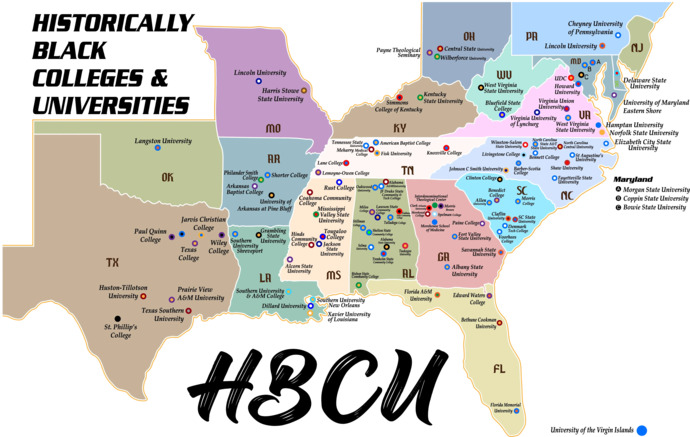
The answer was to go to a college that admitted Black students - and there were almost none down in the South.This is why the vast majority of HBCUs are located in the South - former Confederate "slave states" as shown in this map.
This Google AI Overview may help...
===========
Google Search Box: colleges and universities which practiced segregation
AI Overview:
Historically, racial segregation in higher education was deeply entrenched in the United States, predominantly driven by state-mandated segregation laws (often referred to as Jim Crow laws) in the South, and by restrictive quota systems or separate facilities at many Northern institutions.
Major colleges and universities that practiced segregation can be categorized into several historical frameworks:
1. Southern State Universities (Enforced De Jure Segregation)
Before the landmark Brown v. Board of Education decision in 1954 and subsequent civil rights legislation, state laws legally prohibited Black students from attending predominantly white, state-funded public institutions. Segregation at these schools often ended via federal court orders, frequently requiring the intervention of federal marshals or the National Guard. Notable examples include:- The University of Alabama (Tuscaloosa, AL): Desegregated in 1963 after Governor George Wallace’s infamous "Stand in the Schoolhouse Door".
- The University of Mississippi (Oxford, MS): Famously desegregated in 1962 when James Meredith enrolled, an event that sparked deadly riots.
- The University of Georgia (Athens, GA): Desegregated in 1961 when a federal judge ordered the admission of Hamilton Holmes and Charlayne Hunter.
- The University of Texas at Austin (Austin, TX): Practiced strict racial segregation until the Supreme Court ruled in Sweatt v. Painter (1950) that the separate "law school" established for Black students was inherently unequal.
2. Private Northern Institutions (Enforced Quotas and Dorm Segregation)
While not bound by Jim Crow laws, many prominent private universities in the North practiced covert or overt segregation and discrimination. They frequently enforced quota systems to strictly limit the number of Black and Jewish students, or maintained segregated social and housing facilities. Notable examples include:- Harvard University (Cambridge, MA): Under President A. Lawrence Lowell in the 1920s, the university proposed policies restricting the admission of Jewish students and enforced racial segregation in the newly built first-year residence halls.
- The University of Minnesota (Minneapolis, MN): In the 1930s and 1940s, the university maintained segregated student housing for Black students.
3. "Separate but Equal" Black Public Land-Grant Colleges
In states where segregation barred Black Americans from attending the original public land-grant universities, state legislatures established and funded separate colleges for African Americans. While these institutions were vital educational havens for the Black community, their creation was initially a product of the legally segregated, "dual" higher education system. Examples include:- Alcorn State University (Lorman, MS) - Established in 1871 as the first Black land-grant college in the U. S..
- Alabama A&M University (Normal, AL) - Established in 1875.
- Prairie View A&M University (Prairie View, TX) - Established in 1876.
How to Learn More
To explore primary documents, legal rulings, and the history of how these institutions were finally integrated, consult the following resources:- The NAACP Legal Defense Fund: Offers extensive historical archives regarding the landmark court cases that dismantled higher education segregation.
- The Civil Rights Digital Library: Features curated collections, photographs, and oral histories of university integration events, such as the Ole Miss riot and the desegregation of the University of Georgia.
- Historically Black Colleges and Universities (HBCU) - Britannica: Provides an overview of how legally segregated systems led to the development and evolution of HBCUs.
===========
SO...
Q: What's the point of HBCUs?
A: To give opportunities of a higher education to Blacks where such opportunities did not previously exist.

00 Reply
Most Helpful Opinions
- 7.4K opinions shared on Society & Politics topic.

1 monever been to one so don't know but I'll make an assumption.
IF... and that is a big IF... they operate differently and focus on enabling a student to achieve their highest level, rather than dragging down all to the level of the lower level kids, then yes... it's beneficial.
there's HCCI... historically chinese colleges. where? In china! Ditto france and other cultures. So nothing weird about it. Used to be very "white" places and very jewish and still are very christian ones. People segregate, differentiate, all over.
Schools based upon values, smarts and such, would certainly have a benefit... as long as people are free to achieve rather than being dragged down. That is the problem I see in public schools, some of them... it takes only one or two distractions in a classroom to impact everyone.
00 Reply
1 moWell, there was this thing called “segregation” in a lot of western nations, the US being a very egregious example of this. Black people weren’t allowed to attend the same schools, eat at the same restaurants, or even shit in the same toilets as white people. Now obviously, segregation is no longer legal however there is still cultural segregation in the sense that there are places that surround specific cultures that cater best to certain groups more than others. Churches and schools are more segregated based on race now than they were in the 1960’s and are strong examples of this cultural shift (look into “white flight” and “red lining” and that will explain a lot of why this all came to be). HBCUs are colleges that are well aware of this and work within that culture to best educate all of their students on this history in a way that works into their overall education in a way you wouldn’t see at other non-HBCU schools. It’s a kind of awareness and critical thinking skill that doesn’t always appear in traditionally white schools.
00 Reply
Anonymous(25-29)1 moOrginially to give black kids a chance at education but now they are just a license to print money and have a low graduation rate.

01 Reply
Opinion Owner1 moBefore colleges were discriminating to capable keep black folks out but now they robbing them leaving them in massive debt.
What Girls & Guys Said
Opinion
11Opinion
12.2K opinions shared on Society & Politics topic. That's as fucked up and ignorant as asking "what's the point of female medicine?"

HBCUs provide access, and educate students who might be underserved by larger or wealthier institutions, including first-generation students and students from lower-income backgrounds.
They provide community and cultural affirmation. Students can learn in an environment where Black history, identity, leadership, and experience are not treated as side topics.
They produce outsized outcomes and have historically played a major role in educating Black doctors, lawyers, teachers, engineers, scientists, judges, politicians, artists, and civil-rights leaders.
In other words, it's higher education for people who would not otherwise be able to access or afford such in a predominant "White" university.
00 Reply- 4.8K opinions shared on Society & Politics topic.
1 moprobably they have cheaper tuition. it is really cute how democrats call names 'racist' for opposed diversity- hiring
just to distract that the democrats were the real racists on THIS TOPIC schools. like tillman -d and even recently "biden -d don't make the school a jungle" SAME racist democrat in 1960 as in 1860!
01 Reply- 1 mo
"Based on the transcript, the headline of the article on Team Trump USA is true — he did say integration via mandatory busing would create a "racial jungle."
919 opinions shared on Society & Politics topic. I've always liked the idea of having them, because in theory, at least, they would seem to help minorities receive more access to higher education. But you're right; perhaps in the current environment, their time has passed.
00 Reply- 1.4K opinions shared on Society & Politics topic.
1 moSo black people can have a college that is all black. That way they can be with their own race and immersed in black culture. Otherwise it would be full of non black races who don't even understand or care about black culture.
00 Reply - 6.7K opinions shared on Society & Politics topic.

u 1 mothey can be cheaper by almost half... sometimes
other schools might be more for profit, but I guess that varies as well00 Reply The group that fought for desegregation want black schools.
111 Reply- 1 mo
Why should they ”unexist"? They are not exclusively Black colleges. This is why they are ”historically Black". Anybody can attend an HBCU.
This is not unlike many women's colleges which were created for the same reason - denial of women entering college - although many of them remain exclusive to women. - 1 mo
The only reason why they allegedly wouldn't be welcoming to Whites is that a White person might feel apprehensive - perhaps for the first time in their lives - at becoming a minority... something minorities have to deal with every day of their lives.
Now, that's human nature. People who belong to some social group often come together. If that wasn't the case, for instance, you wouldn't have Little Italy or Little Saigon or Chinatown etc. Immigrants went to places where they felt comfortable - with people from "the old country" because of commonalities like language and customs and the fact that those who immigrated earlier can help out the new immigrants. Now, the example I just used has to do with nation-based ethnicities, but the situation is the same with other definining characteristics too such as race or intelligence or sex... Look at The Big Bang Theory... that show was a success because intelligent nerds socialized with each other.
OK, well, it may take courage to interact with other groups, but it does happen. And that usually leads to good things. A good example of this is leaving your comfort zone and going away to college where you cannot help but learn about people from other places and even about the local culture where the college is. It's like travel without doing the travelling (other than to get to the college). I will let Mark Twain speak for me:
“Travel is fatal to prejudice, bigotry, and narrow-mindedness, and many of our people need it sorely on these accounts. Broad, wholesome, charitable views of men and things cannot be acquired by vegetating in one little corner of the earth all one's lifetime.”—"Innocents Abroad," 1869
“It liberates the vandal to travel—you never saw a bigoted, opinionated, stubborn, narrow-minded, self-conceited, almighty mean man in your life but he had stuck in one place since he was born and thought God made the world and dyspepsia and bile for his especial comfort and satisfaction.” - 1 mo
This may help...
I put this in a Google search box:
are hbcus unwelcoming to white students
This was the AI Overview...
AI Overview
HBCUs are legally open to students of all races and regularly admit white students. They generally foster highly welcoming, inclusive environments. However, because the cultural center of the campus is Black culture, white students must be prepared to navigate being a racial minority.
Navigating the HBCU experience involves understanding several realities:
* Diversity is the Norm: Nationally, non-Black students make up roughly \(24\%\) of HBCU enrollment, with white students comprising a notable portion of that. Some HBCUs, such as West Virginia State University and Lincoln University in Missouri, have predominantly white student bodies.
* Welcoming Culture: White students attending HBCUs frequently report feeling embraced by faculty and peers. They commonly participate in campus life, student government, and athletics.
* Cultural Adjustment: Being the racial minority can be an adjustment for white students who previously attended majority-white schools. HBCU campuses celebrate Black excellence and history, which provides a rich, cross-cultural learning environment rather than an exclusionary one.
* Institutional Mission: White students are encouraged to learn about the institution's historical significance. The environment gives white students an opportunity to learn about the Black experience, debunk stereotypes, and build cross-racial bridges.
Choosing an HBCU offers a unique educational setting that requires open-mindedness and a willingness to engage respectfully with a different cultural framework.
- 1 mo
I didn't write that. The AI did.
No, I am not kidding.
Look, I am muting.
You have a choice in life. You can continue to retain your racist views or you can move on.
But, you are at the age that you should know this: Hate takes a lot of effort and letting go of it can be liberating.
Unfortunately, you and I are also of the age that we should know this:
It is human nature for a person to assume that others are just like us. So, for example, if we are hateful, we assume others are hateful too.
However, we are both of the age in which we should realize that is false. After all, if everyone was just like us, there'd never be conflicts or differences of opinion.
So, let go of your prejudices and realize that many people are not filled with hate and are welcoming to others who are not like them.
Anonymous(36-45)1 moHelps me on my tinder matches if I wanna sleep w a black girl I head to that area?
00 Reply12.1K opinions shared on Society & Politics topic. What's the point of women's sports?
01 Reply
1 moTo help perpetuate systemic racism.
10 Reply- 5.9K opinions shared on Society & Politics topic.
1 moSupposedly to turn out black leaders.
00 Reply
1 modm me?
00 Reply
What's the hype about bts?
Learn more
We're glad to see you liked this post.
You can also add your opinion below!
Girl's Behavior
Guy's Behavior
Flirting
Dating
Relationships
Fashion & Beauty
Health & Fitness
Marriage & Weddings
Shopping & Gifts
Technology & Internet
Break Up & Divorce
Education & Career
Entertainment & Arts
Family & Friends
Food & Beverage
Hobbies & Leisure
Other
Religion & Spirituality
Society & Politics
Sports
Travel
Trending & News