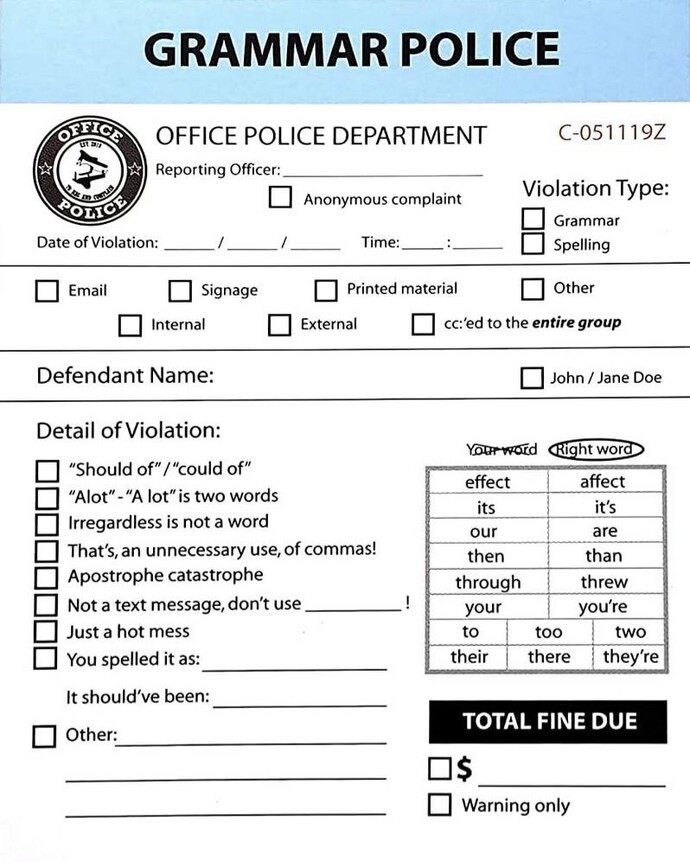
Bad grammar is the biggest danger facing society today. Armed with only a dictionary, thesaurus, and an uzi, you've been tasked with stamping out bad grammar and making the world safe again.
But where are you starting?
You've been recruited by the grammar police. Who you going after?
Frankly, I feel a lot of grammar rules are wrong. From a scientific or engineering perspective, they are a disaster. Thus, those rules which are disasters, I ignore.
And a lot of organizations also don't bother with the rules of grammar which is why they have to publish "Style Guides". I am reminded of that great quote from compute scientist Andrew S. Tanenbaum:
"The nice thing about standards is that you have so many to choose from; furthermore, if you do not like any of them, you can just wait for next year's model."
Here's an example:
1. Lack of Oxford comma. I will never write a sentence that should have an Oxford comma but doesn't. Newspapers don't bother and that infuriates me. For example, this comes from the NY Times Style Guide:
Where’s the Comma?
Many traditionalists complain about what they view as a missing comma in a sentence like this: He bought apples, pears and bananas.
Style guides for book and academic publishing generally would insist on another comma after “pears,” the so-called serial comma or Oxford comma. But news writing has traditionally omitted the serial comma — perhaps seeking a more rapid feeling in the prose, or perhaps to save time and effort in the old days of manual typesetting.
We do use the additional comma in cases where a sentence would be awkward or confusing without it: Choices for breakfast included oatmeal, muffins, and bacon and eggs.
Organizations who do this should be fined millions of dollars just like what happened to this company in Maine.
2. Commas inside quotations in sentences. The US Style is to have the comma, which is NOT part of the quote, inside the sentence. The British Style is to do it properly: have the comma on the outside. I am an American, but fuck the US Style.
Example: US: She said, "I'm leaving now," and closed the door. UK: She said, "I'm leaving now", and closed the door.
3. Two spaces after the end of a sentence. Anyone who thinks this is obsolete is an idiot.
The reason for the single spacing goes back to newspapers which wanted to maximally utilize the space on a printed page. Later, in the early computer era, every single byte of memory that could be saved was important and, like it or not, that extra space takes up at least 1 byte.
The best reason for two-spaced is error detection and correction. In the old days when a typewriter had ribbons or even in today's printers, when the ink is running low, small punction marks like a period at the end of the sentence might not be printed. The two-space is a redundant way to tell you the end of the sentence. Without it, two sentences that are single-spaced apart and with a missing period after the first can lead to confusion. Fortunately, capitalization of the first letter often helps, but that's not always the case. In this day and age when we have AI systems reading materials to learn, it is imperative that we get it correct.
"Let's eat, Grandpa!" "Let's eat Grandpa!"
>>>> Proper punctuation and grammar — they can be a life-saver.
Oh, I fucking hate this in the NYT and elsewhere... =====
The New York Times (NYT) uses a distinct style for acronyms and abbreviations: all-caps for pronounceable acronyms (like NATO) four letters or fewer, but Title Case (first letter capitalized) for longer ones (like Unesco, Nasdaq). They also use periods in initialisms (N. F. L.) unless it spells an actual word (like AWOL), a contrast to many other publications that often use all-caps for all initialisms. This approach aims to balance tradition with readability, though it can seem inconsistent to readers.
NYT Style Rules for Acronyms & Initialisms * Short Acronyms (4 letters or less): All caps (e. g., NASA, NATO, PIN). * Longer Acronyms: Title case (e. g., Unesco, Nasdaq, Nafta). * Initialisms: Use periods (e. g., N. F. L., F. B. I.). * Common Words: Acronyms that become common words (like radar, laser, scuba) are usually lowercase unless at the start of a sentence.
Examples & Reasoning * N. F. L. vs. NHL: The Times uses N. F. L. with periods, while many others use NHL. * NATO vs. Nafta: NATO (4 letters) stays all caps; NAFTA (5 letters) becomes Nafta. * SEALs: They print "Navy Seals," not "Navy SEALs," a point of contention with the Navy itself.
This unique style, sometimes called idiosyncratic, reflects internal tradition and reader preference for clearer text, even if it deviates from AP or other styles.
I usually follow what the US military does in their documentation. The military assumes everyone is an idiot — and they are correct to make that assumption — so they don't fuck around when it comes to clarity and meticulousness in their documentation.
For instance, personally, I will use a military form of dating. For example, if I write: "Today's date is 1/9/2026" Then what is today's date? Here in the US, that's January 9, 2026. But, elsewhere in the world, this would be interpreted as September 1, 2026. Military dating avoids that. They do with dd MMM yyyy so today's date is written 09 JAN 2026.
One thing I also do which is not the best perhaps is that I use a single letter to represent the days of the week. This is some type of standard somewhere although I don't know where it is, but many colleges and other organizations use it, for example, when printing class schedules. U: Sunday M: Monday T: Tuesday W: Wednesday R: Thursday F: Friday S: Saturday
So, today's date I would write as F 09 JAN 2026 or 09 JAN 2026 F (but I usually don't do this one). Also, if the time is also critical, I use a 24-hour time like the French do and add the timezone and, sometimes, I parenthetically add what the time is in UTC.
So, for example, as I type, it is 5:11 PM Central Standard Time in the USA on Friday 09 January 2026. So, I would write: F 09 JAN 2026 1711 CST (2310 UTC)
The more time I've spent teaching English, the more I'm against teaching more than VERY basic grammar. Harping on grammar is a disservice to the students.
I think teachers keep pushing grammar because it makes their job easier. It's easier to grade something objective like grammar than something subjective like real language.
If a significant number of people use language in a certain way, it's automatically :"correct". "Could of" is a good example of this. There is nothing wrong with saying ":could of".
A bunch of elitists in their ivory towers at Oxford and Harvard can't tell people how to talk.
A child is already fluent in their language before they even learn what a noun is. You don't need to teach them about grammar when they are already fluent.
@WindAtMyBack I have to disagree and I need to be clear why.
Something that is becoming increasingly important in the world is the ability to communicate with machines. For instance, writing AI prompts is now a legitimate profession and that requires meticulous understanding of both logic and grammar.
When we need to convey information to the machine, the machine is going to parse our language and how and what we speak/write is the data that the machine uses as its input. In engineering, we say "Garbage in, garbage out" meaning that, if you give the machine (software, whatever) garbage information as input, then the output will also be garbage.
Similarly, when want information from the machine, we need to be highly specific so as to not have the machine make incorrect assumptions about what we are thinking or wanting. Sort of like the infuriating "autoincorrect" emoji crap here at G@G.
Example in a way: HUMAN: What is 1 + 1? MACHINE: 2 HUMAN: What is not 1 + 1? MACHINE: 74.6. Human is frustrated as the human was looking for 3 as the answer. The machine is actually right— it gave an answer that is not 2 and any answer other than 2 is acceptable. If the machine was thorough, it would have replied "Any number other than 2." That lack of specificity by the human resulted in time wasted by not being specific enough about the answer. If the human had asked: HUMAN: What integer is not 1 + 1 but is between 2 and 4? then the machine would have replied with: MACHINE: 3
So, what does this have to do with "could of"? A machine will be programmed on proper grammar and MAY be programmed to be robust and reinterpret bad grammar like "could of". But, there's no guarantee of that. As I showed with the "What is not 1 + 1?" question, there are an infinite number of ways of doing something wrong but often only one or a few ways of doing it right.
I predict there will be something of a revolution in language as human interact more and more with AI. There will be a change in education about grammar as the ability to communicate with AI systems or other machines will take a more prominent part of the lives of future generations. This will likely force more discipline in the writing and speaking processes. Either that, or we are going to have to program machines to be really really smart and be able to interpret (correctly, hopefully) our bad grammar.
Oh, I am so guilty of the text messaging type writing. 😳 What really, really makes me cringe though is when people say "merch" instead of "merchandise". Like, omg, come on, people! It's a whole 3 syllables! You can manage to say it!
They should have to wear a dunce cap while writing out "merchandise" 500 times.
I'd start with education systems, promoting strong grammar foundations. By equipping educators with effective tools, students can develop essential communication skills early on. This proactive approach can create a ripple effect, enhancing overall communication standards and minimizing grammar issues in the future. Ultimately, a well-informed generation will be better equipped to navigate and improve societal communication challenges.
People that start every sentence with the word, "So" or "I mean". People who repeat, "is". "The problem is is..."" People that speak with redundancy. "The left wing, they like to..." You've JUST MENTIONED who you're talking about!! You don't NEED to add, "they"!! Just continue your statement!! "The left wing like to..." People who say, "Good to go!" That's more of a personal one and reminds me of a night where a drunk driver I was in a car with, who said that A LOT nearly killed me by falling asleep at the wheel!! what does it even mean? What's wrong with, "Okay." Or "I'm ready." Or, "Let's go."? People who write "Should OF" instead of "Should HAVE" or "Should've". People who say "are" instead of "our". People who write "woman" instead of "women" and vice versa. People who write, "affect" instead of, "effect". 'How does that affect you?" "It doesn't. It effects me." To affect is to put on or fake something. Example, "Bill Mumy once asked Jon Harris why it is that, if he was born and raised in the Bronx, he speaks like he was born in England? Jon replied, "Affected, my dear boy, affected.". An effect is something caused by what someone said or did. Or, in the recording or movie world, a special effect. Jim said to her, "I hate you!" which had a profound effect upon her.. I'm sure there's a few others but, I'm about to fall asleep so, maybe later.
I'd go after politicians and lawyers. They take the simplest thing and turn it into War and Peace, lots of mumbo jumbo, most of which is totally meaningless.
It's interesting that the original US Constitution that defined how to run a country is four pages long, while a simple budget bill to keep the country open was 18 pages, and a full budget bill is thousands of pages long.
Champion to all who use the Oxford comma! We may be few, but we are mighty, and we shall not stand for those who believe it is outdated! 💪
The Comma Crusader shall strike fear into the hearts of high school and college kids everwhere! Never shall an essay, or thesis, be safe from my ever-vigilant gaze!
Together with my sidekick, the Semicolon Kid, we shall prevail!
People who use “of” where “have” is appropriate. I understand their mistake, but the fact that autocorrect won’t LET you make that mistake until you train it to, it’s pure ignorance. Far and away the worst grammatical error that i see most often. The second closest is the misuse of “who” and “whom”. It’s SO easy to correct yourself that mistakes should mean execution. If you can’t do it right, then you don’t care. Therefore we have no use for you in human civilization. Buh-bye!
As a linguist by profession, I spot mistakes everywhere: billboards, subtitles in movies and in news bulletins... Whenever I go to a restaurant, I'll have spotted about 10 mistakes in the menu before I even know what I'd like for dinner.
I would start with people on television. They constantly make grammatical errotrs, mis pronounce words and nobody uses correct punctuation. Everyone sees it and thinks ot is okay. Where I would start is when people drop the "t" in words. Instead of "bottle" they leave out the "T" and say "bo'el
You’re conflating soft t’s with glottal stops. Most people say “boddle” instead of ‘bottle’, and “bo’el” is almost exclusive to the UK. In the meantime, your posts are unironically loaded with misspellings and made up words. You might want to start with your own side of the street.
"Refute" rather than "rebut," "conversate"( which my late sister Karen hated) instead of "converse," "it isn't RAN right" which should be "it isn't RUN right." I can think of dozens of other misspelling and misstatements were I allotted the time.
I'm going after the same morons I've been going after my entire adult life. MAGA filth is a good example. Zero critical thinking skills. Zero written or verbal communication skills. And zero plans to change any of that.
I gunning for those who use your instead of you're and folk who don't use apostrophes right. Got to stamp misuse before and after an s e, g. 's versus s' plus its versus it's
1: erase microsoft 'word' 2: help America building their wall - and more walls overseas 3: ban Thai teachers from international travelling 4: burn all Chinese user manuals 5- learn French
 Girl's Behavior
  Guy's Behavior
  Flirting
  Dating
  Relationships
  Fashion & Beauty
  Health & Fitness
  Marriage & Weddings
  Shopping & Gifts
  Technology & Internet
  Break Up & Divorce
  Education & Career
  Entertainment & Arts
  Family & Friends
  Food & Beverage
  Hobbies & Leisure
  Other
Other  Religion & Spirituality
  Society & Politics
  Sports
  Travel
  Trending & News