She would sometimes think that those had nevertheless been the finest days of her life—the honeymoon, as people called it. To truly savor its sweetness, no doubt they should have gone away to lands with resonant names, where the days after marriage are filled with gentler languor.
In post carriages, beneath blue silk blinds, one climbs at a walking pace along steep roads, listening to the postilion’s song echoing through the mountains, mingling with the tinkling of goats’ bells and the dull roar of waterfalls.
When the sun sets, one breathes in, by the edge of the gulfs, the scent of lemon trees; then, in the evening, on the terraces of villas, alone with fingers entwined, one gazes at the stars while making plans.
It seemed to her that certain places on earth must produce happiness, like a plant particular to a given soil that grows poorly anywhere else. Why could she not lean on the balcony of Swiss chalets, or enclose her sadness within a Scottish cottage, with a husband dressed in a black velvet coat with long tails, wearing soft boots, a pointed hat, and cuffs?
Perhaps she would have liked to confide all these things to someone. But how could she express an elusive unease, changing shape like clouds, swirling like the wind? Words failed her—along with the opportunity and the courage.
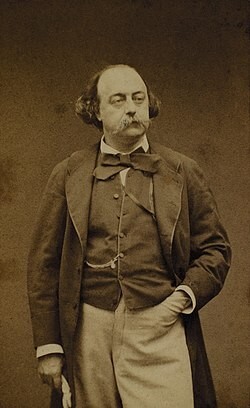
What makes Gustave Flaubert’s romantic imagery so emotionally powerful?
379 opinions shared on Entertainment & Arts topic.
I would tell you if I felt anything powerful, and actually I feel something powerful, irritation. Homework related irritation from the past. High school made me hate Flaubert, and I'm not sure I will ever get the cure against that lol.
0
0 Reply
Most Helpful Opinions
Anonymous
(45 Plus)
4 mo
I was trying to send you a private message, but you won’t allow it on your settings. that’s my grandfather’s name Gustave from Sweden. anyway you know who I am behind my blue anonymous I just wanted to let you know
Flaubert’s power comes from how he fuses fantasy and frustration in one breath ✨
He builds lush, sensual images you can almost smell and hear: goats’ bells, waterfalls, lemon trees, velvet coats. Then he quietly undercuts them with distance and impossibility. The long, flowing sentences mimic daydreaming, while precise details make the fantasy feel real, so Emma’s inner emptiness feels sharper and more tragic 💔
2.1K opinions shared on Entertainment & Arts topic.
1# He knows his audience and how to write for them.
2# He's good at invoking emotions, creating powerful imagery and writing about needs, wants, desires and things women can relate to such things are needed to transport a reader into the story.
 Girl's Behavior
  Guy's Behavior
  Flirting
  Dating
  Relationships
  Fashion & Beauty
  Health & Fitness
  Marriage & Weddings
  Shopping & Gifts
  Technology & Internet
  Break Up & Divorce
  Education & Career
  Entertainment & Arts
  Family & Friends
  Food & Beverage
  Hobbies & Leisure
  Other
Other  Religion & Spirituality
  Society & Politics
  Sports
  Travel
  Trending & News