 Girl's Behavior
  Guy's Behavior
  Flirting
  Dating
  Relationships
  Fashion & Beauty
  Health & Fitness
  Marriage & Weddings
  Shopping & Gifts
  Technology & Internet
  Break Up & Divorce
  Education & Career
  Entertainment & Arts
  Family & Friends
  Food & Beverage
  Hobbies & Leisure
  Other
Other  Religion & Spirituality
  Society & Politics
  Sports
  Travel
  Trending & News

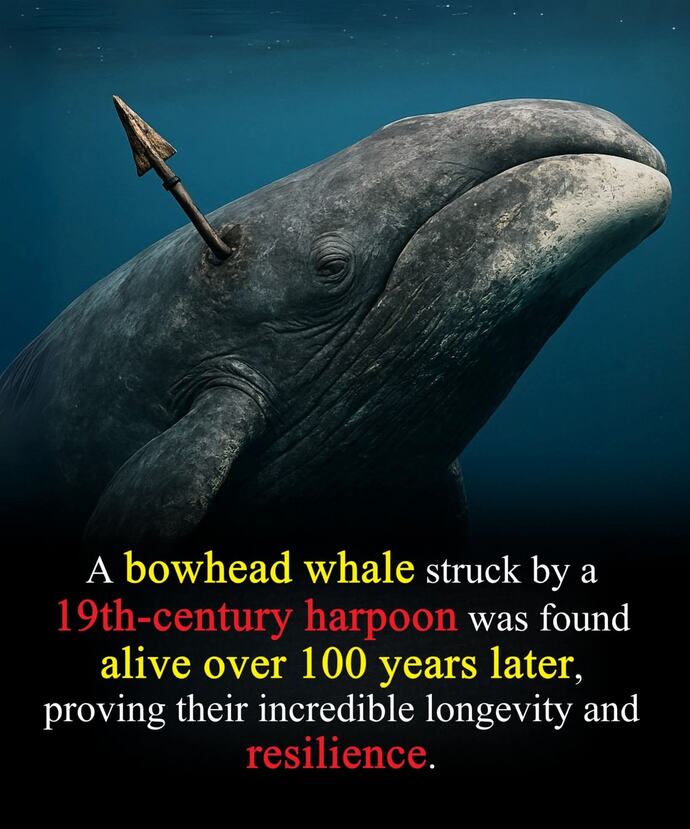
In 2007, native Alaskan whalers found a bowhead whale with a Victorian-era harpoon tip embedded in its neck. According to Forbes, the harpoon was identified as a “b*mb lance” used by whalers in the 1880s, meaning the whale had survived the attack and lived for over 130 years. The harpoon was lodged in a thick layer of blubber, which likely helped the whale survive the explosive impact.
This discovery supports earlier research suggesting bowhead whales can live up to 200 years, making them the longest-living mammals on Earth. According to the California Academy of Sciences, their longevity is linked to unique genetic adaptations for DNA repair, cell cycle regulation, and resistance to age-related diseases.
The harpoon fragment is now on display at the Inupiat Heritage Center in Barrow, Alaska, serving as both a scientific artifact and a symbol of the bowhead whale’s resilience. It’s a rare moment where history, biology, and mystery collide, proving that the ocean still holds secrets older than most human lifetimes