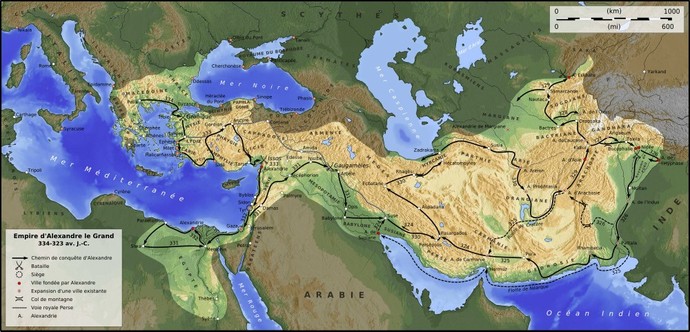
In every respect, the Persian Empire at that time had no rivals, and the chances of Alexander the Great succeeding in defeating an empire that was not only larger in surface area, but also possessed almost unlimited demographic, economic and military resources compared to Alexander's Greece. So how did he win?
Geopolitical question: how can a "country" defeat a power with far greater resources than its own, whether demographic, economic or military?
First of all, its important to point out that Alexander the Greats empire broke apart immediately after he died and chances were high it would break apart even if he had stayed alive as well. He was the textbook definition of overextended by conquering more land than he could feasibly integrate into his nation at one time. So basically, while he won the war part he had not yet actually won the occupation part yet but moving on.
Why where the Persians in particular so badly prepared for Alexander? First of all, the Persians are weaker than they look on a map. They were on a general decline and had internal problems such as revolts and such but also the fact that their system of governance had several layers.
Basically, regional matters were handled by regional administrators. As such, when Alexander first invaded Persia the imperial government did not really care and left it in the hands of the local government to handle, they had their hands full with other stuff and could not bother with some random Greeks invading lands that Persia had already taken from them earlier.
It was only much later that the Imperial army went to stop Alexander after he already was on a roll taking over much of what is Turkey today. After suffering from a loss the Imperial army retreated and Darius the 3rd who was the leader of Persia at the time basically was too scared to try again and spent literally 2 years avoiding the problem while Alexander the Great continued to conquer.
After it became clear to Darius the 3rd that he really had to go fight he went with his now 2nd army to try get as good of an advantage as he could so the first defeat due to bad terrain and such would not happen again. In this fight he almost succeeded but Darius the 3rd personally fled early in the battle and that probably doomed his army afterwards.
And those were the only two times the Imperial Persian army actually challenged Alexander. First time they lost due to bad circumstances and the 2nd time it was kind of a coin toss who would win until the end. Darius the 3rd was assassinated before he could raise a 3rd army and Persia never managed to recover after that.
Without the support of the central imperial government what actually ended up happening was that Alexander mostly just sieged individual cities and fought against local armies that could not really measure up against his own. Think of it as if Texas had to raise an army to defend themselves as compared to USA or even smaller such as individual cities having to defend themselves.
The Persian system of governance was really great at keeping the empire together and maintain stability but at the same time that was at the cost of not nearly giving the central government as much power as you might think. While this sounds great in theory it also means Persia has a weakness for while the local authorities had a lot of power to call upon that also meant that the total power of Persia was divided up among all these much smaller local governments and you actually had to get them all individually to support you for the full might of Persia to concentrate on something.
In regards to Alexander he arguably only faced the full might of Persia once with the battle against the 2nd army and that was a battle he almost lost only to save with a bit of luck and his great leadership as well as troops. Had that battle happened earlier the Persians would probably have wiped the floor with Alexander.
The moral of this story is that just because a country is much greater than yours does not mean that they are able to leverage that superiority at all times. It is very possible that much of their power and influence is simply spent trying to keep their nation from falling apart and if they have a bad leader then what remains could very easily be misdirected into an easy defeat. In contrast both Macedonia and Alexander the Great was expertly crafted by his father to be in the best possible position to wage war with Alexander as the perfect general to oversee it. All he had to do after getting the throne from his father (after quelling some rebellions) was to point his army towards Persia and go for it.
I'm largely satisfied with your answer, but for example, the Ottoman Empire, which had a similar system, was able to expand and retain almost the entirety of its territory for centuries.
Or how do you explain that Prussia was able to win the Seven Years' War against countries like France and Austria? ...
Again, this form of governance is really good for stability. That means that if you have a long enough timeline then they will probably come out ahead. They would have less problems with things such as internal struggles since it would be handled by a strong local authority and given enough time the imperial government can organize their divided forces and do a unified push.
This is especially true if they get to be on the offensive and only start the war once they are ready to push already. Alexander the Great explicitly did not give the Persian Empire this luxury as he was continuously pushing into their lands.
A lot of interesting answers and Soteris is convincing. In both battles with Darius, Alexander lead a right hook attack which personally threatened Darius. Maybe Darius could have anticipated the same in the second battle and maybe he should have accepted a Greek mercenary body guard.
In general there could a lot of things that the inferior side could leverage over numerical advantage. Generalship, sheer dogged determination by the troops on one side, asymmetric engagement, superior technology, inventiveness.
Who would have thought Ukraine could have turned a blockade on their Black Sea Ports into a blockade of Russian ports and it wasn't smart for Russia to provoke that? If the Baltic freezes over there will be a period where they can't ship in or out.
0
0 Reply
Anonymous
(18-24)
+1 y
How did Germany defeat France & Britain in the summer of 1940.
Alexander's Army was superior to the Persian military. The Persians outnumbered the Macedonians by a lot but that quality of troops using new weapons and tactics. The Macedonian Army was tailor made to defeat the Persians.
A significant factor in 1940 was that Germany had superior tank doctrine. Tanks in the French army were distributed amongst the troops but Germany used them as one force. Their tanks were inferior but they used them better.
@RavVid I can't disagree but I would also mention combined arms. For instance one of the problems the British had to solve in North africa was that each branch of the military from the RAF fighters to the bombers, the tank corp to the infantry to the artillery to anti tank gunners to the navy etc were all fighting their own individual war instead of collaboration with each other like the Germans.
Likewise I can't disagree with your comments on combined arms. One solitary British tank fought it's own individual war against German tanks which is the exact inverse of combined arms but it successfully delayed Germany & aided the evacuation of Dunkirk.
We could make similar comments on cooperation between the French & British which is best exemplified by the shelling of the French fleet at Mers-el-Kébir on the 3rd July 1940 just a little after the Fall of France.
@RavVid well the French surrendered they became a minor part of the AXIS. The British couldn't know what the Vichy French would do with that fleet. I mean combined with the German navy, Italian navy and possibly French navy the Royal navy would have a serious challenge especially in the Mediterranean.
That was the fear. French naval Force X at Alexandria was quite compliant and eventually entered on the allied side. Odd how it worked out so different.
The larger power usually can't put its entire resources into subduing the smaller one and it doesn't have unlimited resources. The larger power's military may not be as motivated as the smaller power's. The smaller power may have a better strategy and tactics. It's also easier to be the defender on your own turf. Supply lines also used to be a potential issue. On paper, a larger power may look stronger than it actually is.
12.4K opinions shared on Society & Politics topic.
They must be visionary, true believers in the future. They must have a strong religious/moral foundation, BUT... Don't seek to annihilate their opponents. They must offer a better idea than than the greater power has.
The USA did this in 1776. We defeated the British because we had a better idea and were willing to put our lives on the line for it.
18.6K opinions shared on Society & Politics topic.
How did Vietnam defeat the United States?
1. Soviet and Chinese benefactors. 2. Horrible public opinion back in the states, which relies on democratic votes. 3. And fighting to defend your country most likely has more emotional (and recruiting) power than invading a country…for really no reason. (Cough, Russia…)
The same way Atilla, Mohammed, and Genghis did: by picking a target that had had no competition for quite a while, and had grown decadent and weak; one that was unwilling to take them seriously as a threat.
Home > Society & Politics > Questions > Geopolitical question: how can a "country" defeat a power with far greater resources than its own, whether demographic, economic or military?
 Girl's Behavior
  Guy's Behavior
  Flirting
  Dating
  Relationships
  Fashion & Beauty
  Health & Fitness
  Marriage & Weddings
  Shopping & Gifts
  Technology & Internet
  Break Up & Divorce
  Education & Career
  Entertainment & Arts
  Family & Friends
  Food & Beverage
  Hobbies & Leisure
  Other
Other  Religion & Spirituality
  Society & Politics
  Sports
  Travel
  Trending & News