Sometimes when I talk to Americans here, they tell me that the French language and culture are sophisticated and so on. So I wonder where this feeling about French culture comes from?
Why is the French language and culture generally considered "sophisticated" by Anglo-Saxons?
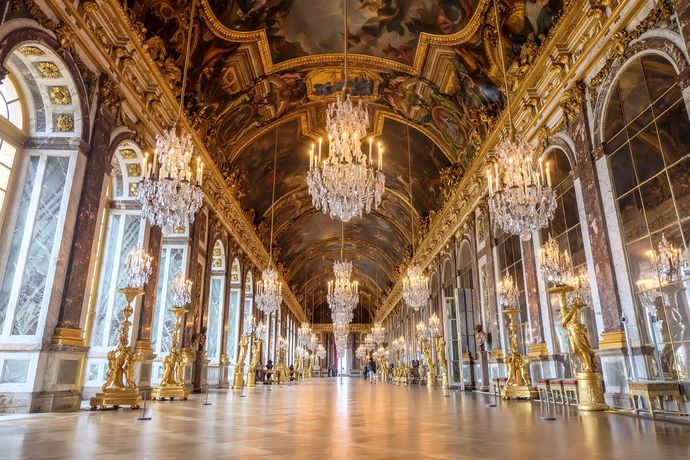
This is largely due to Louis XIV (the "Sun King"), and of France generally, during the period of his very long reign as king, 1643 until his death in 1715, which is over 72 years - the longest of any recorded European monarch. And for most of this period, France was the major power and certainly the major cultural influence in Europe, much of it stemming from Louis XIV's leadership, at a time when England was experiencing major chaos.
England had recently been through 2 civil wars and a number of other wars and conflicts under King Charles I, who was ultimately taken to trial, found guilty, and beheaded, with England abolishing the monarchy and establishing a republic or "commonwealth" lead by Oliver Cromwell in 1949. While successful, Cromwell's republic was still full of strife, and when he died in 1658, his weak and ineffectual son tried unsuccessfully to take his place, but ultimately England restored the monarchy and Parliament in 1660, crowning Charles I's eldest son as Charles II.
During this decade when the English monarchy was abolished, much of Charles I's court (highly-ranked advisors and others of influence, mostly all nobility) were exiled to France, where they were heavily influenced by Louis XIV and his court, who had utter control over France and who quickly made France the center of Europe in virtually every way - the biggest economy, the best artists and writers and musicians, etc. Louis XIV was incredibly wealthy and could afford to sponsor lots of scientists and artists (which is how the top such people generally were able to make a living - being sponsored by a wealthy royal), so people came from all over Europe looking for a sponsorship and to be around the most important person in their world.
The effect on England's nobility was substantial, and both during their exiles and even more upon their return, they made everything French fashionable in England, from clothes to art to writing - an influence that endures to some extent even today. Several generations of England's monarchy after Charles I spoke French, not English, as their primary language, and all of those "u"s in words like colour or neighbourhood are the result of French spelling influences during this time.
Louis XIV was arguably the most powerful, most successful, and most well-known person in the world during his reign - a rockstar of his time. And he was in power for 72 long years, so he had a very long time to influence Europe, but no other independent country was as influenced by him as England was.
I would guess from a confluence of factors: the Norman conquest of England, much like the Saxon conquest of Britain, didn't change the genetic demographics of the common people much, but it DID change those of the nobility. Most of modern English's swear words are those of the common people (who by 1066 had already begun speaking something more like modern English than modern German OR the old Celtic British tongue), as opposed to their early French counterparts. Even among more everyday words, look at "eat" vs "dine".
In the US more specifically (which culturally rebounds to the rest of the world), our historical relationship with France was... mixed, to say the least. Oh, your help won us our Revolution, but we almost wound up at war not long thereafter, and if it weren't for the Egyptian mosquitoes, we'd probably have wound up fighting Napoleon- which naturally would've nixed the Louisiana Purchase (unless we'd won and taken the land in the peace deal, I guess).
Overall, I think it's a combination of exoticness with accessibility; for an Englishman in most of their history, you'd hear of, and maybe even interact with, elements of French culture and people far more than with, say, the Japanese. Even if you'd never get a chance to GO to France, you might see their diplomats or tourists.
In a word, money. After the Normans took over French became the language of aristocracy. Even after the French ties were broken, the wealthy families that settled in England continued to modern times. People simply saw those living in big stately homes with French ancestorsy and made the link to sophistication.
Here's your problem: that's an "American" point of view.
Most Americans have never been out of the country, and barely even leave their own spheres within their cities. Barely half of our student population can even name the two countries we share a border with, or find other countries on a map. Those of us that do travel abroad do so for work or short vacations/tourism, and beyond that, it's internet exposure which tends to dramatically fluff up any given foreign culture. The result is that people who are well-travelled really only have a snapshot of the country, and their glowing admiration is based entirely on being pampered in a touristy area, or worse, reading it on the internet. (This is also overwhelmingly true for foreigners' view of the United States). This makes almost anything foreign or different a novelty, and in the fast-paced American fad-centric lifestyle, basically anything that can distract for a few minutes or hours a day is the most interesting thing in the world for a short while, and anything they've already seen or lived around is old news and taken for granted. Therefore, anything new is "sophisticated."
It comes from two things: First, although Western culture began in northern Germany around 1000 AD and spread rapidly from there, due to the sense of chivalry and beauty that was strong in the French people France became the center of culture and fashion for the West. For a time, it was the center of power in the West as well. The use of French as court language throughout Europe attests to this. Second, the Normans who invaded England were part of the French nation, spoke French, and retained important possessions in France. Richard the Lionheart, one of the most admired kings of England, dwelt in his possessions south of the Channel and went to the Levant but only spent six months in England during his reign. For a brief time, English king Henry V ruled all of France. It’s easy to see why the English aristocracy would have spoken French, enjoyed French culture, and (especially) preferred French cuisine. It is therefore easy to understand why English commoners would view French as sophisticated.
Napoleon III i'd say at first thought. He did rebuild Paris from a medieval city to a modern one of boulevards. (now I want to read about that whole process but I have I just started on Israel/Judea).
The French Revolution helped pushing chefs out of serving nobles and into starting commercial kitchens.
However I think we get back to Louis XIV again for Versailles. Frederick the Great was impressed. Peter the Great was impressed. Aside from building, Louis the XIV's reign was skilled in diplomacy hence langua franca. I guess it helped to be closer to Latin.
Before Parisian French came to dominate there were troubadours composing in L'Occitan.
When I was in Paris I did notice even the beggars had more sense of style and theatre than anglo Aussie beggars. I have mentioned before the dentist I was complelled to see in Paris.
In the end I am going to settle on it being genetic. There is France and Japan.
Personally I find French culture more sophisticated then American and British culture.
When it comes to cuisine, architecture, art and social norms French culture is more sophisticated.
The language sounds more sophisticated and I know there are distinctions such as using “vous” and “Tu” depending on if you know the person you are talking to which seems more sophisticated.
I've been to both countries and I agree that they have similarities in terms of things like science, inventing and art, but the people are NOTHING alike! Italians are so hyper and full of themselves, while French people are more relaxed, polite and humble.
I haven't been to the Alps, but the Alps are higher and more rugged than the Pyranees. Andorrans are culturally closer to Catalans. There really isn't anything unique about Andorra, aside from the churches.
I think every culture has sortof a crush on another culture. I studied in an international program when I came to france, we had students from 42 countries and if asked each would name a different culture as being romantic and sophisticated. It just so happens french culture is the object of attraction to Americans (in general of course)
Savoir vivre plus haute cuisine plus haute couture. Also the English populace has this weird emphasis on being blue-collar as to not being seen as a snob.
Well I'm in Canada so I hear it all the time. It's a smooth sounding language which gives it a sprinkle of sophistication. Not like German which sounds like somebody trying to talk with a chicken bone stuck in their throat.

 Girl's Behavior
  Guy's Behavior
  Flirting
  Dating
  Relationships
  Fashion & Beauty
  Health & Fitness
  Marriage & Weddings
  Shopping & Gifts
  Technology & Internet
  Break Up & Divorce
  Education & Career
  Entertainment & Arts
  Family & Friends
  Food & Beverage
  Hobbies & Leisure
  Other
Other  Religion & Spirituality
  Society & Politics
  Sports
  Travel
  Trending & News