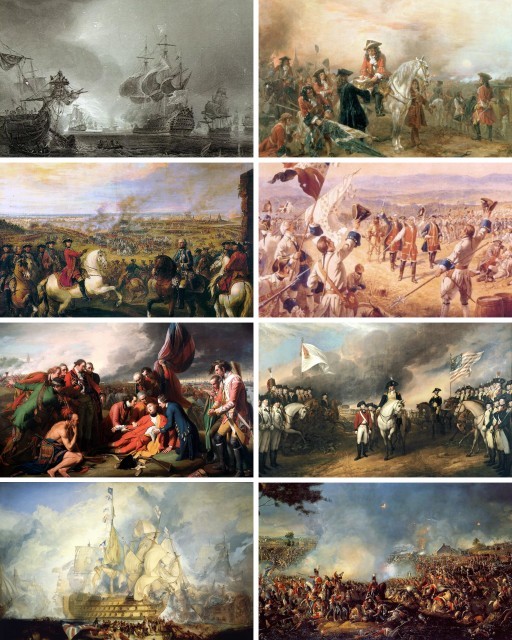
This rivalry began under the reign of Louis XIV and ended under Napoleon in 1815. During this "long 18th century", as historians also call it, the French and English clashed for domination of the globe.
This conflict had consequences on every continent, from America to Asia and Africa.
Maybe I should write a mytakes that would allow me to go into more detail, I had done one, but it wasn't very well written on my part.
Have you ever heard of the Second Hundred Years' War between France and the United Kingdom, which had worldwide consequences?
Well, no I hadn't heard that term before. I had heard of that period being the first World War, maybe we should call it WW 0, for the reasons you mentioned.
Googling, I see it is rated from 1689 to 1815. So an interesting dimension is after the Glorious Revolution in England to very early Industrial Revolution. Glorious Revolution = constitutional monarch/parliamentary government. This was not democracy as universal franchise only happened after WWI.
in France, Louis XIV had established absolute monarchy earlier than this period and the Estates General was inactive (never called?) during his reign. The Stuarts unsuccessfully tried to mimic Louis XIV.
The period was in some ways parliamentary gov't versus absolute rule for much of it.
I would very much like to see a MyTake from you on this period. Probably challenging for you to restrict the scope down to a MyTake size.
I have heard professional historians comment it is the most interesting period of European history - I guess that means complex :)
As I am awaiting the new MyTake, I shall look up & enjoy the earlier one.
Well, no, he didn't ally himself with the English against the French. For the Haiti affair he mismanaged the situation as he said himself, because he said he should have simply appointed black generals etc..
By the way, Napoleon wanted to authorize mixed marriages, he abolished slavery in Malta and he was close to a slave in St Helena, whom he wanted to free but the English refused.
The Haiti affair had nothing to do with an English alliance. On the contrary, Napoleon wanted to retake the island, as it was of strategic and economic importance, particularly against the English. Toussaint Louverture betrayed France because he wanted to ally himself with the English...
There were slaves in Malta? I can't find the damn article now. It was about that movie. They said it left out his atrocities in the Caribbean and it talked about Haiti and Martinique. That something to do with slavery was different on Martinique than elsewhere in the Caribbean. Like it was the only island that did SOMETHING. And it said it was competed against with the British and the French had different policies on slavery. This would make sense since the UK was the first to abolish slavery. But I remember the article annoyed me because it left out how Napoleon was betrayed by the Poles in Haiti
"In a 1799 speech to the French government, Bonaparte explained that if he had been in Martinique at the time the French lost the colony, he would have been on the side of the British – because they never dared to abolish slavery."
This article is a piece of crap. The journalist who wrote it knows absolutely nothing. The islands represented a geopolitical and economic challenge precisely against the English.
As historian Thierry Lentz, one of the greatest historians on Napoleon, wrote
"Why did Napoleon, who until then had freed the slaves in Malta and Egypt, and who, once in power, had stubbornly refused to re-establish slavery, deny himself to such an extent? The answer is both simple and complicated. Simple, because a statesman is not a saint who remains stoically deaf to the imperatives and atmosphere of his time. Complicated is making it clear that the 1802 decision was essentially based on economics and geopolitics, and absolutely not on racism: Napoleon wanted to revive colonial activity, which for some years accounted for more than 10% of "GDP".
If Napoleon dictated firmness, if he wasn't afraid of having to assume the human cost of the reconquest, he didn't give orders for massacres, and even less for "black genocide". He was no more "racist" - the word did not exist - than his contemporaries, for whom the issue of slavery was unfortunately not a priority.
When it was too late, on St. Helena, Napoleon revisited these events, of which, to sum up, he was not proud. He regretted having given in "to the outcries of the colonists", believing that this sad affair was "one of his greatest follies" and that he had acted "against [his] own judgment". More generally, he regretted having taken away the freedom of the blacks in the colonies, and predicted that the colonial system would not last much longer. He was wrong. "
I suspect that this person must have been inspired by a French writer who wrote a book about Napoleon in 2005 entitled "le crime de Napoléon" (Napoleon's crime) in which he compares Napoleon to Hitler, and talks about genocide etc. I suppose that this journalist has just taken up the arguments of this French author.
Thanks for that link. I enjoyed reading even though I found myself disagreeing with interpretations at times. I was vaguely aware of the slave rebellion but not in any detail. Disliked the recent Napoleon movie and I don't think including Haiti could have rescued it.
It is a popular piece. Did you notice the author, Marlene Daut, is Yale Professor of French and African American Studies? A brief bio here as alluded to by Kostas Kouvallis.
I dislike socio-political re-interpretations of historical event intensely and falsication of history for socio-political reasons even more. Sad if Napoleon is at risk of being cancelled.
I've not heard the term but it makes sense to lump all the wars at that time together because there was little peace inbetween and they are linked to some extent. Even the American war of Independence should be incorporated rather than be seen as a stand alone war and viewed as part of the bigger picture.
A different government doesn't change geopolitical realities. And the English want is for France not to dominate the continent, and to be able to build a powerful navy. The monarchy, in this case Louis XVIII, was ready to accept the balance of power defended by the English, but in reality the French political system mattered little to them. The proof is that when France proclaimed the second empire or the 3rd republic, England was an ally of France. Because they had abandoned all ambitions for continental and maritime domination.
Home > Society & Politics > Questions > Have you ever heard of the Second Hundred Years' War between France and the United Kingdom, which had worldwide consequences?
 Girl's Behavior
  Guy's Behavior
  Flirting
  Dating
  Relationships
  Fashion & Beauty
  Health & Fitness
  Marriage & Weddings
  Shopping & Gifts
  Technology & Internet
  Break Up & Divorce
  Education & Career
  Entertainment & Arts
  Family & Friends
  Food & Beverage
  Hobbies & Leisure
  Other
Other  Religion & Spirituality
  Society & Politics
  Sports
  Travel
  Trending & News