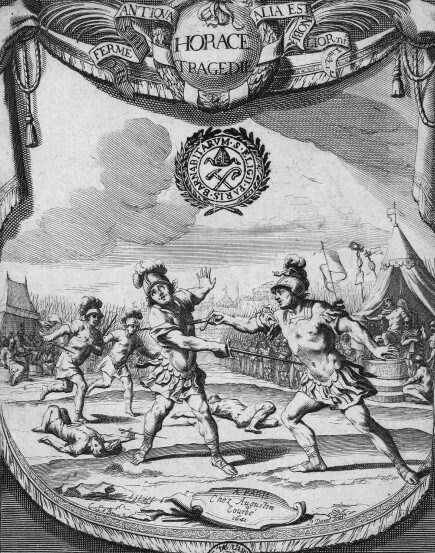
Rome and a neighboring city-state called Alba are about to go to full-blown war. To avoid massive casualties, they agree to a 3-v-3 champion duel to the death. Winner takes all.
Rome picks three brothers (the Horatii, led by Horace). Alba picks three brothers (the Curiatii).
These two families are deeply intertwined. Horace is married to a girl from Alba, and Horace’s sister, Camille, is engaged to Curiace—the main champion fighting for Alba. The guys tasked with slaughtering each other are literally brothers-in-law and best friends. It’s patriotism vs. human love.
While Curiace is heartbroken that he has to fight his best friend, Horace is a cold-blooded nationalist. His view? 'If my country asks me to kill my brother-in-law, I'll do it with a smile.'
Horace wins the fight and slays all three opponents, including his sister’s fiancé. He walks back into Rome as a national hero, wearing the dead fiancé's bloodstained cloak.
When his sister Camille sees it, she breaks down and curses Rome for destroying her happiness. Horace’s response? He stabs his own sister to death on the spot for putting her personal grief above the glory of the Republic.
This is the core of what Corneille loved to write about. The play leaves the audience dealing with some heavy moral questions:
What matters more? Your loyalty to your country, or your love for your family and your own humanity?
Horace saves his city and does his 'duty' perfectly, but he becomes an absolute monster to do it.
When the King pardons Horace, it proves that national survival completely crushes law and ethics.
In Corneille’s Horace, is blind patriotism ever morally justified?
Post Opinion
Like
Share
Follow
2 likes
What is your opinion?
Add Opinion
Superb Opinion
Anonymous
(45 Plus)
2 mo
It's interesting that you asked this question. Because i had a several hours long debate with a fellow yesterday over the same thing. It was less about a personal stance and more about an understanding of all the moving parts involved. Yes it had to do with Trump. No i'm not MAGA. Nor do i rail against Trump though i am suspect of some of the moves he makes.
The point i was making in the debate is how far Americans are willing to go to preserve their way of life. I do think most Americans are good people. And i do think they take moral stances. Right up till they consider it too costly to them personally. Ironically much of the time it's the people in this country with the least to lose that will fight tooth and nail to defend it.
No, blind patriotism is not morally justified. But no one EVER (even in the (dis-) information age, gets the whole unvarnished truth. We're always making our decisions with incomplete information. But at the end of the day if you very way of life is threatened, you will circle the wagons and do whatever is necessary to continue that existence.
The concept of champions challenging each other was a real and old tradition. David and Goliath. More than one in Homer's Trojan war.
Quite often it was a way of beginning a battle, before general engagement - circa 1300's. It ceased when warfare became more a matter of disciple and doesn't sound very ancient Roman at all.
There was still a tinge of this in WW1 when combatants on one side knew or were related to enemy combatants. The King of England was related to the Kaiser after all.
For the state, blind patriotism was what was wanted and was honored.
Spot-on about Corneille’s take on blind patriotism—Horace literally kills his own sister just for crying over her dead fiancé. The State comes first, human feelings are treason. You’re off on the Romans, though! Champion combat is actually peak early Rome, not just medieval knight stuff. The Horatii vs. Curiatii story comes straight from Livy, and Rome’s absolute highest military honor (spolia opima) was specifically reserved for a general who killed the enemy leader in 1-on-1 combat before the main battle. As for WWI, true about the royal cousins, except for one detail: the Horatii fought to prevent a bloodbath, while George V and the Kaiser sent millions to die in the mud while exchanging polite letters.
Spoila opima was a little different though to champions leaving their lines and challenging a warrior on the other side to come fight them. Or a group of warriors battling a group of enemy warriors.
The one non legendary case of spolia opima seems to be opportunist; it wasn't that uncommon for commanders to seek each other in the midst of battle.
I just think it is a distinct and different concept.
Didn't work out so well for Richard III. George II is the last English king to have lead and fought in a battle incidentally in 1743.
Real wars aren't about patriotism, it's just an ideology for 80IQ fools. Even the idea of sacrificing few one to save lives of many doesn't apply for war, where resources need to be conquered and other population decimated. Maybe it's some weird kind of war Belletristic this Pierre Corneille wrote about, but it has just entertaining value for the reader because it doesn't explain mechanics behind war and comes with choices between patriotism vs. human love which both are fairy tales.
I rarely, if ever, have found a situation where blind allegiance to anything is morally justified. The key is the blind part, obviously. By the way, where in France do you reside? You can tell me the region if you choose to answer and don't want to get any more specific. I'm curious because I'm there now.
I was. Went to the La Cite du Vin. It was fabulous. Had the two glasses of wine on the 8th floor. A few days prior I went to the Bassins des Lumières, nearby the wine museum. That was also fabulous. Why do think I'm making that up? LOL Also, finally found great Szechuan food in France at a local place. Finally !!
Personal relationships or country loyalty? That's based on the individual. There's a quote in Game of Thrones. A common sell sword stands between 3 men: a priest, a rich man, and a king. "The priest says that he should kill the other two to gain favor with God, the rich man promises him gold, and the king promises him a knighthood all for killing the other two. It depends on the sell sword; he will do what he considers the most important. Horace considered loyalty to his country the most important, over his family.
I was unfamiliar with that story. I can understand killing soldiers in battle. But killing his grieving sister was beastly. That is madness. If that's patriotism then count me out. I could never kill an unarmed person, especially a woman, especially my own sister, over ideology.
 Girl's Behavior
  Guy's Behavior
  Flirting
  Dating
  Relationships
  Fashion & Beauty
  Health & Fitness
  Marriage & Weddings
  Shopping & Gifts
  Technology & Internet
  Break Up & Divorce
  Education & Career
  Entertainment & Arts
  Family & Friends
  Food & Beverage
  Hobbies & Leisure
  Other
Other  Religion & Spirituality
  Society & Politics
  Sports
  Travel
  Trending & News