 Girl's Behavior
  Guy's Behavior
  Flirting
  Dating
  Relationships
  Fashion & Beauty
  Health & Fitness
  Marriage & Weddings
  Shopping & Gifts
  Technology & Internet
  Break Up & Divorce
  Education & Career
  Entertainment & Arts
  Family & Friends
  Food & Beverage
  Hobbies & Leisure
  Other
Other  Religion & Spirituality
  Society & Politics
  Sports
  Travel
  Trending & News

Hello everyone, it's Toad-1 with a new mytake. I should admit right now that I, probably like many people on GAG, suffer from either depression, social anxiety, or some other mental illness. The list I am presenting here comes from a popular Cognitive Therapist named David D. Burns and his famous book Feeling Good: The New Mood Therapy.

These are what he calls 'Cognitive Distortions' which are exaggerated or irrational thought patterns that are believed to perpetuate the effects of several mental states, especially depression and anxiety. I learned of these through my sessions with therapists and learning about them has definitely made it easier to spot them when they occur in my mind.
Included with most of these are both a negative and a positive (as i also feel it's important to identify the positive distortions as well) example of the distortion. You may have seen these before but check them out and share with us if you can identify any that seem or feel familiar to you.
1. All or Nothing Thinking
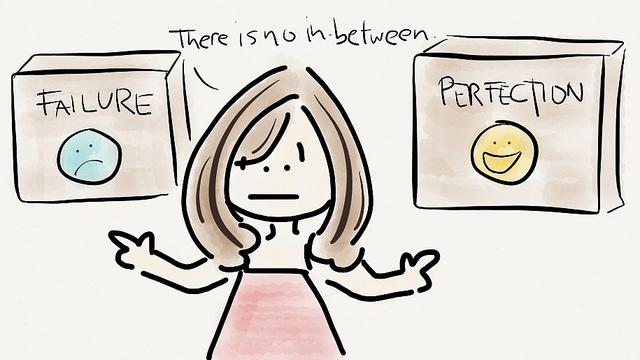
I am definitely guilty of this one where you see things in black or white categories. If a situation falls short of perfect, you see it as a total failure. When a young woman on a diet ate a spoonful of ice cream, she told herself, “I’ve blown my diet completely.” This thought upset her so much that she gobbled down an entire quart of ice cream!
Negative Distortion Example: When you fail, you may tell yourself that you’re a complete failure.
Positive Distortion Example: When you succeed, you may tell yourself that you’re a winner and feel superior.
2.Over generalization
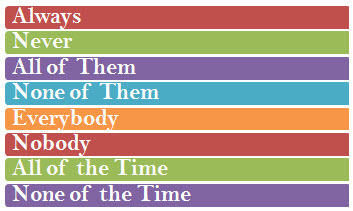
Negative Distortion Example: When you’re rejected by someone you care about, you may tell yourself that you’re an unlovable loser who will be alone and miserable forever.
Positive Distortion Example: When you overcome an episode of depression or self-doubt, and you’re suddenly feeling happy again, you may tell yourself that all your problems are solved and that you’ll always feel happy.
3. Mental Filter
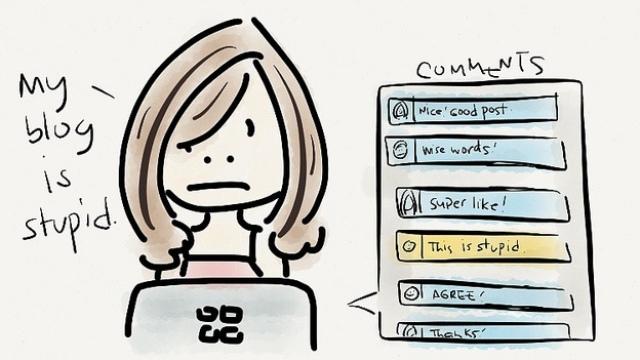
You think exclusively about your shortcomings and ignore your positive qualities and accomplishments. Or, you dwell on the positives and overlook the negatives.
Negative Distortion Example: A TV talk show host says that he typically received hundreds of enthusiastic emails from fans every day, but there was nearly always one critical email from a disgruntled viewer. He explained that he’d obsess for hours about the negative email and completely overlook the hundreds of glowing ones. As a result, he constantly struggled with feelings of anxiety and low self-esteem in spite of his tremendous ratings and popularity.
Positive Distortion Example: You may fantasize about how good that desert will taste, and ignore the negatives, like gaining weight and feeling guilty or bloated afterwards. Or, you may tell yourself how great you’ll feel if you have a drink, and ignore the fact you nearly always drink too much and end up with a hangover.
4.Discounting the Positive

You reject positive experiences by insisting they "don't count" If you do a good job, you may tell yourself that it wasn’t good enough or that anyone could have done as well. Discounting the positive takes the joy out of life and makes you feel inadequate and unrewarded.
Discounting the Positive: When someone genuinely compliments you, you may tell yourself they’re only saying that to make you feel good.
Discounting the Negative: When you’re trying to diet and feeling tempted by something tasty, you may tell yourself, “I’ll only have one little bite.” But you’ve probably given yourself this message on hundreds of occasions, and it has hardly ever been accurate! During an argument, you may get defensive and insist that the other person is “wrong.” Then the conflict escalates.
5. Jumping to Conclusions:

This has two components to it. This is when you interpret things negatively when there are no facts to support your conclusion. The two common forms of this are called Mind-Reading and Fortune Telling
Mind-Reading:
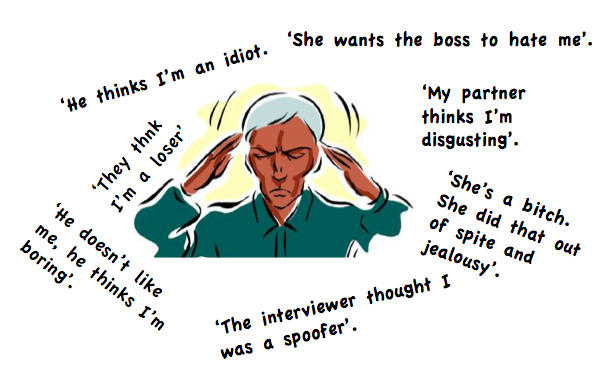
This one I am most guilty of doing. It's when you make assumptions about how other people are thinking and feeling about you without asking them.
Negative Distortion Example: If you’re feeling shy at a party, you may tell yourself that other people don’t have to struggle with shyness or that they’d look down on you if they knew you were shy.
Positive Distortion example: You tell yourself that a relationship is going really well when the other person is actually feeling annoyed or unhappy with you.
Fortune telling:

You predict that things will turn out badly. Before a test you may tell yourself, “I’m really going to blow it. What if I flunk?” If you’re depressed you may tell yourself, “I’ll never get better.”
Negative Distortion Example: When you’re depressed, you may tell yourself that you’ll never recover. When you’re feeling anxious, you may tell yourself that something terrible is about to happen—“When I give my talk, my mind will go blank. I’ll look like an idiot.”
Positive Distortion Example: You tell yourself, “I’ll just have one drink” or “one bite,” when, in fact, you hardly ever stop at just one drink or bite.
6. Magnification/Minimization:

You exaggerate the importance of your problems and shortcomings, or you minimize the importance of your desirable qualities.
Negative Distortion Example: When you’re procrastinating, you may think about everything that you’ve been putting off and tell yourself how overwhelming all those tasks will be. (Magnification) You may also tell yourself that your efforts today wouldn’t amount to anything anyway, so you might as well put it off. (Minimization).
Positive Distortion Example: When you’re trying to diet and you’re feeling tempted, you may tell yourself: “This ice cream will taste so good!” (Magnification). Will it really be that good? Will it be worth the way you’ll feel about yourself after you give in to the urge to binge?
7. Emotional Reasoning:
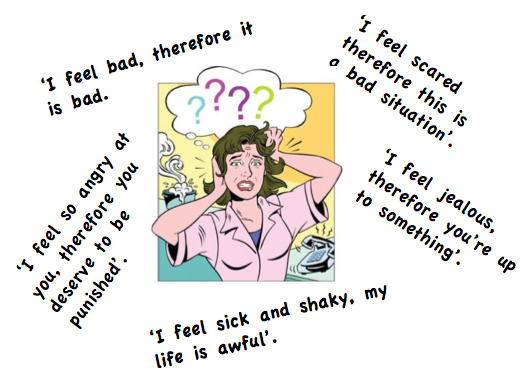
You assume that your negative emotions necessarily reflect the way things really are: “I feel terrified about going on airplanes. It must be very dangerous to fly.” Or “I feel guilty. I must be a rotten person.” Or “I feel angry. This proves I’m being treated unfairly.” Or “I feel so inferior. This means I’m a second rate person.” Or “I feel hopeless. I must really be hopeless.”
Negative Distortion Example: When you procrastinate, you may tell yourself, “I’ll clean my desk (or start my diet) when I’m more in the mood. I just don’t feel like it right now.” Of course, the feeling never comes. When you’re depressed, you may tell yourself, “I feel like a loser, so I must really be one.” Or “I feel hopeless, so I must be hopeless.”
Positive Distortion Example: When you’re gambling, you may say, “I feel lucky! I just know I’m about to hit the jackpot.”This distortion also triggers romantic intoxication. When you meet someone attractive, you may feel so happy and excited that you think that he or she must be wonderful—the man (or woman) of your dreams.
8. “Should" statements:
Another one I am pretty guilty of doing; This is when you tell yourself that things should be the way you hoped or expected them to be. After playing a difficult piece on the piano, a gifted pianist told herself, “I shouldn’t have made so many mistakes.” This made her feel so disgusted that she quit practicing for several days. “Must's,” “ought's” and “ have to's” are similar offenders.
"Should statements” that are directed against yourself lead to guilt and frustration. Should statements that are directed against other people or the world in general lead to anger and frustration: “He shouldn’t be so stubborn and argumentative.”
Negative Distortion Against Yourself Example: You tell yourself that you shouldn’t have screwed up and made such a stupid mistake.
Negative Distortion Directed at Others Example: You may tell yourself, “That fellow shouldn’t cut in front of me in traffic like that. I’ll show him that he can’t get away with it!”
Positive Distortion Against Yourself Example: When you’re feeling tempted, you may tell yourself, “I’ve had a hard day. I deserve a drink (or a nice dish of ice cream).”
Positive Distortion Directed at Others Example: You may tell yourself that your values are the best values and that other people should think and feel the same way.
9. Labeling:

Labeling is an extreme form of all-or-nothing thinking. Instead of saying “I made a mistake,” you attach a negative label to yourself: “I’m a loser.” You might also label yourself “a fool” or “a failure” or “a jerk.” Labeling is quite irrational because you are not the same as what you do. Human beings exist, but “fools,” “losers,” and “jerks” do not. These labels are just useless abstractions that lead to anger, anxiety, frustration, and low self-esteem.
You may also label others. When someone does something that rubs you the wrong way, you may tell yourself: “He’s an S.O.B.” Then you feel that the problem is with that person’s “character” or “essence” instead of with their thinking or behavior. You see them as totally bad. This makes you feel hostile and hopeless about improving things and leaves little room for constructive communication.
Negative Distortion Example: You may label yourself or someone you’re not getting along with as “a loser” or “a jerk.” A physician slipped up on her diet and gave in to the temptation to eat a donut. Then she told herself that she was “a fat pig with no will power.” This thought was so upsetting that she ate six more donuts.
Positive Distortion Example: When you do well, you may think of yourself as special or as “a winner.” Motivational speakers, politicians, and athletic coaches often use this strategy to motivate people. But in reality, there’s no such thing as a “winner” or a “loser.” We’re all human beings, and no one can win or lose all the time.
10. Personalization and blame:


Blaming others: They blame other people or their circumstances for their
problems, and they overlook ways that they might be contributing to the problem: “The
reason my marriage is so lousy is because my spouse is totally unreasonable.” Blame
usually doesn’t work very well because other people will resent being scapegoated and
they will just toss the blame right back in your lap. It’s like the game of hot potato - no one wants to get stuck with it.
Example of Personalization: If you’re depressed, you may beat up on yourself constantly and mercilessly, blaming yourself for every error and shortcoming instead of using your energy to find creative solutions to your problems.
Example of Blaming Others: During an argument, you may tell yourself that the other person is to blame for the conflict. Then you feel like an innocent victim and overlook your own role in the problem.
-----------------------------------------------------------------------------------------------------------------------------------------------------------------
That is the end of that. I hope this has been enlightening for many of you. please share your thoughts about what you identify with. It's a constant struggle but knowing these things can certainly help you when they are happening. It helps me.


































Most Helpful Opinions