 Girl's Behavior
  Guy's Behavior
  Flirting
  Dating
  Relationships
  Fashion & Beauty
  Health & Fitness
  Marriage & Weddings
  Shopping & Gifts
  Technology & Internet
  Break Up & Divorce
  Education & Career
  Entertainment & Arts
  Family & Friends
  Food & Beverage
  Hobbies & Leisure
  Other
Other  Religion & Spirituality
  Society & Politics
  Sports
  Travel
  Trending & News

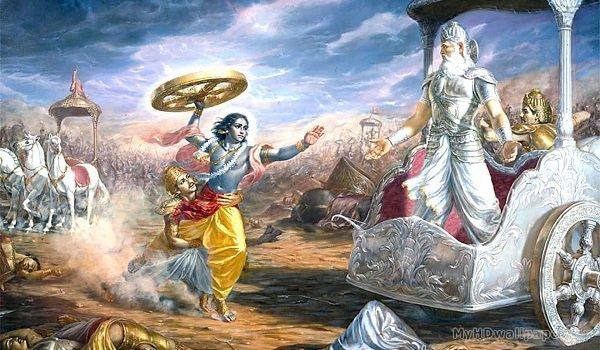
Warning!
* This is a bit long and wordy my take.
* It is probably not very interesting either.
* Don't bash your head on a wall if you didn't like (or didn't understand shit) it.
Usually, I'm not very interested in religion and stuff.
But the image of 'Sanatan Dharm', I call it, has mostly been projected incorrectly in the world.
To me, Hinduism is not a religion. It's a deep analysis of the nature of creatures and also of history.
Most 'Hindus' don't even know 1% of their religion. (Worshipping cows and idols is the only thing they can do.)
Here we will see some of the most interesting things I've come across in the ancient texts.
1. Gāyatrī Mantra
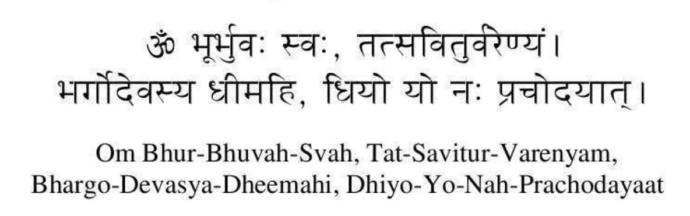
The Gāyatrī Mantra, also known as the Sāvitrī mantra, is a highly revered mantra from the Rig Veda.
It's written is old Sanskrit and therefore, incredibly difficult to understand.
The problems is that the meaning of the words isn't clear.
Its recitation is traditionally preceded by oṃ and the formula bhūr bhuvaḥ svaḥ, known as the mahāvyāhṛt, "the great mystical utterance".
And now comes the interesting part.
The three most interesting words here.
1. Bhūr
Bhūr means something that has no beginning and no end, is eternal, unchanging and is continuous.
2. Bhuvah
Bhuvah means the consciousness of all.
3. Swah
Omnipresent, formless and devoid of any feelings.
This is my understanding of the given. There is no literal meaning here. It's all conceptual.
When you think about it, the Mahāvyāhṛti seems to explain the nature of God.
As a formless consciousness which is devoid of any emotion, which every creature is a part of. Omnipresent, no beginning, no end.
If you are into physics and theories of universe, then this sounds very strange yet fascinating.
2. Shiv Tandav Stoatr
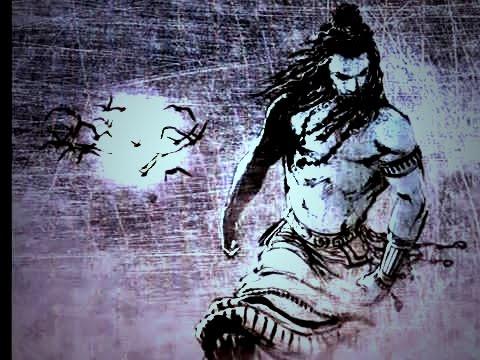
Devoted by the demon king Rāvan, who also happens to be a Brahmin, to Shiv.
The poetry describes Shiv in a physical form as seen by Rāvan.
Check this like if you wish to get the full poetry with translation and (probable) meaning.
https://en.m.wikipedia.org/wiki/Shiva_Tandava_Stotram
However, it is the 12th and 13th part where he asks a question.
Here.
"When will I worship SadāŚiva (eternally auspicious), with equal vision towards the people and an emperor, and a blade of grass and lotus-like eye, towards both friends and enemies, towards the valuable gem and some lump of dirt, towards a snake and a garland and towards varied ways of the world?" [12]
"When will I be happy, living in the hollow place near the celestial river, Ganga, carrying the folded hands on my head all the time, with my bad thinking washed away, and uttering the mantra of Lord Śiva and devoted in the God with glorious forehead with vibrating eyes?" [13]
Rāvan was obsessed with his powers and was egoistic, and to display and prove his powers he was about to move Mount Kailash (the abode of Shiva who was his ancestor God). He managed to lift the mountain but Shiva immediately placed it back just by pressing his toe crushing Ravana's fingers in the process. That is when Ravana sings "Shiv Tandav Stoatr" and he was spared and blessed with 'chandrahas' (sword of moon) by Shiv ,considered one of the most powerful.
It makes you wonder what kind of a person Rāvan was and what he desired in life.
3. Mahābhārat
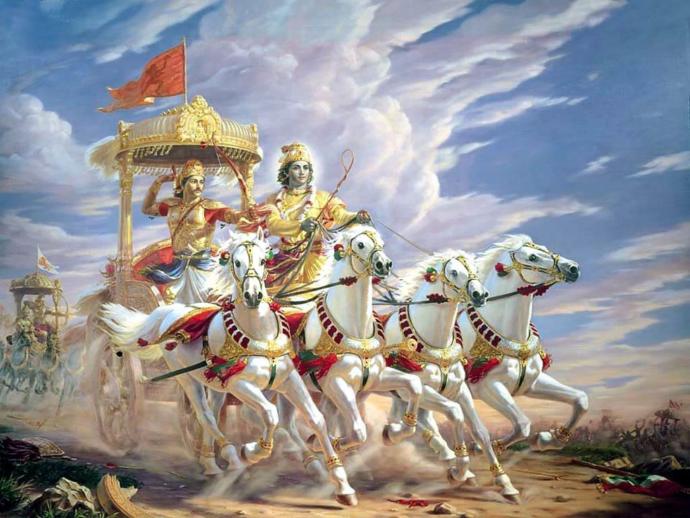
(FAMOUS PAINTING)
The story is about a mega what between the Kauravs and the Pandavs, cousins.
The Mahābhārat is truly a mind bender.
It describes the nature of humans in absolute detail. How a single insult by a lady caused a war that consumed countless people and bloodied the soil so bad that it stayed red for years.
Interestingly, there are regular mentions of weapons which cause massive destruction, and leave the land 'poisoned' forever.
The Mahābhārata is the longest epic poem known and has been described as "the longest poem ever written".
It's longest version consists of over 100,000 ślok or over 200,000 individual verse lines, each shloka is a couplet, and long prose passages.
About 1.8 million words in total, the Mahābhārat is roughly ten times the length of the Iliad and the Odyssey combined.
The oldest preserved parts of the text are thought to be not much older than around 400 BCE, though the origins of the epic probably fall between the 8th and 9th centuries BCE.
4. Om
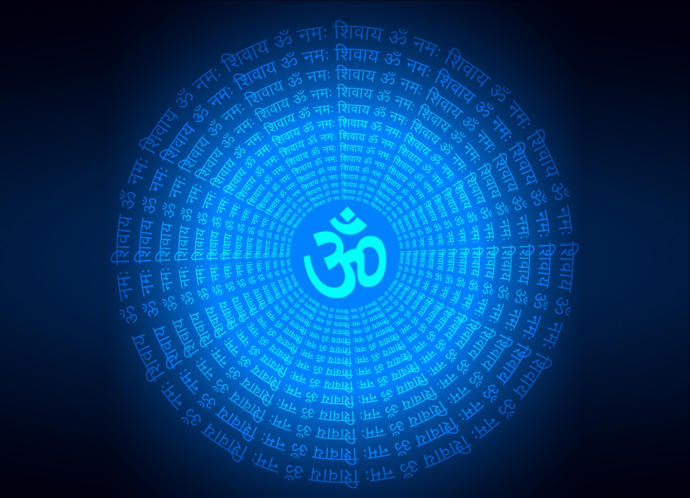
Om is the shortest Mantra in existence.
Pronounced like Ω.
Om is considered the most sacred mantra in Hinduism and Tibetan Buddhism.
This is probably the single most confusing thing is Hinduism. 'Om' is not just a sound but a whole concept.
After thinking a lot about it, I think that if one were to describe everything in existence in one single word, it would be 'Om'.
Yes, I know I sound like I'm talking out of my head here.
Still a lot many things are not clear. I can explore for years and still wander like a mad freak.
And now you can pat yourself in the back.

You have learned something new (and weird).












What Girls & Guys Said
Opinion
1Opinion
Tbf from this take I haven't learned anything new as I'm Hindu Bramhin myself. And it is insulting when you call Hinduism weird though I'm not religious person.
" Most 'Hindus' don't even know 1% of their religion. (Worshipping cows and idols is the only thing they can do.)"
I totally agree with you. However Hinduism is so vast that no man can know 100% of it. Also many holy books are in Sanskrit because of that no common man can read them. I also agree that Hindu isn't a religion. It is study of nature, human mind and spirits.
In Hinduism there are 330 Million gods. In my opinion each of these god represent single thing like Shiva represents anger, Lakshmi represents Money, Saraswati represents Knowledge and list goes on.
Thanks for the awesome take! :)
When you grab the concept, it doesn't seem vast.
I think the Mahāvyāhṛti explains it very well.
Share the first opinion in your gender
and earn 1 more Xper point!