This gets a little complicated - although to their great credit, a number of people who answered your question appeared to understand it. Nationalism has been traditionally used as a synonym for patriotism, and more recently for racism. How it was directed toward you it is impossible to judge without some context. That said, overall, historically speaking, nationalism has been generally a good thing.
Recall that ancient man - as civilization arose - identified his loyalties to his tribe, his village, or some other community to which he had a direct material attachment. Thus, the ancient Greeks were loyal to ancient Athens, or Sparta or some other city-state, not to an amorphous thing called Greece. (In fact, Greece as a national state is a fairly recent innovation.)
As empires began to be built loyalties were transferred to the metropolitan power center. Again, this being identified mainly with a geographic location. This holding up until first Christendom and then the Enlightenment began to alter man's sense of his loyalties and thus his identity. No longer was he a mere citizen of Athens or a member of some tribe, but suddenly he was a child of God or, later, an individual who owed his loyalty to an amorphous thing called "humanity."
Thus, kings ruled by "divine right" and were owed loyalty for that fact. Later, they were "Enlightened Despots," who ruled in conformance with man's reason and his nature. Suffice to say, there was much good coming from this but also much potential for tyranny. In reaction to this, people began to resent the "enlightened despot" who, whatever his enlightenment, did not speak their language nor share their customs and traditions.
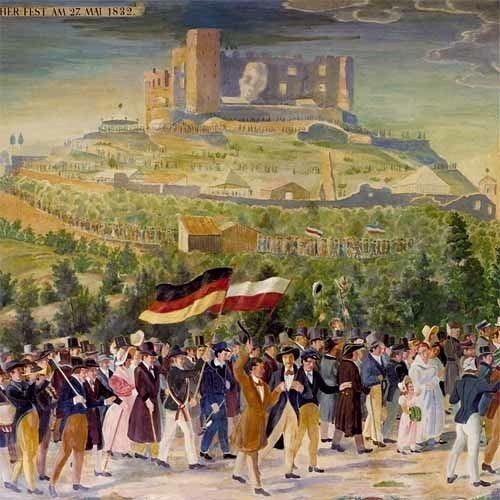
From this, nationalism was born. It was the identification of the individual with people like themselves. Who shared the same language, shared the same customs and traditions. This being a particularly powerful reaction to the place where the Enlightenment was born and its intellectual traditions were most prominent - Europe.
Thus, Frenchmen were no longer loyal to a king or a duke or whoever the local potentate happened to be, but to their fellow French speakers - to France. Kings began to identify not with the ideal of the Enlightenment or - earlier, Christendom - but with a state called France. Thus nationalism gave birth to the national-state.
Of course, there were variations of this. France, Germany, Italy, Spain, Portugal, Russia, Poland, and so on tend to identify with their nationalities. By contrast, the United States and the United Kingdom adapted nationalism to a specific set of ideas. These are "creedal states," and their nationalism is rooted in their ideas. Thus, for the UK, four nations - English Scots, Welsh, Irish (at least Protestant Irish) - identify with "loyalty to the Crown" and all the ideals that attach to the Crown. Americans are a mish-mash of races, ethnicities, religions, etc., all bound together by the ideals articulated in the Declaration of Independence, the Constitution and the Bill of Rights.
In a strict interpretation of the terms, the UK and the USA would be patriotic, whereas as Germans, Italians, etc. would be nationalist. (France gets a bit complicated. Strictly speaking, it is nationalist, but the French have, over time, merged their sense of national identity not just with their nationality/ethnicity, but with the ideals of the French Revolution.
No matter, nationalism was generally seen as a good thing until the cataclysm of World War I. Suddenly, the nationalities were not living peacefully alongside one another, but out of a sense of nationalism and national interests were slaughtering each other. The reaction to this was the effort after the war to make those national loyalties compatible with an order based on international law, collective security and a "parliament of man." (The League of Nations.
The reaction against this was even more fierce. Thus was born Communism. The erasure of all national distinctions in favor of class identity. Thus also national came to be identified with race - hence NATIONAL Socialism. (Fascism was a return to a more traditional, if extreme nationalism in which the state was identified with national identity.)
Thus today, you tend to get two interpretations of nationalism. It being equated with patriotism particularly in the Anglo-Saxon world. It being equated with racism in other contexts. Yet, in a fair interpretation, it is generally a good thing that, like all good things, can be warped to bad ends.
Hope that helps.
P. S. Just started the Debray book. Into it very early and so I don't have any opinion on the substance, though I will say that the writing style - perhaps because it is being translated - is a bit clunky.
You answered the question perfectly. Indeed in Europe to say of someone that he is nationalist is not really a compliment. Suffice to say that it is even considered to be a person close to his own nation and hateful towards other nations.
Oh well for Regis Debray in French he has very nice writing. I must admit that I do not know the quality of the English translation, for reasons of convenience I have only read these books in French. However I hope that the translation reproduced the original text as faithfully as possible, so that in the end we read the same book lol.
I hope it wasn't because of my message the other day that you started reading it. I'm in no rush and I didn't want to push you to read it because of my message.
Not at all. It was my intention to read it and it just so happens I finished the last book I was on and it was Mr. Debray's turn, so to speak.
As far as the writing, the translation may be a problem but I'll get through it. Besides, as I always say, your English is better than my French. I have to figure that will be true of the book, too.
Anyhow, as far as nationalism, I was not there when you were called a nationalist, so I can't judge how it was intended. I would also add that, at least here in the States, sometimes people will use the word "nationalist" - as opposed to "patriotic" - just because they think the former sounds more intellectual.
It's kind of shallow, but there it is.
Frankly, if I were you, I would not dwell on it. Since we met here, I have noted that you always seemed very much to love your country, though not uncritically. That is a good thing. You love your country while being cognizant of its flaws and are willing to engage in debate to improve your country.
@Odile1323 Oh believe me, she and I have discussed Napoleon before. We gently refer to it as her... uhmmm... eccentricity. (Kidding. Though I have to admit, particularly with her generation, the Napoleon Fan Club is a wee bit small.)
@nightdrot Expression funny and right at the same time.
You should have seen my face when she asked me for a statue of Napoleon when she was 12, I am a fervent Republican and now my daughter loves the historical figure who wanted to create a dynasty. What do you want, I still love her, she's still my daughter after all. (it's a joke).
Well, he had certain admirable traits, but at the end of the day he brought war and bloodshed to Europe. This in pursuit of an ideology that, whatever its pretensions, tilted toward the totalitarian.
Recall that column I sent you a while back by George F. Will? That scratched the surface, but I thought many of the points valid.
That said, New Orleans is my favorite American city, so we do owe him that.
P. S. Oh by the way, neither your mom and I are laughing at you. Go back and read what I said about you. I have nothing but the highest regard for you. You are polite, thoughtful, and articulate. We may not agree on some things, but that does not mean that I hold you in less regard.
As to your mom, put yourself in her shoes. How many 12 year olds tell their mom that they want a statue of Napoleon? She I am sure - because she said so - loves you dearly. However, raising you must have been quite the adventure.
Most kids your age were into rock and some cute guy. You were into Napoleon. Let's face it, you don't run into that every day.
Though there was a time - I was in my 30s - when a neighbor pointed at me and asked my mother, "What was he like when he was a baby?"
To which my mother replied without skipping a beat, "About like he is now."
@nightdrot Oh when I said you were laughing at me it wasn't in a bad way. I was speaking in a humorous sense. I understood very well that it was humor, no problem. I have never taken your messages badly, they have always been respectful, and I have esteem for you.
Nationalism means self determination , right of people to rule, people governing themselves instead of getting governed by monarch, clergy, colonialists or elites. Nationalism means populism and democracy. For example I am a Turkish nationalist not because I think Turkic race are superior than everyone else , this would be racism, not nationalism. There is a huge difference . I believe every ethnic group and race are equal. I am Turkish nationalist because there are neo ottomanist and islamist idiots in my country who are in favor of monarchy and stuff due to some islamic teachings I dont wanna mention. I perceive them as a threat for secular and democratic vaIues that my country builded on. I consider myself as a defender of those values that freed my people from colonial rules (We have never been colonised but they tried) or the rule of monarchs such as house of osman (ottoman) . So a real nationalist has to be anti monarchist and secularist since religion and clergy are tools used by ruling class.
But you can be proud of your country, its history and its culture, without wanting to return to its religious values and its political system of other times.
by the way a True nationalist shouldn't be blindly proud. A true nationalist should aim progress and in order to progress he/she should have ability to self critization.
no, believe me come to the West, and you will see a hatred that many Westerners feel towards their nation because of the woke culture from America.
The problem with criticizing the mistakes of one's nation may be a good thing, but put in its global context, all nations have made mistakes and things of which they are not proud.
In the end, I adopted this philosophy of the philosopher Emile Cioran. , "As long as a nation retains the consciousness of its superiority, it is ferocious and respected. As soon as it no longer has it, it becomes humanized and no longer counts."
I'm raised as a nationalist, I've pride in my country, culture, traditions & history. I'm raised to be proud that my country is now a independent Republic - not under another countries crown.
Now I've migrated to Denmark, (who we did belong to) & I am a Danish citizen, the tone of nationalism in the political debate here - I don't care for. There's a lot of hygge racism here, I'm a acceptable Danish citizen - since I'm Nordic & therefor close with the Danish cultural standing (& I'm white asf). Nation before others & that includes the citizens of Denmark at times.
Nationalism is the belief that people born in the same geographic region you were are somehow better or more deserving of life than other people. It's functionally identical to racism, though even more arbitrary, and should be treated with the same disdain that we treat racism with.
Kin selection is the evolutionary strategy that favors the reproductive success of an organism's relatives… Much like the basics of kin selection, someone who is a nationalist cares more about the safety and well being of their own countrymen than they do of people on some other continent. I bet you care more about your own family than you care about me… I bet you like men that are protective of you and your potential children and make you feel safe right? So why wouldn’t that same concept by extension apply your local community of friends, neighbors, and colleagues? Your tribe of relationships will always gain more of your attention and effort than some random nobody you’ve never met. Their success and you working with them is your success. You have to live and work together after all… The fruits of their labor help to increase your standard of living within your own civilization after all. The same is true at the nation state level. You are all part of a more local economy than the entire globe. You are interdependent on one another, thus your loyalty and devotion to your own nation would serve you and your family more than if you were for example to work your butt off in your own country and then donate all of your money to starving children in Africa at the expense of your own family. Would you let your children starve to death so that some random person in Africa could eat? What if that person was a Somalia pirate and ran around with an AK shooting people in the face? Is that person more important than your own kids? Are they more important than your neighbors? Are they more important than some homeless guy in your own city that can’t find work or a meal to eat? People have to look out for their own and place their loyalties where they make most sense.
Once we as people broke free of the servitude of Lords, Counts, Dukes, Kings, etc. we no longer belonged to them as property... We were free people, but that came with individual responsibility. Of course those old royals didn't like that and they wanted to continue to enslave us, so we pooled together our strength with people with common interests to fend off foreign enemies that wanted to subjugate us. That's what nationalism is about. You stand up for your own people, don't submit to tyranny.
The basic idea behind nationalism is that the leaders of the country should take care of the people within that country before the rest of the world. To me, that's perfectly sensible.
There are two types of nationalism: civic nationalism and ethnonationalism. The main difference between the two is that ethnonationalism is race-based and anti-immigration, whereas civic nationalism is more based on shared values and culture, pro-legal immigration.
If I believed that there was any point in voting and had any faith in the political system at all, which I don't, I'd be an ethnonationalist.
If you drop "nationalism" into Google, you will produce a pretty wide variety of results but it fundamentally means putting the needs of your nation ahead of others. There's not really anything inherently wrong with that, but it frequently gets tied in with the National Socialist German Workers Party (Nazis), and more recently with secessionist movements.
0
0 Reply
Anonymous
(36-45)
+1 y
Leftists and globalists have tried to smear nationalists as being connected to "white nationalists" which are 2 completely separate things. Nationalists are good. They are patriotic, believe in country first over foreign involvement. They believe in individual nation states over the globalist agenda of "one world".
People always assume nationalism is having such an intense love for your country that you feel the need to conquer other countries to make them a part of your country.
Even if you want to see your country succeed, you are nothing but a Nazi to the people who don't.
Nationalism is the belief that your nation is better than others and a resistance to accepting that those from other nations are actually the same as you (i. e. human beings) with the same right to exist as you.
I don't think focus on nation is important. It's the values and way of living that is important. If those are removed or changed, you can toss your nationalism in the trash because you are now fighting for the wrong thing.
A stupid philosophy where someone believes their country and culture is flawless and only wants people from their own culture living there, as they think their culture is superior to others.
Nationalism is the belief in a specific nation state as well as what belongs to that nation state. Nationalist stake all sorts of claims some that agree with others, and some that clash with others
To love your own race and culture. The radical form of nationalism is called racist. That is, their own society and culture. and everyone who loves their state is a nationalist.
 Girl's Behavior
  Guy's Behavior
  Flirting
  Dating
  Relationships
  Fashion & Beauty
  Health & Fitness
  Marriage & Weddings
  Shopping & Gifts
  Technology & Internet
  Break Up & Divorce
  Education & Career
  Entertainment & Arts
  Family & Friends
  Food & Beverage
  Hobbies & Leisure
  Other
Other  Religion & Spirituality
  Society & Politics
  Sports
  Travel
  Trending & News