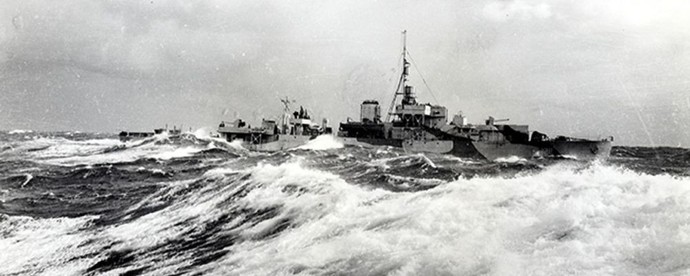
Was the Battle of the Atlantic the most important battle in winning the Second World War?


It was. Britain's population had long exceeded Britain's ability to produce food for a start. It was also highly dependent on imports of oil products and munitions to fight a war. No petroleum products then no functioning airforce or navy let alone munitions.
There were two happy times for the wolf pack of Germany. Happy times were a euphemism for prolific sinking of commercial shipping. July to October in 1940 and after US entry between January to August 1942 along the US eastern seaboard.
The Royal Navy reduce the first happy time by convoys and air patrols and by lend lease frigates from the US. escorting convoys. Also wargaming what the wolf pack would do helped a lot with countering tactics. There is a story of an RN admiral losing the first wargame and demanding a second which he also lost then demanding a third that he also lost. The admiral than asked to meet his opponent. H was not well pleased to find his opponent was a young girl - a WRNS.
None the less it helped to develop counters. Technology help as well - Most will have heard of ASDIC an early sonar. It helped that the enigma code could be deciphered. Radar helped when magnetron radar was developed. A surfaced Uboat was likely to find a coastal plane bearing down on the coning tower. When two lights (one on each wing) merged it was the exact moment to drop the bomb (mine?) onto the Uboat. There was Huff Duff too. That looked for radio transmissions from Uboats and with two readings the Uboat location could be triangulated.
The second Happy Time was sad. US people may disagree - and I'd like a US counter-take - but after US entry the eastern seaboard was a shooting gallery. The US admiral reputedly didn't like Limeys and rejected the UK lessons learn't. Not convoying and no black outs. In some cases US ships were perfectly silhouetted by city lights and the bodies of sailors were washed up onto US beaches.
That was remedied (after too long) but Battle of the Atlantic shifted to the Atlantic Gap - the bit in the middle where US & Canadian anti-submarine coverage didn't overlap with UK coverage. Uboats were free to hunt in the Gap.
This Gap was fixed by a creative treaty with Iceland. Creative in the sense that Iceland didn't have much of a say in the treaty. You could possibly use the word invasion from what I understand.
Offensively the hedgehog was lethal. It was the shotgun of depth charges. I dunno but maybe half a dozen depth charges were sprayed out from the backend of a frigate so it didn't matter if the Uboat dived fast or dodged so much after the frigate got to location of the Uboat guided by ASDIC. There was still a good chance of a kill.
At the end Uboats didn't survive for long and they were destroyed quicker than they could be built by the Reich.
The Battle of the Atlantic was a fascinating counter-play of operational strategy aided by war-gaming and technology development from necessity. Technically Uboats aren't classified as submarines but instead as submersible boats because they needed to spend a lot of time on the surface. Back in WWI Uboats had snorkels so they could run on diesel under water. But if the flap on the air end of the snorkel was closed by a big wave, the diesel engines would quickly create a vacuum which burst ear drums and distracted the crew with the pain.
Incidentally we can also see Uboats as an own goal by RN just as the dreadnoughts were. The later were so superior they made every other navy's battle ships retrograde - including the RN's own battle fleet. Which of course other nations appreciated as leveling the playing field. After Germany lost the dreadnought building battle they diverted to another RN interest - submarines. The J class was designed pre WWI but mostly built in 1915.
Most of them ended up in my city, Melbourne, after WW1. One of them serves as a break water at a yacht club. We should really recover it as well as the only monitor class vessel still above the waves - for 163 years to date.
There lots of good Battle of the Atlantic video's on YT I'd encourage people to watch. The above is just my mind dump to interest folk. May have made lots of mis-remembrances :).
@Drewtate Yes and Germany started on coal to oil much earlier. One type of the process was developed before WWI and another in 1920's. Conversely UK had black coal whilst Germany was liquifying brown coal. I have no real basis for saying so but I'd have to think you'd do better with black coal as the feed stock.
Still a national effort to liquify coal would seem to be misplaced. Effort directly related to the war would have had to redirected to that. If Germany had not declare war on the US and the US did not enter on it's own accord as in WWI, then it would be different.
Fortunate for the UK that Japan launched Pearl Harbor which caused US to declare war on Japan which caused Germany to declare war on the US.
In wartime needs must. Britain didn't really bother with synthetic oil because it had a massive empire full of oil and were able to buy direct from America and it had control of the seas. Coal was important for Britain as it fueled its trains.
Germany relied on Romania and the hopes of oil in Russia for its oil.
@Drewtate Yes as needs must. Have seen pictures of UK gasbag vehicles of WW1&2? A blimp was put on cars trucks and buses and filled with town gas to be the fuel. undoubtedly they would have run badly because town gas is about 50:50 carbon monoxide and hydrogen and hasn't the get up and go energy density of gasoline. But as you say as needs must.
The problem for any country in a major war is there are many things it needs to do but very finite inadequate resources to do those things. A current example is Ukraine. Before their wars with Russia, it was the fourth largest weapons manufacturer. Undoubtedly they would like to be making missiles and have the technical expertise to do so but can they put up a factory to do so? Unlikely.
We haven't seen any of their simple build-in-a-garage rejigged WW2 V1 flying bombs yet either. Sadly, as i would to see V1's flying to Russia.
Thing is we supported the corrupt Cuban government & military, the South Vietnamese government and military, the Afghanistan government & national army, the Iraq government & military, the Libyan government and military, free Syrians & military in their civil wars & wars & now Ukraine against the Russians but the difference is that unlike the rest of those for the first time since ww2 & ally we are supporting is actually willing to fight & do the fighting themselves
This isn't a fair question because unlike land battles the sea is not taken and occupied so it can't be resolved in the same way as a land battle and so it is endless; the 'battle of the Atlantic' lasted the entire war.
For me the answer is Stalingrad, it was a massive over extension and a completely unnecessary one for the Germans; they should not have changed their plan, securing the oil in the Caucasus and consolidating their hold on the Ukraine's food supply etc and not trying to push so hard beyond their supply capability was the way to go or just do a knock out blow on Moscow. Germany failed hard in Russia because they tried to do too much, so much that they ended up doing nothing and they spent all their manpower doing it.
Had Germany been able to defeat Russia without wasting all its manpower and then exploit its resources stopping them at all might have been very difficult because they would have had everything they needed.
None of this is really what is important about WWII anyway though, what is important is that Hilter was only able to come to power because he was being bank rolled by the rich and the powerful in the west because he was their solution to their enemy; communism.
https://archive.org/details/jfk-to-9-11-everything-is-a-rich-mans-trick-4
Americas greatest defence was the fact its so far away it was impractical to mount any attack on it. That meant they could produce an inexhaustible amount of materials to support the war. Wars are won by the side that can sustain war the longest and so yes I think you may be right.
Opinion
5Opinion
Probably the evacuation of Dunkirk from the allies point of view mattered most. Had the Nazis been able to destroy the British army on the beaches of Dunkirk the British would have surrendered or sued for peace meaning there would have been no battle of Britain, no battle of the Atlantic and no battle in Greece and Cyprus, no battle of malta, no north African campaign, basically no one left in 1940 to oppose the nazis. Most importantly Germany would face no Naval blockade on global trade meaning it could aquire all the war resources it needed for the invasion of Russia from the British, French and other European empires. The US would have been more than happy to produce arms and manufactured goods for the nazis. The USSR would suffer greatly without US lend lease and the British sending them what they needed to fight.
The Battle of the Atlantic was definitely important because without the control of the seas Britain would have been unable to bring in the resources it needed to manufacture weapons etc and move troops around. When the US joined the war without winning the battle of the Atlantic the Torch landings could not have happened, the 8th airforce bombing German industry could not have happened let alone D-Day.
Definitely.
Though you also have to understand that the Axis never had a chance of actually winning that battle just by sheer numbers alone. Even if the US and UK hadn't developed effective counter-submarine tactics, so many ships slipped through anyway, and the surface fleets so badly outnumbered the kriegsmarine and regia marina that it wouldn't have affected the ultimate outcome. The biggest impact the Germans could've had would've been to shut down the convoy routes into Russia. Instead, most of their victories were more psychological than anything, such as sinking multiple carriers early on and forcing the British to keep their escort carriers away as much as possible out of fear of losing more, and sinking a battleship while it was at port and keeping tallies of sunken cargo ships to rally the uboat and surface raider crews even though they were going on statistically the most deadly missions of anyone in the war other than a suicide bomber.
The Battle of Britain and Stalingrad in the European theater of the war and Midway in the Pacific. Note that the Battle of Britain probably would have been lost had it not been for the Polish and Czech pilots who flew for the RAF.
No but definitely helped get well needed supplies
Battle of Britain I believe
You can also add your opinion below!