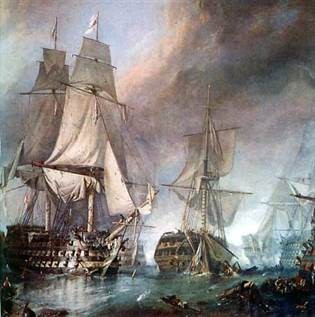
Was the most important British victory of the 19th century Trafalgar or Waterloo?
 Girl's Behavior
  Guy's Behavior
  Flirting
  Dating
  Relationships
  Fashion & Beauty
  Health & Fitness
  Marriage & Weddings
  Shopping & Gifts
  Technology & Internet
  Break Up & Divorce
  Education & Career
  Entertainment & Arts
  Family & Friends
  Food & Beverage
  Hobbies & Leisure
  Other
Other  Religion & Spirituality
  Society & Politics
  Sports
  Travel
  Trending & News


People forget French troops did set foot on British soil a few years previous to Trafalgar. They were hoping to meet up with potential allies up the Bristol channel but bad weather drove them around the corner to Fishguard. Had the commanders kept control the troops wouldn't have got drunk and upset the local women which is never going to end well. A little diplomacy and Napoleon could have found safe port and support.
Once Trafalgar is lost the ability to land in Britain is gone so I think Trafalgar is the turning point and more important. With threat of invasion gone resources can be turned to the battle in Europe.
I would say Trafalgar. It is much easier for armchairs to understand land battles than sea battles especially in the age of sail. Wellington's reverse slope tactic just seems sensible when it is pointed out.
Frankly I am unable to understand the brilliance of Nelson's doctrine. Laying alongside French & Spanish ships and pounding away with a superior British rate of fire (they could get off 3 shots a minute) ... well I miss the brilliance. Both Admirals ditched line astern order of battle in favor of a huddled mass. The French for protection and the British for shock.
Strategically Nelson was fighting for sea power dominance and achieved it, setting up a long period of British dominance and colonial expansion. So i think that was greater.
Waterloo more set up Prussian expansion though it had the definitive boon of well and truly ending the Napoleonic era.
I am mostly thinking this out as I write, so I'd appreciate counter arguments.
If you haven't seen it, I recommend @lightbulb27's opinion.

Commanding the seas critical for British, being an island of fish and chips people. It's all about that navy navy navy. Frankly, that rings true today but maybe is changing more towards space.
If ever people needed to study strategy and math, what an example.
How could there be no ABBA song about Trafalgar?
"Trafalgar... you cut us to pieces at Trafalgar..."
"Trafalgar, knowing you'd lov eme for ever more... whoa whoa whoa..."
No... they sang about Waterloo romance... oh well... here's one view of how it went down.
Sad to think about all this in history, so many died and sufferred. We are quite awful, us band of human "apes"...
https://www.youtube.com/embed/YeyTC9vTtLc I have to say I laughed a lot at the quip that a land of fish and chips people must have command of the sea.
On the nasty side, without taking a moment to fact check, I seem to remember that the pyre at Waterloo burnt for a week fueled by human fat. Nasty. Also Waterloo was a great source of false teeth for the British and lead to the term frenchies for false teeth.
At least they cleaned up the Waterloo battlefield after they were finished playing there. Mostly they didn't back then.
@goaded An interesting point on inverse tactics to land warfare. I found a US naval commander's history which had both sides bunching instead of being line astern. I guess both could be semi true.
It was funny at Jutland that the high seas fleet just turned 180 and steamed away when Britain crossed their T. So much for a few centuries of naval strategy :)
@RavVid I recall a story about the Royal Navy. Around the turn of the 20th century, they'd got so used to being controlled by radio and blindly following orders that, during a manoevre where they should have had two lines of steam ships pass through each other, the captains didn't react to avoid some massive collisions.
Fortunately, we were between wars, at least naval wars, at the time.
@RavVid I aim to make funny quips, thanks!:) although I now question if those "Chips" came from the french...
That's news to me about Waterloo... wow. Unreal to think about the scope of human suffering and death. Makes sense the bodies were used to make fertilizer... what else could they do? War is a racket!
looking at Jutland, looks like Germany won that by numbers and losses, but they must not of had enough to go again...
You succeed in funny quips!
I think the root of Chips is not French but the Old Kiwi word "Chups. That might be too antipodean of me but I like to be sly in my humor.
With Waterloo, people packed a picnic lunch with bottles of wine to spectate! And toured the battle field the next morning. At least some had the grace to vomit from it.
With Jutland my understand is the same. It was a tactical victory but a strategic defeat as they never ventured out again.
@goaded Thank god for the discovery of curry! These battles lead the way to... freeedom... from bland food.
Now that I think of it... thats why "America" was "discovered". Curry! risked life... because food was so boring... and profit.
Everyone just wants to eat good food.
Oddly, I don't meet many French that like spicy food. Note to self... must respect culture and preferences!
won't ask what it took to get those recipes... another story.
Thanks. Looting the dead and dying is sadly traditional. I think it was mostly left up to nature to clean up. Rome sent legions to Teutoburg Forest to bury the bones some years after three legions were massacred by Germans.
I don't know what was most common practice but I'd guess victors would be getting as drunk as they could whilst losers were running as fast as they could. The commander of the winning side could easily have urgent followup tasks to the victory. But burial pits have been found. Maybe it was hit and miss.
@RavVid I like this discussion, educational. Be a really good documentary... as to how these battles end. We never get to see that. Maybe get a painting or photo, but what it look like. Closest maybe "The Pacific" series, where there's mounds of bodies, abusing nearly dead soldiers, but there's no sense of the stench, cleanup and burial duties. That should be shown... maybe then, people more refrain from conflict.
@RavVid here's the video I was thinking of.
I read some WWII pacific..."with the old breed, Peliliu". It was awful...
https://www.youtube.com/watch?v=VamEbP5CQJA
That's the thing you discover when dealing with death... people don't just die from a bullet hit. they lay there... possibly for hours or days.
That may not be as true today with the explosives that make so many holes.
That is quite a brutal video illustrating the savagery of war.
Just to be sure, you know that wounded Japanese soldiers were left with grenades or had grenades wired to them as booby traps? And would falsely surrender to induce our troops to expose themselves?
Our Australian troops were instructed not to accept surrenders if the Japanese troops didn't have open hands. Even though command wanted prisoners, troops were unwilling to accept them till late in the war. The officer in the clip might have said safer rather than easier.
Some of our troops certainly did loot gold teeth in North Africa and on the Kokoda Trail though they might have been unwilling to turn over bodies due to said booby traps. I've read in the Iraq war troops routinely shot outwardly wounded Iraqis to be sure they were safe for the same reason of finding they had a grenade.
Guess we can see savagery begets brutality. In WW1, Australian troops did not appreciate being machined gunned right up till they had jumped into the trenches and did not think it legitimate for German machine gun crews to then put their hands up. Canadian troops did not accept surrenders either.
Civilized war is a thin veneer.
Yes wounded are likely to lie were they fall for hours but hopefully not for days as in WW1. Reputedly military rounds are designed to wound because that takes out two other soldier in carrying the wounded man out.
In Dum Dum India expanding bullets were developed to combat over penetration but they were banned from civilized (European) war. However it seems military rounds are designed to tumble their way through our body making larger wounds which tends to make the dumdum ban moot.
Can't say this is true. Just what have read. It might be difficult to stop a bullet tumbling when it hits a body. Dunno.
For every man killed there have been 2-3 lying wounded till they could be recovered. Hard to find adequate words.
@goaded Indeed. Fish and chips has a claim to be the original fast food but hamburgers, sandwiches and sausages can dispute that claim I guess.
Your comment has given me a realization. Also at the end of the 1800s trains were kicking in and the poorer classes took to day trips like ducks to water. For the first time they could go somewhere nice as an outing.
So there was a need for a cheap fast food! Thank you.

For the British it was trafalgar. Not only did they defeat the entire French navy but also the spainish navy. They would never be challenged again at sea until 1914.
Waterloo was about stopping napoleon, the armies of Europe were descending on France and the French had not the strength they did before the Russian campaign. even if napoleon had defeated the British/Dutch/Germans at waterloo its likely that the French would not have had the strength to defeat the prussians, Russians, Austrians, spainish and Italian cities. Napoleon was not the same man and previous defeats napoleon suffered were far more important.









Opinion
11Opinion

Let's see. There's Nelson's column in Trafalgar Square, London, which I've visited many times. I've never seen a Waterloo square... but there is a monument at Waterloo in Belgium... I've driven by it on the motorway.
I guess that means Trafalgar wins.
Waterloo train station London. There's also a famous Duke of Wellington statue in Glasgow which always has a traffic cone on its head (have a google). There's one in Shrewsbury England, lord hills column. Carmarthen has a large monument to Picton. There's also lots of defensive structures and cannons from the Napoleonic wars along the britsh coast that perhaps serve as better monuments to the war. The sad thing is despite them still being solid most are neglected or just used as storage space
Probably Trafalgar, because otherwise Napoleon had a better chance of winning and there wouldn't have been a Waterloo.
The Battle of the Nile was an important prelude to both, but that was 18th century. Basically, the story of England and the British Empire is a millennium of good luck and being strong in the right thing (probably starting with longbows) in the right place at the right time.
Still a bloody impressive achievement from a small island off the coast of Europe!
Probably Trafalgar. The Trafalgar cemetary at Gibraltar is one of the saddest places I have ever been.

I think Waterloo but I don’t know that much about it

Trafalgar was sort of the beginning of the end for Napoleon and solidified Britain’s position as a naval power. I would rate it slightly higher.
Trafalgar. Waterloo was a land battle; France didn't have the naval power to invade the UK after Trafalgar. Even if Napoleon had won Waterloo, he still couldn't threaten the UK.
Whatever happened to these great militaries of England and France? Now they're just a bunch of chumwaylas
Successive right wing governments kept cutting the military budget and slashing troop numbers to fund tax cuts for the rich. There was also too much emphasis on having two aircraft carriers at the price of several other ships. Being part of nato also means we have to buy stuff from American defence companies as part of the contract which pushes prices up.

Only Trafalgar was truly just a Brittish victory. Waterloo involved much of Europe

Probably.
At least one of the most.

The battle against cholera
sure waterloo
Paved the way for Britain to become a global power
The Treaty of Vienna, which followed Waterloo, gave Britain no territory in Europe, but ceded territorial possessions such as modern-day South Africa and Sri Lanka. These became strategic naval bases that Britain later used to control its vast colonial empire.
Joan of Arc was ultimately executed by the English, but her capture and transfer to their custody were facilitated by internal French divisions. She was captured in 1430 near Compiègne by the Burgundians, a faction allied with the English during the latter part of the Hundred Years’ War. The Burgundians sold her to the English for a sum of 10,000 francs, as requested by Pierre Cauchon, the pro-English Bishop of Beauvais.
The English aimed to discredit Joan by trying her for heresy and witchcraft. Her trial in Rouen was deeply biased, led by French clergy loyal to the English. Despite her strong defense, she was found guilty and burned at the stake in May 1431. Joan's execution was not a direct action by the French crown but rather a consequence of the fractured political landscape of France at the time.
This betrayal reflected the complex alliances within France, where some factions saw Joan as a threat or sought to curry favor with the English. Later, in 1456, Joan was posthumously exonerated in a retrial initiated by Charles VII, solidifying her status as a martyr and a symbol of French unity.
Joan of Arc believed she was guided by divine voices and visions, which she attributed to saints such as St. Michael, St. Catherine, and St. Margaret. These voices began appearing to her around the age of 13 and became central to her mission. They reportedly gave her precise instructions, such as convincing Charles VII to reclaim his throne and leading the French forces to significant victories, including the Siege of Orléans.
Many contemporaries and soldiers were inspired by Joan’s confidence and spiritual certainty, which boosted French morale. While there’s no evidence of supernatural foresight, she demonstrated remarkable intuition and leadership, sometimes appearing to predict battlefield outcomes. For example, her visions reportedly guided her actions before significant victories.
Skeptics, including some modern historians, suggest her experiences might have been influenced by psychological or neurological factors. Nevertheless, her contemporaries, including the church authorities who investigated her, largely accepted her visions as genuine, and her victories were seen by many as evidence of divine support.
Personally I'm an atheist, so I tend to think she must have been pretty psychologically damaged to hear such voices, but I admire her.
@Mettbltt Napoleon's letter to the Ottoman Sultan
"My ambassador informs me of the good conduct and bravery of the Muslims of Constantinople against our common enemies. You have shown yourself a worthy descendant of Selim and Suleiman. You requested a few officers, and I am sending them to you. I regretted that you did not ask for a few thousand men; you only asked for 500, and I immediately ordered their departure. I intend for them to be paid and clothed at my expense, and that you be reimbursed for any costs they might cause you. I have instructed the commander of my troops in Dalmatia to send you weapons, ammunition, and everything you request. I have given the same order in Naples, and cannons and gunners have already been placed at the disposal of the Pasha of Janina. Generals, officers, weapons of all kinds, even money—I place everything at your disposal; you only need to ask. Make your requests clear, and whatever you ask, I will send it to you immediately.
Coordinate with the Shah of Persia, who is also an enemy of the Russians; encourage him to stand firm and to attack our common enemy vigorously.
I have defeated the Russians in a great battle; I captured 75 cannons, 16 flags, and a large number of prisoners. I am eighty leagues ahead of Warsaw, and I will take advantage of the fifteen days of rest I am giving my army to head to Warsaw and receive your ambassador there.
I understand your need for gunners and troops. I had offered them to your ambassador, but he declined, fearing to alarm the sensitivities of the Muslims.
Confide all your needs to me. I am powerful enough and sufficiently interested in your success, both out of friendship and political considerations, to refuse you nothing.
Here, I was offered peace; I was granted all the advantages I could desire. But they wanted me to ratify the state of affairs established between the Porte and Russia by the Treaty of Sistova, and I refused. I replied that absolute independence must be assured to the Porte and that all treaties forced upon it while France was dormant must be revoked."
I say Trafalgar.

You can also add your opinion below!