What do you think caused this mess?
In my view... it's fear and pride... which lead to grasps for control of territory and resources.

What do you think caused this mess?
In my view... it's fear and pride... which lead to grasps for control of territory and resources.


At the most fundamental level, the cause of World War Ii was the collapse of the West's self-confidence in the wake of World War I - even on the side of the victorious powers. That collapse - which exists to the present day - undermine trust in Western values and set the stage both for World War Ii and the Cold War as well.
I is hard for most to imagine in this day and age, but the Western world was supremely confident in itself by the 19th and early 20th centuries. To be sure, there were differences within the Western world - rival nationalisms, etc. However, overall, the Western world was suffused in an ethos that assumed that progress was inevitable and that the world's problems would be, in due course, solved.
Then came World War I. A war begun almost by accident with an assassination and which, once started, no state or combination of states could find a way to end. Where progress had once been assumed, now Western leaders, governments and societies could not figure out how to end what had begun out of their hands.
When the war finally ended in an Allied victory, there was something of a euphoria but it was shallow and Western societies no longer could assume that science and Western culture would lead to inevitable progress. This was true even in the victorious states - see also Italy, one of the victorious Big Five powers.
The Edwardian social model had collapsed and Western cultures and governments now struggled with how to stabilize society, but lacked any convincing model. Into that vacuum came a host of ideologies, notable - but not only - Communism, Fascism and National Socialism (Naziism.)
These ideologies took power and sought to restore the stability and confidence in their countries. These ideologies were, of their nature, aggressive and the states where they dominated began to threaten the peace.
At first the Western democracies lacked the confidence and stability to fight back. States that had marched to war with an almost grim enthusiasm in 1914 now were horrified at the idea of unrelenting slaughter and so sought to appease these new ideologies. The old balance of power and realpolitik went out the window and in their place the Western democracies sought to appease the new ideologies.
Suffice to say, the ideologies - particularly in Germany, Italy and the USSR - continued to push the envelope. Convinced that "History" - with a capital "H" - was on their side. (As an aside, Japan was slightly different. It drew a slightly different conclusion from World War I - convinced that the merging of its' culture with Western methods would bring Japan to an unassailable great power status.)
Suffice to say, the West was pushed to the wall and was finally forced to fight for its' own survival. Thus World War II.
After came the Cold War - and while the some parts of the West seem to be experiencing a post-"Cold" War euphoria, an overconfidence in their own position - overall the West has never recovered from World War I. It remains a culture of enormous accomplishment but deeply uncertain about itself. (Thus, "wokeism" as a recent manifestation - a challenge to Western certitudes.)
To circle back, World War II was a symptom. Its' root causes born of the collapse of the West's self-confidence. Leaving behind a world that, when challenged, found it could not muster the will to save itself until extreme pressures and circumstances forced them into action.
I'd have to hear more about the "loss of confidence". Interesting take.
Thanks. The age of reason and the Enlightenment had instilled in the West a sense that History was manageable. That the human mind was capable of discerning truth and the subsequent technological innovations in almost every dimension of human life - medicine, transportation, etc. - created in the West a supreme self-confidence.
This was further affirmed by the dominance of Western political institutions in the post-Napoleonic era. There had been no major war since 1815. Africa, much of Asia and portions of Latin America were all under European control. The only great powers outside of Europe were Japan - which after it was opened to the West embarked on an adaptation of Western institutions and the USA, an offshoot of Britain.
Taken together, this gave the West, in the late 18th, 19th and early 20th centuries a supreme sense of self-confidence. A belief that History could be managed and progress was inevitable.
Then come World War I, which as I noted was a war that started by accident in a remote Balkan town with the assassination of an Archduke. From there, the war could not be stopped. Leaders on all sides sought to win the war and yet could not - for all their technological and intellectual resources - stop the bloodshed.
In that context, confidence in Western institutions collapsed. This manifesting itself most obviously in the Russian revolution and subsequent civil war where an ancient dynasty was brought down. Even in Italy, one of the Big Five powers, the loss of faith in institutions, notwithstanding victory in the war, led to the rise of Fascism.
CONT.
Suddenly Western democracy looked fragile and imperfect and the restoration of order was dependent on ideologies that derived from theories of man's role as mere instrument of greater forces. With Communism, the dynamics of class war, with Fascism, the corporatist state, with National Socialism, man's perfection would be achieved in the war of the races and victory by he super race.
Suffice to say, the Great Depression also undermined confidence in Western institutions. Thus does the USA enter a period of tumult leading to the New Deal - a reordering of what had been seen as capitalism. Also, came isolationism, which was a desire to withdraw from the world and shield behind two oceans.
This is, in brief, the "big picture" of the tumults that tore the West to pieces and made countries like France - in which the common citizen had yelled "On to Berlin!!!" in 1914 - to go to Munich to hand over Czechoslovakia to the German master race.
It was only when pressed against the wall that the West decided it had to fight back. As one wit put it, "On to Berlin!!" became "Let's just get this over with." Thus the early days of World War II, the early days of the Cold War and the end of the dominance of Western civilization.
WWI (this is important) started because so much of Europe had treaties with other European countries that guaranteed that if one went to war, they would side with that country and declare war themselves. This was supposed to be a deterrent to prevent war, but all it took was one smug politician (Archduke Franz Ferdinand of Austria-Hungary) who got himself assassinated, which (STUPIDLY) led Austria-Hungary to declare war on Servia, which set of a chain reaction of treaty requirements that brought all of Europe to war with each other. Germany didn't start the war - they were brought into it by treaty obligations - but as they were the strongest power by the war's end, the winning side decided to blame the entire war on Germany and to make Germany financially responsible for war reparations - payments that weren't sustainable.
This short-sightedness set up the conditions that destroyed the German economy and allowed a madman like Hitler to come to power. Hitler vowed to end the Treaty of Versailles, which required Germany to pay war reparations and take the blame for the war, and to restore glory to Germany, and because Germany was in such a terrible situation, Germans supported him. Of course, Hitler's personal ambitions were FAR beyond just restoring Germany - Hitler decided that Germany needed to be the biggest and strongest power in Europe, and that they needed room to grow, and if he had to invade other countries and either subjugate them or exterminate them, so be it. Hitler's invasions of his neighbors started the war in Europe.
Japan had already had similar ideas: Japan saw itself as a "superior race" that "deserved" to have control over more territory and more natural resources, and they'd invaded China and south-east Asia, along with many islands in the South Pacific, with the goal of completely owning East Asia, including its many resources and it's foreign trade. This started in the mid 1930s, before Hitler's invasions. Both Germany and Japan had legitimate fear of the USSR, and agreed to support each other in the hopes that this would split the attention of the USSR and reduce their ability to defend themselves from simultaneous attacks from Germany and Japan. If not for this reason, there's no reason to believe that Germany and Japan would have aligned with each other.
The bottom line was simply that both Germany (under Hitler) and Japan decided that they were entitled to other people's land and resources and they were willing to take them by force.
It's essentially the same thought process that Putin had with Ukraine: "I want it, I need it, so I'm going to take it."
Poland getting invaded. As simple as that, Hitler wanted to get his own empire and he tried to do so, others countries were afraid of getting invaded and fighted back.
Opinion
14Opinion
In WW2 asia I guess Japanese imperialism in China and the United States alarm at the growing strength of the Japanese Navy and army.
In WW2 Europe the lack of will from the Polish, French, czechoslovakia, Holland, Belgium and Denmark from stopping the Nazis in multiple occasions namely Hitler taking over czechoslovakia. Czechoslovakia IN 1938 had a very decent modern military of over 1 million men and arms industry with defences on the German boarder yet their government choose not to oppose Germany. By occupying Czechoslovakia, Germany gained 2,175 field cannons, 469 tanks, 500 anti-aircraft artillery pieces, 43,000 machine guns, 1,090,000 military rifles, 114,000 pistols, about a billion rounds of ammunition and three million anti-aircraft shells. This amount of weaponry would be sufficient to arm about half of the then Wehrmacht. Czechoslovak weaponry later played a major part in the German conquests of Poland (1939) and France (1940). If the czechs had fought the French, Polish and Dutch could have invaded Germany. Another example is the French and British doing nothing while Poland was invaded in 1939 waiting for the germans to come to them. Another big one is the Soviets making a deal with Hitler for half of Poland, Latvia, Lithuania, Estonia and Finland instead of joining the allies in 1939 and fighting with the poles against the nazis and with the allies. Instead Hitler was allowed time to carve up Europe country by country until he had enough resources where he was very powerful.
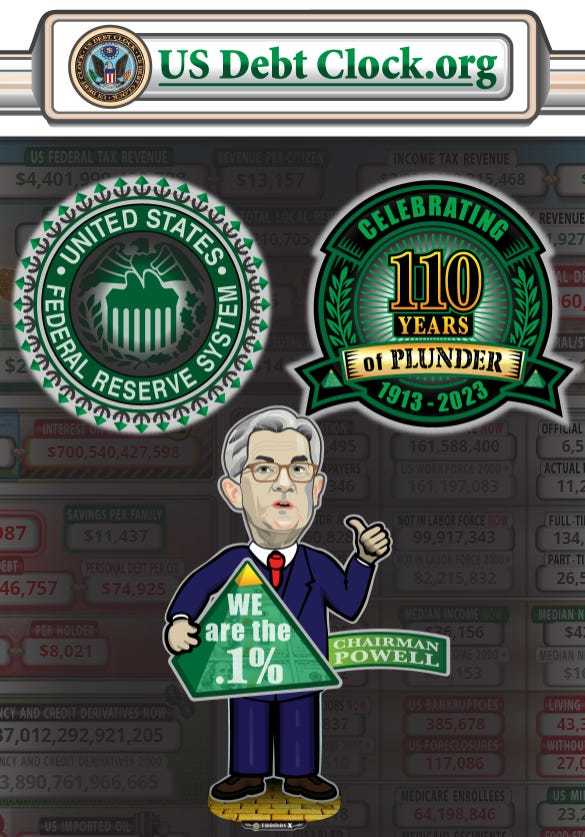
Central bankers being central bankers... The invisible enemy is responsible... That's why everyone gets turned against one another and certain groups get scapegoated... Divide et impera...
Apparent Capital as "Paper" Inductor
In this structure, credit, presented as a pure element called "currency," has the appearance of capital, but is in effect negative capital. Hence, it has the appearance of service, but is in fact, indebtedness or debt. It is therefore an economic inductance instead of an economic capacitance, and if balanced in no other way, will be balanced by the negation of population (war, genocide). The total goods and services represent real capital called the gross national product, and currency may be printed up to this level and still represent economic capacitance; but currency printed beyond this level is subtractive, represents the introduction of economic inductance, and constitutes notes of indebtedness.
War is therefore the balancing of the system by killing the true creditors (the public
which we have taught to exchange true value for inflated currency) and falling back on whatever is left of the resources of nature and regeneration of those resources.
Mr. Rothschild had discovered that currency gave him the power to rearrange the economic structure to his own advantage, to shift economic inductance to those economic positions which would encourage the greatest economic instability and oscillation.
The final key to economic control had to wait until there was sufficient data and high-speed computing equipment to keep close watch on the economic oscillations created by price shocking and excess paper energy credits - paper inductance/inflation.

Essentially the way the Germans were humiliated by the allied forces at the end of WW1. It left a bitter taste for them that was magnified by the Depression and allowed Hitler's twisted view of the Aryan as described by Nietzsche to get into the consciousness of the German people. It laid the foundation for the Holocaust by letting this broken little corporal with a chip on his shoulder put the blame for Germany's suffering onto the Jews as his scapegoats.
I thought it was down to some madman with a funny moustache that wanted to take control of the world.
part of it... but why...
Well Germany did not like having to give up their territory after losing WW1 which only happened because someone shot a Duke, and allies of various countries felt obligated to get involved in. One of those was Germany and they ended up being on the losing side
you stay trolling your ahhhhh
a goofy fr fr
I haven't caught any fish yet...
A lot of reasons. One of which being the you know who’s…
the Nazis of course…
Germany wanted to expand its territory and turn eastern Europe into part of greater Germany.
Japan wanted to expand its empire to get more natural resources
Probably politics and puppet masters
The dirty methods by which Jews were conducting business in Germany.
Hitler wanted to rule the world.
The spread of Nazi occupation into Europe.
Human nature
that's not good cause can repeat.
im not so convinced we've learned anything and possibly, know less than those before us...
Root cause?
Treaty of Versailles
Nationalism.
The only opinion from girls was selected the Most Helpful Opinion, but you can still contribute by sharing an opinion!
You can also add your opinion below!