Does a record on the platter move at the same speed under the stylus on the tonearm from the beginning to the end of the record?

Girl's Behavior
Guy's Behavior
Flirting
Dating
Relationships
Fashion & Beauty
Health & Fitness
Marriage & Weddings
Shopping & Gifts
Technology & Internet
Break Up & Divorce
Education & Career
Entertainment & Arts
Family & Friends
Food & Beverage
Hobbies & Leisure
Other
Religion & Spirituality
Society & Politics
Sports
Travel
Trending & News Does a record on the platter move at the same speed under the stylus on the tonearm from the beginning to the end of the record?


No. Rotation is the same but radios is smaller at inner side of the disc. That's why songs with more high frequencies should be pressed on outer side of a vinyl while songs with less high frequencies on inner side because inside is the travel speed of stylus slower. More speed means more high frequency resolution.
By the way I never owned a turntable but I watch sometimes vids about tone recoding and audio stuff.
The same linear speed? No, the rotation rate is constant but the length of the groove covered in one second decreases as the needle moves closer to the center.
Correct, the answer is the speed stays the same AND it changes. Angular velocity remains constant as the disc spins at the same speed the entire time. But linear velocity of the needle in the groove slows down from the outer edge at the beginning of the recording to the inner edge at the end of the recording because linear velocity changes with the diameter the needle is tracking.
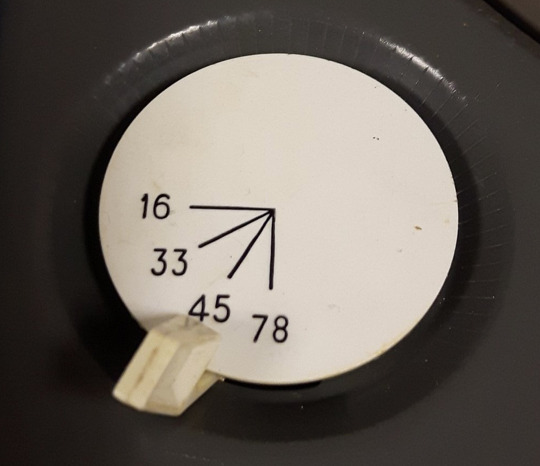
You have to switch the player to the record‘s speed (e. g 45rpm), so the platter itself always has the same speed.
Nope.
Then what is supposed to happen here:
Angular velocity is changed before you set the needle down. You wouldn't change an LP from 33 to 45 or vice versa when the record is playing. Linear velocity changes even with constant angular velocity as the needle tracks from the outside (beginning) of the record the the inside (ending) of the record at any constant angular velocity because the needle is tracking a smaller and smaller diameter as it moves inward. Just something no one ever thinks about.
Yeah, I get that. I understood your question asking about the platter speed, which is like you stated set before playing and then stays the same.
Just trying to see if people differentiated angular and linear velocity going on in a simple turntable spinning a Beatles album while a needle traces a groove.
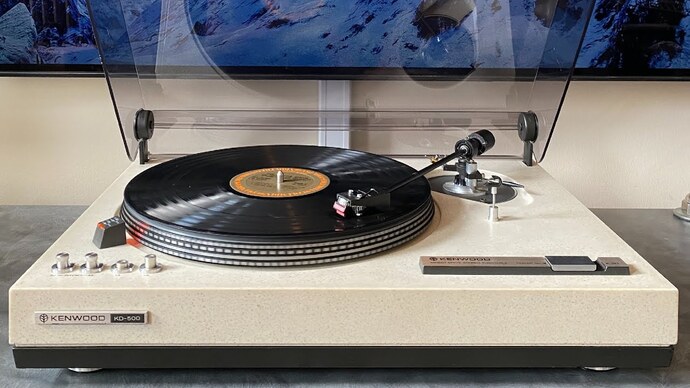
by the way, I've never seen a turntable with a 16 rpm setting. And Even 78 rpm was rare. That's one of my vintage turntables. I have 2 identical KD500's.
16 rpm is almost always speeches or voice recordings. 78 rpm are the very old shellac records (until the 1950s, I think?). Nice hardware you have.
Opinion
3Opinion
No, the rotations per minute are fixed, but it's a lot less far at the centre of the record than the outside.
Correct, the answer is the speed stays the same AND it changes. Angular velocity remains constant as the disc spins at the same speed the entire time. But linear velocity of the needle in the groove slows down from the outer edge at the beginning of the recording to the inner edge at the end of the recording because linear velocity changes with the diameter the needle is tracking.
Yes, of course. The band doesn't play faster towards the end of the record. lol
Actually it slows down.
@OneViewpoint I don’t know how
How to use a turntable?
It better or your record player is fucked
Not even close.
You can also add your opinion below!