There are several common misuses of words and grammar in the English language. In the poll below, (words are listed alphabetically with correct usage shown first) which one bothers you the most? Or maybe nothing does?

There are several common misuses of words and grammar in the English language. In the poll below, (words are listed alphabetically with correct usage shown first) which one bothers you the most? Or maybe nothing does?
Pretty much The New York Times and AP Styleguides.
They are horseshit.
1. The Oxford Comma is a must-have.
2. NASA and DARPA (*) and NARAL any other abbreviations need to be identified as abbreviations and not turned into words.
3. "Internet" (*) should be capitalized when it is used in the context of the World Wide Web. An "internet" may be antiquated a bit, but it is still a technically correct usage since there can be many networks that are interconnected but not part of the World Wide Web.
4. It's two spaces after the end of a sentence. Why? Because if provides typographic redundancy thus lowering the probability of error in communication due to typographical errors of missing end-of-sentence punctuation.
>>> These people should all be fired. Furthermore, the NYT should assert intelligence by being fully independent of the AP's Styleguide.
>>> If I was hiring someone for a job, the interview process will involve questions of grammar. You don't "toe the line" (not "tow the line") on my orthodoxy (which is based on reliability and clarity), you are gone. And, for any internal communication, I want only monospaced (and sans-serif if involving code) fonts with a slashed-zero, clearly different 1 and l and I (unlike this font in which the cap-I and small-L are indistinguishable). All numbers are written as numbers when used in the context of being numbers.
===
(*) Example of how DARPA is written as "Darpa" in the NY Times yet, in the same article, (a book review) they quote others who use the proper DARPA. Also, note the NYT uses "internet" for the Internet.
How an Agency of Oddballs Transformed Modern War and Modern Life
By Fred Kaplan
June 30, 2017
THE IMAGINEERS OF WAR
The Untold History of DARPA, the Pentagon Agency That Changed the World
By Sharon Weinberger
Illustrated. 475 pp. Alfred A. Knopf. $32.50.
Few have heard of the Defense Advanced Research Projects Agency, but this small Pentagon enclave has spawned some of the transformative inventions not just of modern war but of modern life: the Saturn rocket, stealth aircraft, armed drones, biofeedback systems and — biggest of all — the internet.
Yet Darpa has also devised some of the most disastrous fusions of science and war, including Agent Orange (the defoliant that disabled thousands of American troops, as well as untold numbers of civilians, in Vietnam) and myriad other projects that treated the world as a giant laboratory but neglected to notice the people inside. In “The Imagineers of War: The Untold Story of DARPA, the Pentagon Agency That Changed the World,” Sharon Weinberger, an executive editor at Foreign Policy and the author or co-author of two previous books about the military-scientific complex, traces the ups and downs of this agency, with its “mix of geniuses and mediocre bureaucrats” and the “procession of nuts, opportunists and salesmen” who pitched wild ideas and often won contracts to pursue them.
...
(9 total uses of "DARPA"/"Darpa" in this article; 6 being "Darpa".)
Apparently, the countless others who have bitched to the NYT and/or AP have made them smell the coffee. The NYT is back to using "DARPA" in text.
For example, this 2023 article:
www.nytimes.com/.../nasa-nuclear-rocket-darpa.html
Oh man, I get SUPER bothered by words, lmao, even down to the way people say them, but in that case, the more correct it is, the more it probably annoys me. Crisp enunciation make me want to swan dive off the Empire State Building, lmao, people saying the full “-ing” and the end of a word instead the lazier “-in’ “ (talking vs talkin’, etc), and I get homicidal when people say the “-ing” and I can hear the hard G sound at the end. THAT’S SUPPOSED TO BE SILENT!!! Goddamn…. lmao.
This lady Cathie Wood makes my skin crawl when she talks, she pronounces every letter and it drives me up the wall lmfao
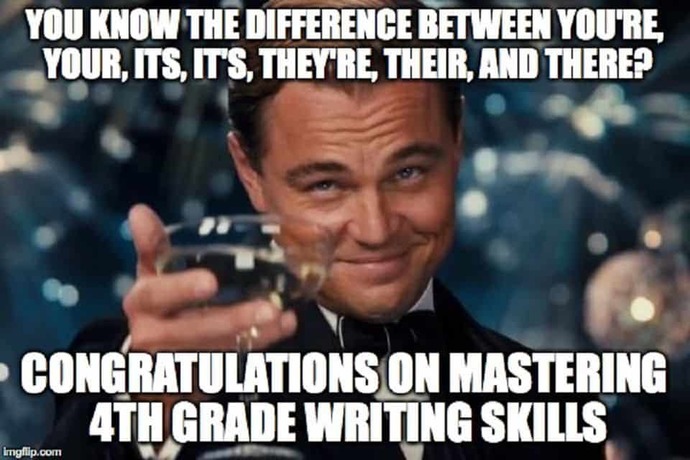
Anyway, that’s the opposite of what you asked😂 My ones that I’m more of a stickler about in the other direction are the standard stuff, just people not knowing very, very basic things like your/you’re, there/they’re/their, knowing that it’s “should have/should’ve” and not “should of”…. like I’m absolutely astounded that words are around us, all day, every day, for our entire lives, yet seemingly no one can consistently fucking spell or use the correct forms of words🤦♂️🤦♂️🤦♂️
Oh, tell you what, just thought of a less obvious answer…. people who say something happened “on accident.” No. NO. Things are “ON purpose” or “BY accident.”
I don't expect people to have good grammar on the Internet. I hate people that do. Not everyone wants to take their time to add punctuation and correct grammar. They just want to speak their mind quickly and move on. Hence why slang text terms and abbreviations were invented
I knew a guy who'd get really upset about bad grammar. I'd put my arms around him and say, "There, their, they're."
The ones that grate me are "where you at" instead of "where are you."
"I treat the dog for fleas" instead of "I treated the dog"
And anyone who thinks the plural of octopus is octopi needs to go back to school.
@purplepoppy everyone knows its octopussies.
@exitseven it's actually octopussys
Opinion
18Opinion
To annoy some people welcome to a proper English sentence. Before was was was, was was is. Until next time.
Oh also It is I and it is me are both correct grammar. Example. Behold, for it is I, the dark, the demon, the consumer of worlds! Vs. Who's there? It is me. Both are correct
"It is me" is not correct English. The verb "to be" is reflexive and cannot take an object, therefore only the nominative form of the first person "I" (not "me") is allowed. But everyone says "It is me", which has become common vernacular, even though it's actually incorrect.
It is me is grammatically correct though. It is more informal than for example this is me or it is I. It is me also is more commonly used in casual speaking or writing. Most writing/thesaurus/English sources also state that it is me is correct grammatically and list several examples as to why.
to jacob, also me is an object, he gave it to me, so better to use as object "it is me" as object by grammar itself.
@strateguy632 of course. My point though is that both versions are grammatically correct
As I - as you meanwhile may know - live in Thailand... I can't be too picky about 'correct English' when I don't want to become a mass murderer :)
So what's left is my distaste for bad spelling.
It's in examples like:
TYRE
TROUSERS
CENTRE
BEHAVIOUR
FIBRE
DIARRHOEA
and such 🤔
People who correct "you're" to "your" in the phrase "you're welcome" since the phrase means "you are welcome".
Also people who can't understand the difference between "there", "they're" and "their"
And simple spelling bugs me. Basically anyone outside the USA using American spellings.
huh? why can't japanese write meter and favor?
Apologies.
American English isn't English. The spellings don't take the root languages into consideration. Consider pronunciation: "I sit on a rough bough of a tree though I thought my chesty cough would be enough - but it's through"... American spellings change "bough" to "bow" in some cases but the spelling is based on the language it's derived from.
Favour, honour, aluminium, etc are just examples of laziness after the rules were set. Shakespeare spelled (not spelt) his own name a dozen different ways and Chaucerian English is something else again. But it's again the root languages.
It's a preference because I'm English I guess and I studied English literature.
what bothers me is when peolle make a fusswhen it is easy to understand.
depite it's has a different meaning it sounds same and is understood. so making a fuss is annoying.
even words in the wrong order, probably due to translation just find the verb.
I hate it when people don't know when to use "your" and "you're", as well as "there", "they're", and "their".
When people don't bother to properly write French words. Cafe. Deja vu. That pisses me off for some reason
the use of "waiting on" instead of "waiting for". Examle "We are waiting on the train". It is confusing and incorrect - you cannot tell if th3e person is ON the train, or is just waiting for it.
I loath it when people say "Could of" instead of "Could have".
"Take for granite"
I have read "a blessing in the skies" or "fully involved in flames". Ugh...
lol Just anyone Leaving Out A word to Complete a Good Sentence. xxoo
Using "of" instead of "have" makes me want to punch that person.
The use of their, they're, or there. People always mess their use up.
People make my head hurt.
Not knowing the difference between their, there, and they're.
I am so used to seeing hatchet jobs regarding the English language that nothing phases me.
In formal writing, all. On a website like this from the list above probably "Your" instead of "You're." "its" and "it's" confuse a lot of people for obvious reasons so I cut some slack there.
Oh dear, I always write "Your're welcomed".🙈 So the correct way to write is "Your welcome"?
Don't be a grammar nazi. As long as it's not a formal paper or research, it doesn't always matter.
People who say "I'm doing good" instead of "I'm doing well" or when they say "I'm done" when they mean "I'm finished"
Oh, and the Oxford comma must be used.
I don't care for the order of your choices. You should have put the incorrect first and the correct choice second. I would understand the choices easier
but mine is peaked vs piqued
They all bother me!
All of the above, except for the first one.
Ahem, these are all examples of correct grammar, except the third one for some reason.
Examples:
Did you went? Does he sleeps?
sounds redundant and we don't speak that way but grammar rules they are correct matching time. in general the rule is must match.
@strateguy632 my mother tongue is not English so I mingle with many people who make that error and do not want to learn.
(in it) on the end of any they say.
Irregardless is not a word.
Actually, "irregardless" IS a word. It didn't used to be but has become so common that it is now recognized as an uncommon synonym of "regardless" in the Oxford dictionary.
It’s a double negative within the word to ultimately mean “regards”. I weep for society and immediately judge those who use it in context. It’s noninexcusabless.
@AviatorTom So now if we don't like a word we can add "ir" as a suffix? Who knew?
@love_conquers_lust Regardless and irregardless are similar to flammable and inflammable, a double negative word pair with the same meaning. Isn't English fun?
You can also add your opinion below!
Most Helpful Opinions