Updates
+1 y
*No one can decide if BEDMAS, PEMDAS or BODMAS is correct.
 Girl's Behavior
  Guy's Behavior
  Flirting
  Dating
  Relationships
  Fashion & Beauty
  Health & Fitness
  Marriage & Weddings
  Shopping & Gifts
  Technology & Internet
  Break Up & Divorce
  Education & Career
  Entertainment & Arts
  Family & Friends
  Food & Beverage
  Hobbies & Leisure
  Other
Other  Religion & Spirituality
  Society & Politics
  Sports
  Travel
  Trending & News



BEDMAS, BODMAS and PEMDAS are all the exact same thing, just different ways of saying it. 'Brackets' are the same as 'parentheses', and 'exponent' is the same as 'order' (also can say 'index' instead which would give BIDMAS, etc), and multiplication and division are the same thing as one is just multiplying by the inverse fraction. Additiona and subtraction are also the same as subtracted is just adding a negative number.
So literally all three of those are correct. As to the actual answer then for the maths problem.
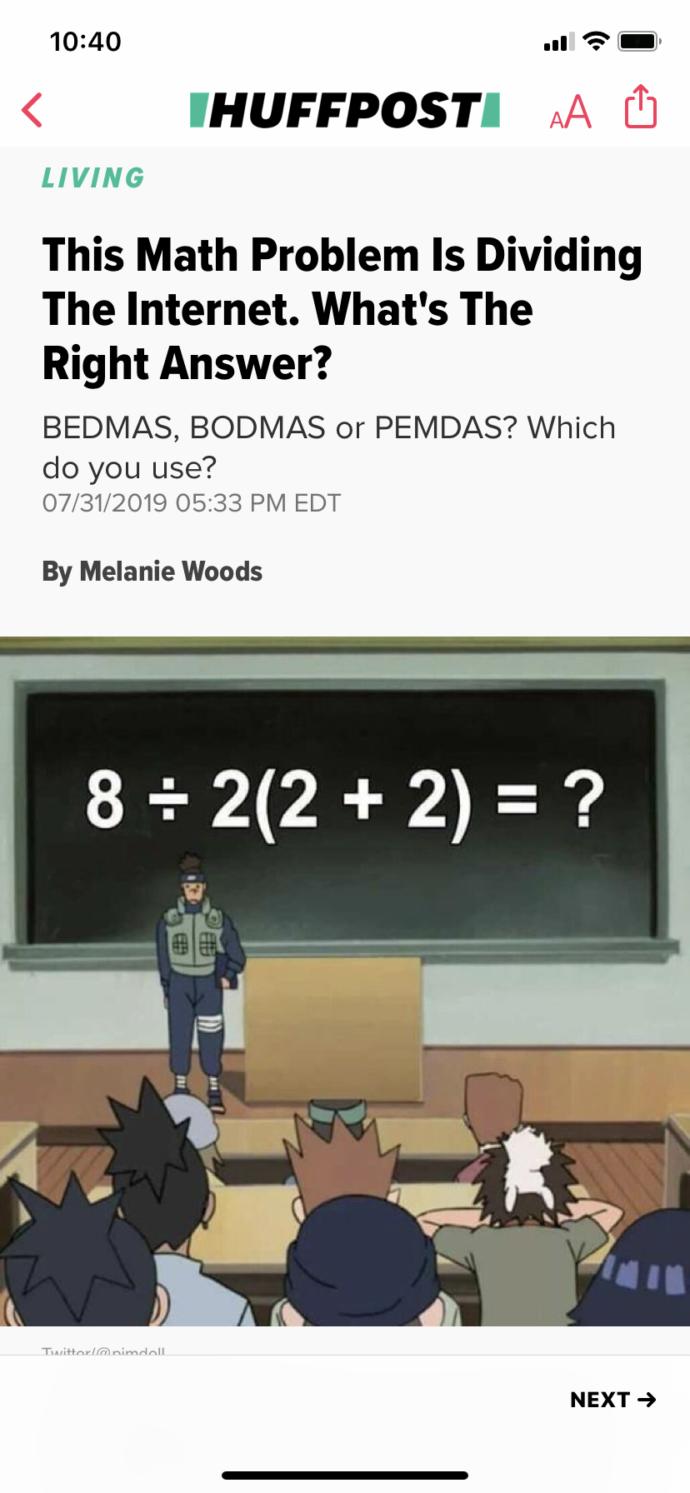
8 / 2(2+2)
You always do the brackets first, so this becomes 8 / 2(4)
2(4) is exactly the same as 2x4 and you can do the multiplication and division at the same time. You work from left to right though, that is always the case when you have the same order of functions, so this has to be 8 / 8.
So the answer is 8 divided by 8 which is 1.
QED.
@WalsallGuy90
😂 the opreration ÷ with no bracket after it, does not treat everything after it as one operand. 8 ÷ 2 (2+2) is not the same as 8 ÷ [2(2 + 2)]
I hope you understand division is inverse of multiplication so ÷ 2 means the multiplicative inverse of 2, call it inv (2)
then try again 😂
@betaTester It's down to how the original question was posed, since it was written specifically as 2(2+2) with no space then it is equivalent to 2*(2+2) so the BOMDAS turns this into 2*4.
There isn't any function stated between the 2 and the (2+2) so they are counted together as one thing, to separate the (2+2) from the 8 / ... you would have to put another set of brackets and rewrite it as (8/2)(2+2) which turns it into a completely different equation.
... but why are you looking at 2 (2 + 2) first? LOL
In this expression 8 ÷ 2 (2+2)
it is fine if you do 2 + 2 = 4, because there is a bracket (...) around 2 + 2
Is there a bracket around 2 (2 + 2) ? No. So you have to look at 8 ÷ 2 (2+2) as 8 ÷ 2 * 4 :)
@betaTester As I said to someone else below, the correct way to write it out is as follows:
8
--------
2(2+2)
That's what the divide sign after the 8 corresponds to. You go left to right so everything after that divide sign is counted as being under the number before it. To avoid that you would have to use correct placement of more brackets to separate it out.
So you interpret 8 ÷ 2 * 4 as 8 ÷ (2 * 4), that's what you think the divide sign after the 8 corresponds to. And that is wrong.
@betaTester But why is it wrong? So far you've not given me any actual mathematical reason as to why it's wrong.
It's wrong because associative law does not work when you mix * and ÷
I gave a mathematical reason in the first line of my first post. You want me to elaborate on why
a ÷ b * c is not the same as a ÷ (b * c ) ? LOL do I have to explain all the algebra of the Field axioms here lmao

I don't do math. Never could. I'm honestly lucky I made it to high school and even luckier I graduated, though I nearly didn't because I failed a special test senior year 3 times. I had three chances to pass it, all of us had to take it. I wasn't the only who failed. I got a certificate of completion but not a diploma. Not until my mom and I signed a petition to have these tests be considered null in void. Senator at the time, Niki Hayley agreed and anyone in the last 30 years which failed them was offered a diploma.
I had my mom try to solve this math problem, without revealing tonher the potential options and she came to the conclusion that any of those answers (all 3 which she came up with on her own) could be right depending on how you work the equation.
I answered the poll before plugging into a calculator..
I used BODMAS at school, I thought you solved the equation inside the brackets first then completed the rest of it? Therefore (in my head) I got the answer of 1, but when I've gone the same equation into a calculator, I got 16.. Maths is so confusing!
Agreed, it is!
I basically a math dyslexic. there is another term for that but following the basic rules i remember all I can figure is the answer is 1. Parenthesis first x 2 divided by 8. Is there really another way this is supposed to work?
The term is discalcula
Yep, I got the same answer. With BODMAS (European teaching), I believe you’d get 16
@loganator9 thank you I was lazy to look up the term
Good question. I guess there are some formulas which change based on geography?
It absolutely would. It may even require learning certain formulas backwards or in a different order
Math is the same everywhere. What is happening here is just a large scale example of people not following the order of operations properly.
First, people are adding brackets around 2(2+2), that isn't there.
Second people are following pemdas or bodmas or whatever exactly, but the rule is PE (MD)(AS) because multiplication and division are of same importance and are evaluated from left to right, so sometimes it is DM and SA, And others it is AS and MD. Or it can be MDSA or DMAS.
Anyone following the rules (and not adding brackets) will get 16, which is also why calculators give you 16.
@kanelives The bracket in 2(2+2) is kept as 2(4). Therefore you must multiply 2 by 4.
Asker, when you plug this into a calculator you will get 16. That is because the bracket in 2(2+2) is only for 2+2. You then have to do 8÷2 before multiplying by the (2+2). Brackets only tell you to do whats inside them first and not outside. Once the inside is done, you go left to right accordingly. What you're saying is you do the inside brackets, then right to left, which is not how it is done. You must multiply 4 by 4, because you do 8÷2 first.
@kanelives Yes. It seems that is what most of us in North America were taught









Opinion
70Opinion
The numbers tell us how many people suck at numbers.
I said 16, many people seem to be turning it into a fraction and that is something I do not understand. When I see an equation like that. I automatically see 8÷2*(2+2), there is no fraction there... so you do parenthesis then left to right... which i can only see as wrong IFF you turn it into a fraction, but I don't see the logic in having 2+2 in the denominator. The 2(2+2) is not 1 term, if it were that would look like this (2(2+2)). The answer is therefore 16. If the person who made the equation says it's 1, then they do not know how to make equations unambiguous to all, and they also don't know how the order works.
No, that is going out of order. Multiplying the 2 into the parenthesis before dividing, is not following the proper order. What you just said was multiply, parenthesis, divide.
Now if you want to try and argue 2*(4) is not multiply then parenthesis because its not in the parenthesis. Then you're still breaking the left to right order of multiplication and division.
If you're saying 2(4) is part of parenthesis step, then you're still wrong because there are no brackets or parenthesis around 2(4), therefore it is not inside any parenthesis and does not go before division.
If, for whatever reason you STILL think I am improperly using PEMDAS, I would like to point you to two links, the first link is exactly how PEMDAS is used, the second link will be a calculator that shows you step by step the proper solution to whatever mathematical equation you input as long as if it is solvable through PEMDAS (no variables).
www.mathsisfun.com/operation-order-pemdas.html
www.mathsisfun.com/.../...ns-order-calculator.html
and because I am a dumbass that doesn't know how links work, I am reposting the 2nd link so that it actually works.
www.mathsisfun.com/.../...ns-order-calculator.html
Im also an engineer, and have done math my entire life, just like you. Mathisfun is what I am using because it has very good visuals. The right order for pemdas is described there perfectly, and I can attest because I read through it. I check what I post. The calculator is also correct, it is you who seems to misunderstand PEMDAS. So can you please explain to me why you are multiplying before dividing when the division is on the left?
I would also like to mention that I am disappointed that you, who claims to be an engineer, is unable to remember elementary level math. You seem to be ignoring the fact that you go from left to right when resolving multiplication and division. Parenthesis only involve what is inside them, so you should not be distributing the 2 before hand as that would mean you're resolving it from right to left rather than left to right.
Either you are looking at sources that are wrong, and therefore not credible so you can't judge mine. Or you are not looking at sources at all to back up your claim, in which case you are not checking your work. Which I most certainly hope you check your work.
If you're an engineer and asking why any calculator would produce that result I highly doubt your university knowledge and it surly shows that you're very naive in the realm of engineering.
1. never trust software
2. the way the function is written causes the string to be parsed in such a way that it believes it is performing 8/(2*(2+2)) rather than as a flat and procedural string. A problem inherent in methods such as shunting yard where an assumption is made due to inability to interpret perfect syntax from idiots who present a software with 8÷2*(2+2). IE: The software is coded on PEMDAS last after it rearranges your function so it is readable to itself.
3. How about you explain to me the order of operations in PEMDAS and what each letter stands for since you're so high and mighty and for whatever reason common sense doesn't work for you.
4. check your shit at the door
@Blightly
1) I agree to never trust software, but there are times when you need to and there are times when statistics tell you to trust software. Such a time is now with the calculator, if you couldn't trust a calculator to properly do an equation as shown above then no one would be using calculators. Every time software gives you a result, you check it to make sure it makes sense at the very least and calculators have always made sense unless I fucked up what I input. They have actually given me the right answer to things 99.999999% of the time when I input an equation properly (to my knowledge). So I will continue to trust that the calculators I have used for years will continue to operate properly until proven otherwise.
2) Except any calculator that is working properly gives you 16 because it takes 8÷2*(2+2) and uses the proper order of operations on it. THE ONLY WAY to get 1 is if it evaluates the equation as 8÷(2*(2+2)). However the calculators are giving you 16, so therefore software is NOT processing it as you claim. So, since the calculator WILL give you 16, it is clearly capable of processing 8÷2*(2+2). If anything it would actually be parsed as (8÷2)*(2+2), which is following the proper order of operations. If calculators were not doing their job properly, then there would be many MANY more malfunctions in every piece of technology we have today. The chance of a calculator malfunctioning is low, and if you were to plug the equation in over 1000 different properly operating calculators, over 95% of them will give you 16. So unless you're saying the software we have today is dysfunctional 95% of the time, you are still in the wrong.
3) I have explained PEMDAS multiple times, in multiple posts including above. But since you still dont understand PEMDAS, and clearly didn't read through the simple to understand links I have sent, I will spell it out for you.
P - INSIDE *NOT OUTSIDE* the Parenthesis first
E - Exponentials Second
MD - multiplication OR *KEY WORD OR* Division, from left to right
AS - Addition OR *KEY WORD OR* Subtraction, from left to right
IF you got the answer as 1, then you broke the order by NOT going from left to right but instead going right to left.
4) You check your shit at the door. You felt the NEED to claim being an engineer to try and establish yourself as better at math than I, without knowing anything about me. To push the point, I never once claimed to be an engineer to try and get someone to trust my knowledge, I always provide evidence and if after the evidence they wish to ignore it then that is on them. You have yet to provide evidence that proves that you followed the order of operations properly and instead opted to only say you're an engineer, which I do not respect. Especially because you were trying to use that to say you are better than me, when you aren't. You still haven't provided evidence as to why you multiply the 2 into the parenthesis first when it is clearly OUTSIDE of the parenthesis.
You can doubt my university knowledge, I doubt it sometimes myself as well.
However I doubt your basic math knowledge, and that is far worse for someone to be doubtful of.
In addition you have spent MUCH more time talking about me and my knowledge than about the problem at hand and providing evidence, so until you provide evidence rather than trying to provoke me further I am done arguing with an adult child who believes they are a true engineer when they are unable to even provide basic evidence to back up their own points. I have already provided you with 2 sources for PEMDAS, you dont accept them but I assure you i read through it and support it fully. You have yet to provide any sources of your claims.
You're totally fulla shit. You're guaranteed not an engineer nor do you understand how calculators are coded. I pulled my engineer card because you gave me some bullshit "fk you" response so I sent you one right back. Take a good look at yourself, get off your high horse, christ.
by the way I gave you adequate information, basically telling you how calculators are coded and why they'd give such a response. It's why you don't feed a calculator garbage like this math equation. What more do you need, other than "Oh i did basic math on it before and it gave me the right answer so therefore this must be right!"? If that is your argument, as an engineer, you've failed. ALWAYS doubt everyone and everything. The software you use will specifically state "We are not responsible for the accuracy of these calculations". If you operate on the basis of "well it worked last time" you're liable to fail a design and potentially hurt someone.
@Blightly lol you're an engineer who doesn't understand basic arithmetic. if you multiply 2 into 2 + 2 you are breaking the associative law. The mental gymnastic about calculator is hilarious. Now try this: what is 8 - 2 + 4 ? do you add before subtract here too?
Your whole reasoning is based on parroting a rule you don't understand, which is what some engineers typically do after the mathematicians taught them the rule.
The answer is 16.
If you get 1, you have some grade school math knowledge, but you have forgotten most of it.
If you get 1, you remember that multiplication comes before addition hence 2*(2+2) but you are forgetting that the actual formula is division AND multiplication comes before addition AND subtraction.
Division and multiplication are of equal precedence, and thus have to use the rule of left to right.
So you have to do 8÷2 first.
That being said, the equation should have been written as (8/2)*(2+2).
Precedence should be written with brackets to avoid precisely this kind of confusion.
If you get 1 and say you are using PEMDAS... you are simply just using PEMDAS wrong.
MDAS doesn't reflect the actual order of operations, it simply stands for multiplication/division and addition/subtraction.
If you had 12-5+10, you wouldn't do 5+10 first and then subtract it from 12, you would do 12-5 and then +10, left to right.
And you do the same thing with ÷ and *, left to right, because they are of equal precedence.
In your example, if you do 5+10 at any point you're doing it wrong anyway. The fact is the function immediately before the 5 is a negative so you should actually be doing -5+10 which is 5.
Think of it as 12-5+10 = (+12)+(-5)+(+10), by splitting it into only addition but replacing any subtractions with adding a negative figure. That way you can rearrange it literally any way you want and you get the same answer every time.
That's all subtraction is, adding a negative number. Just as division is just multiplication except you're multiplying the reciprocal (aka inverse fraction) instead.
Also, 8 / 2(2+2) is NOT the same as (8/2) * (2+2). The positioning of the numbers is important, it is actually equivalent to 8 / (2(2+2)), which is where the answer 1 comes from. People getting 1 as the answer are actually using BODMAS perfectly correctly.
And before anyone starts accusing me of getting it wrong or misreading the equation, please note that I work in a career where I deal with numbers and figures on a daily basis, and I have a BSc Mathematics from a top UK university so when it comes to numbers I generally know my shit :P
@WalsallGuy90 Then I'm afraid you should be fired, because you have gotten 6th grade math wrong.
The 8 / (...) at the start means that everything that comes after it is underneath the dividing line, if you were to write it out on paper rather than use the rather limited text box on an internet forum. Like so:
8
-------
2(2+2)
If that makes sense to you. So you do everything below the line as one section, which gives you:
8
-----
2(2)
which leaves:
8
-----
8
Or rather, 8/8, which is 1. That is basic maths and that is the correct answer.
@WalsallGuy90 That would be correct, if you were taught math 70 years ago.
But not under the current order of operations standards, in which division and multiplication are of equal precedence and are calculated from left to right, as I have outlined in my reply.
The rules of maths don't change. It's not like languages and other things that evolve over time. Once a rule is in place in maths that rule stays, unless it's proven to be untrue. There are five basic axioms that are the initial building blocks of maths: www.aaaknow.com/lessonFull.php
Every theorem, proof, and rule after that stems from those axioms, and layered upon by previously discovered proofs. You're talking about scientific facts. The order of precedence for algebra and formulae come from those axioms and associated proofs, they cannot change.
The order is, always has been, and always will be, Brackets, Index, Division/Multiplication, then Addition/Subtraction, regardless of whether they're left to right or vice versa. That cannot change, it's like saying that 1=1 changed to 1=2 at some point in the past 70 years.
@WalsallGuy90 You can't "prove" order of operations... it's a CONVENTION established in order to eliminate ambiguity in equations, it's not a "fact", it is a tool.
You should really get fired.
It follows from the axioms that I already provided the link to. If you amend the convention then it changes every other aspect of mathematics that uses BODMAS, which means literally every other equation or formula ever conceived. Meaning the entirety of mathematical development from the time of Pythagoras and even before then.
Yes, it's true that this isn't a specific rule with a particular proof. But it is an established notation which is what we have based our entire understanding of maths on. Take E=MC^2 for example. This is fundamental stuff, it describes a scientific law. If we changed BODMAS to now become BDMASO, thus putting order/index at the end, then the formula would now have M*C first, then square the total, which is entirely different to multiplying M by the square of C which is what we originally had. You get a different result just because you've altered the convention used. So what would be the meaning of the scientific formula? Absolutely nothing.
@Kurαȷ
Don't mind him, he's just misunderstanding the associative axiom
a * b * c = (a * b) * c = a * (b * c), this is correct.
In this case this question asks a ÷ b * c and he treated it as a ÷ (b * c ), this contradicts the associativity above because a ÷ b * c = a * (multiplicative inverse of b) * c which is not a * multiplicative inverse of (b * c)
The axioms are consistent and have been that way for thousands of years, they are more than convention: when we do arithmetic about objects in the real world if we want nice things we have to accept these axioms. This guy is not a typical math major, please ignore
He gave a nice link by the way 😂😂😂
I'm not going to waste more time arguing, but please know I don't hold any ill will towards either of you, just getting a bit frustrated with the debate going back and forth. But just so you know, I wasn't using the associative axiom in that, and your explanation of the axiom is spot on so kudos there :)
What I'm getting at is, again, the spacing in the question. The original question posted specifically has 2(2+2) which without any spacing between them and no mathematical function between them ties them together as a divisor for the 8 on the left hand side.
We're all basically getting stuck in our own view of what it should be and no-one's willing to change their mind as we're all hanging on to mathematical concepts that, in all fairness, are correct and valid after we've discussed and ironed out the kinks. The reason for the argument is entirely down to the poor way in which the question was initially phrased by the Asker and the HuffPost article.
Unfortunately pretty much every similar type of question that gets argued about on the internet is also because of the crappy way the question is laid out on the page, I've seen it plenty of times before although not this particular example.
Division has implied parenthesis, always. the answer is 1.
It is 8/[2(2+2)].
PEMDAS is retarded. There is a hierarchy of operations based on the empirical world.
You do not need to, do parenthesis first. For instance. Let's re-write it as follows:
|/[ ( + )].
How many groups can be split into using two groups of ( + )? Well, ( + ) = ...
So, we can have|, ... Thats two groups of four.
Okay, but we were asked to multiply ( + ) by 2. So thats two groups of which is or '8.'
Well, how many groups of can we have of? Well obviously just one, it's... Cause' it's the same thing.
Therefore the answer is 1.
No division does not have implied parenthesis, that's something you just made up. Division is a binary operation, one operand comes before, and one operand comes after.
https://en.wikipedia.org/wiki/Infix_notation
if there is no parenthesis, you don't imagine there is a parenthesis. People who got 1 from 8 / 2 * 4 basically misuses associative rule.
@betaTester I didn't make it up. If you had 8 apples and dvided them into 2(2+2) groups of apples how many would be left?
One group of 8 apples.
The definitions aren't arbitrary. They are based on empirical observation.
Definitions aren't arbitrary, and in this case I don't think you know the definition of division as an arithmetic operation, you are using some belief you've held since grade school since your teacher didn't do a good job of teaching arithmetic.
This is your reasoning:
"Division has implied parenthesis! why?
- Because if I have apples and divided them into 2(2+2) groups, I have one group!
Why do I divide 8 apples into 2(2+2) groups?
- Because division has implied parenthesis!"
If this is your empiricism, it's astonishingly bad. Suppose the question is 8 - 2 + 4 instead, do you look at that expression and ask yourself: if I have 8 apple and take away 2 + 4 apples how many are left? you're tricking yourself into the wrong answer by asking the wrong question.
I will try to guide you to the right path:
You look at the question, 8 : 2(2+2), what do you see?
You see three operands 8 , 2 and (2 + 2) and two operators of equal precedence: the division ":" and the multiplication "*" , multiplication was implied by placing 2 next to (2 + 2). I hope you can get to the right answer of what is 8 : 2*4 from here. If not you can google it.
If you think this is the same as a division, you're making the same mistake as thinking 8 - 2 + 4 as a subtraction. Mixed operations of the equal precedence doesn't work like that. The reason is based on a simple empirical observation (or just common sense), if multiplication followed by division is counted as a division as a whole, then they are effectively not of equal precedence, you are always doing the multiplication first, when you just defined them to be of equal precedence. And your whole system is contradictory.
@betaTester We're not disagreeing. Division is of equal presidence to multiplication.
Division and multiplication are the same thing.
If you wrote 8 - 2 + 4 then it would need to be specified which operation you want done first in order to accurately describe what you are intending. It's an ambiguous statement and it's the reason parentheses were invented. Either you mean (8-2) + 4 or 8 - (2+4).
Division is just multiplication by a quantity that is not an integer.
Parentheses are invented to give priority to a group of expressions that would normally have lower precedence. If there is no parenthesis, operations of equal precedence are carried out from left to right.
8 : 2 * 4 = 4 * 4 = 16.
8 - 2 + 4 = 6 + 4 = 10.
Every computational engine follows this rule (google, wolfram alpha, your personal calculator etc) because it's the most obvious and effective convention, and it is one of the rules for order of arithmetic operations. If you don't know order of operations, expressions such as 8 - 2 + 4 is ambiguous, but order of operations is taught in like first grade or something, it shouldn't be ambiguous to most people I hope.
I'm glad you think we're agreeing lol I think most of what you wrote thus far are just wrong. e. g. "Division has implied parenthesis", "the answer is 1", "Division is just multiplication by a quantity that is not an integer" (try divide 2 by 1/2) etc.
Division is the multiplication by the inverse (if the inverse exists, otherwise division doesn't make sense like division by zero). The inverse is defined from group axioms en.wikipedia.org/.../Group_(mathematics)
All of these concepts have very good reasons to be defined that way, few hundred years full of good reasons.
@betaTester Touche on division by non integers.
Though, I don't like the left to right convention. in my opinion, it should always be specified exactly what is meant.

It's 1. Parentheses has priority first. Then comes the multiplication, followed by the division. Thus 2 plus 2 makes 4 in the parentheses. Then 4 is multiplied by 2 which makes 8. When there are a number placed outside directly next to a set of parentheses this becomes multiplication. Lastly 8 is divided by 8 which results in 1.
Since there is no space between the 2 and ( they are the same term hench belong below the division line which make the only correct answer 1. With space it would have been 16.
Right. So that bracket - 2(2+2) - implies multiplication, and we get 8/8.
This makes me sad when people post these. Listen you guys suck at math, but it's not your fault.
They wrote the question as poorly as possible
A division sign is the same thing as a the split between the top and bottom of a fraction.
It should be written like this :
8 8 8
--------- = -------- OR -------
2(2+2) 2(4) (4+4)
The brackets or parentheses can be have to number outside be distributed to the contents inside through multiplication or just complete what's inside the parentheses. Either is equivalent.
TL;DR
Its 1, the division sign is what fucks all these problems up. Its essentially a poorly written fraction, and people can't recognize it bec the person who wrote it doenst grasp it either.
lol people suck at math because you are using a wrong definition of '/' sure, at least learn how to use google to see what the convention is. Literally type 8/2*4 and see if it treats that expression as 8/(2*4), or just use your brain, if '/' means to denote fraction, what is the point of the parentheses in inline expressions such as 8/(2*4)?
At least you're not as bad as those who misusing the associative axiom.
The specific way of writing is so the computer program, whether it be a calculator or search engine, understands your intent. The issue with these problems is the person who wrote them articulates them poorly.
The point of the brackets is to specify what the writer's intent was.
My point still stand that these are poorly written, which leads to misunderstanding and the wrong answers.
Go on a website calculator like "derivatives calculator" and you can see what it thinks your trying to say, as you type, according to how it was programmed.
"Which is common practice for higher level math."
lol made me laugh, you obviously have never done any math higher than pre calculus.
Unless you can give me one example from a mathematics journal within the last 20 years where the order of arithmetic operations is affect by SPACING between NUMBERS, I'm just gonna assume this argument is the usual mental gymnastics used by people who couldn't do basic arithmetic properly. I wouldn't bother replying to stupid people but stupid people who think other people suck at math for not knowing some made up convention is the most hilarious.
Here's what I've noticed, the people who got 1 tend to disagree on how they got to the result (you said it's the spacing, some other guy said it's PEMDAS, the asker actually believes the bracket affects numbers outside of it...). The people who got 16 actually can explain the result properly and all agree with each other. See
Simple Math Quiz? ↗
There is no need to reply until you have found one publication in a "high level math" journal that use your convention, in which order of operations is affected by spacing between numbers 😂😂
yeah I am super mad about some random dude on the internet who can't do basic arithmetic and can't learn when he's shown to be wrong lol real mad. The flat earth people also think like you, they know they are right, they just can't explain it better :)
Deep breath buddy, if you keep making person attacks instead sound arguments it doesn't help you.
You do realize my initial point was that the equation is poorly written. Which leads to different interpretations of what was being asked.
Then I started that if we followed common practice after you wouldn't use the "÷" symbol because it leads to these problems. Instead it would be substituted for the "/" symbol. Making this a fraction. This common place convention starts at Algerbra and is used as far as I've gone.
And again the spacing and brackets matter due to how a calculator or search engine are programmed to receive the data.
Friend if your getting upset I'll step away, this wasn't an argument to begin with and you won't get a rise out of me with some so pointless.
I agree it's a poorly written question and it also exposes weakness in basic math. There are numbers, operations and brackets between them. Spacing is not an arithmetic operation, when you placed two algebraic expressions next to each other it is agreed that there's a multiplication between them. People who understand these things don't imagine any extra rule aside from the usual order of operations. Didn't they teach you not to make extra assumptions when doing anything in STEM? this is exactly how all the people who got 16 agreed on the method, while the people who got 1 each have their own misunderstandings coming from their assumptions.
Your initial point is people suck at math and you have an explanation since you know something people don't, then you keep going on and on about this division sign making this whole expression a fraction, which is so funny, it's just some self imposed rule. Like I said I'm willing to accept it if you at least have some proof (a document with official rules) that this is how "/" must behave before making such claim about other people (lol). But as long as you understand that division (by nonzero number) is a binary operation you should already know that this is nonsense. Just having "/" between two operands does not make the whole expression a fraction, the same way having "*" between two operands does not make the whole expression a product. This is what I expect an elementary school student to understand.
You also claim spacing matters in "search engine, calculator". Like I said in my first post, test it out with your search engine: try googling on 8 / 2*4 vs 8 / 2 * 4 vs 8/2 * 4 , use any spacing you like, they are all parsed the same way. Try Wolfram too. Those are the two most widely acknowledged online calculators. This should dispel both of your misunderstandings (about the fraction and about spacing).
If you keep arguing against proofs that contradict your claims and can't provide any evidence for your claim, I'm saying that's the same principle of people who believe the earth is flat. There is nothing personal about that. Also what's with this obsession about how I feel lmao whether I'm mad or just laughing at you shouldn't matter, you should read the content of what I wrote and treat this as a learning opportunity.

No matter if it's PEMDAS, BEDMAS or BODMAS (which I was taught in school), whatever is in brackets must be solved first. That goes for all the rules. The P in PEDMAS stands for parentheses (which is the same thing as a round bracket). And the B in BEDMAS and BODMAS stands for brackets. So keeping that in mind, 8/2(2+2) becomes 8/2(4). From there it's very simple, it's 8/8 and so the answer is 1. It's 8 divided by 2(4). Now keep in mind that division usually comes before multiplication which is then followed by addition and then subtraction. But that has to be in brackets to be viable. The 8/2 is not in brackets and so the division doesn't come first in this case. A simple search on your calculator will give the answer '1'. And a calculator strictly follows the order of operations. Now if the question was (8/2)(2+2) now that would be an entirely different case. Then in that case the answer would be 16. But not in this case.
I think 16 bit I'm not sure. I think when a number is next to numbers in brackets like that it means to multiply the sum in the brackets by the number before it.
So it means 8÷2 = 4 × 4 = 16.
But then I'm not sure if it means 8 ÷ 8 which is 1.
So I don't know

In the US, I’ve used PEMDAS, so the answer for me would be 8/2(2+2)= 1
Exactly. In Canada we’re taught BEDMAS which gives you the same answer
How is it dividing the internet?
8/(2(2+2))
8/(2(4))
8/8
1
Yep I got the same answer. It’s because people can’t agree if BEDMAS, PEMDAS or BODMAS is correct
Somehow people are getting 16
@kanelives The equation inside the original brackets - 2(2+2) - becomes 2(4) which now has to be multiplied because the bracket implies multiplication. So we get 8/8
I should also mention that the 'bracket' you might be referring to is not there. what blutwolfe wrote is correct, EXCEPT he did not write the equation in the picture. The equation in the picture is
8/2(2+2) and not
8/(2(2+2))
The picture's equation is 16, blutwolfe's equation is 1.
@kanelives In both BEDMAS and PEMDAS, brackets and parentheses come first. Therefore, you must first solve whatever is inside and directly outside the brackets/parentheses in order to get rid of the brackets/parentheses before moving on to EDMAS or EMDAS.
www.mathsisfun.com/operation-order-pemdas.html
Should explain it better than I can here.
www.mathsisfun.com/.../...ns-order-calculator.html
Should be even easier...

Order of operations. BEDMAS or PEMDAS. Either way, parentheses first, no exponents so here it would be division and multiplication, which are equal level, left to right.
Spelled out, it is:
8 divided by 2 times (2+2) =
8 divided by 2 times 4 =
4 times 4 = 16.
Many people get confused by 2(2+2). It is shorthand for 2 times (2+2). Many treat is like they would 2x. It is not the same thing.

The answer is 1 and anyone who disagrees is simply wrong.
Hereby retracted.
Please don't like this opinion. It is wrong. Thank you.
Well, it’s generally correct if you’re Canadian or American.
How does it make a difference where you're from? Those acronyms are just different ways of saying the same thing. Doesn't change the math of it.
No it can be right.
The symbols on this problem are incorrect.
(8/2)(2+2) is 16
8/(2(2+2)) is 1
8/2(2+2) is dependent
8/2 (2+2) is 16 because the space indicates the (2+2) isn't on the bottom of the fraction.
However as it is dependent on who reads it the (2+2) could be on top or on the bottom of the fraction.
It makes a difference because evidently we’re all taught the formulae differently (based on the localized common understanding of each formula)

Parenthesis, Exponents, Multiplication, Division, Addition, and Subtraction.
P. E. M. D. A. S people, this is EASY!
8/2(2+2)=
8/2(4)=
8/8=
1

1 with 16 a strong second place - depends on how "strictly" the solver wants to stick to their math abbreviations, etc. A second, and possible third- set of parens would have delineated the proposed solution order much more than speculation and knowledge of math abbreviations.
2+2 is in the parentheses. Add that up first. 2+2=4. 8/2 is the first operation going from left to right. 8/2=4. Now, let's multiply the sum of 2+2 and the quotient of 8/2 since a number next to the parentheses means multiplication. 4(4)=16. Also, in relation to PEMDAS, multiplication and division don't come before or after each other.
8/2*(2+2)
8/4+4
2+4
6
This is a way u haven’t even considered😛
But it’s wrong
Because 16 is correct and my calculator approves of it too lol
4*(2+2)
8+8=16
Or
4*(4)=16
Or
8/2*4=16
Or
8/2*4/1= 8/2 *8/2=64/4=16
Or 16/2+16/2=32/2=16
Uh... no, it's 1.
Yes, you go left to right, and if you calculator is telling you 16, then you're inputting it incorrectly is all that matters.

it doesn't matter what you call it. Parentheses (pedmas) and brackets (bodmas/bedmas) are the same thing and you always do those first. so if you solve the brackets first, you got 8 and then you devide that by 8 and you get one.

8÷2(2+2)
(2+2)=4
8÷2=4
4×4= 16
PEMDAS = Parentheses Exponents Multiplication Division Addition Subtraction
With the multiplication and division you do what comes first. With the addition and subtraction you do what comes first.
But you have to keep the brackets. So 8/2(2+2) becomes 8/2(4), and those brackets imply multiplication. So you have to multiply 2 by (4) and you get 8/8.
^=divide in most shown below
8^2^4=1
*
8^2(2+2)=16
^
If you look there is no addition multiplication subtraction or division.
so 8^24=3
(24 because 2+2 equals 4 so adding it up and taking away the ( --------- ) leaves you with 24)
I don't know im bad at math
It's 16. Solve the parenthesis then go right to left.
@blutwolfe Agreed. I’m from Canada and in high school they taught us BEDMAS, meaning you start with brackets.
8/2(4) becomes 8/8 because the (4) bracket disappears. Thus, 8/8=1!
Yes - brackets are a priority, so you multiply the number inside the bracket (4) by the number next to the bracket (2). Leaves you with 8/8. But I get what you mean about division being first. Were you taught BEDMAS or BODMAS?
@asker the multiplication isn't in the brackets, and thanks for correcting my rusty English by the way, its outside them. I know it sounds weird because you should be able to multiply 2(2+2) and get the same result, but in that case in specific, that does not apply hence there is an "invisible" multiplication before the brackets and you do the + first, meaning you will get a group of 1 number where the brackets aren't necessary anymore, meaning you have 8/2*4 in reality. I'm not sure which system, sry.
I have no idea how people get anything out of it besides 1...

Um... only PEMDAS is actually... you know... correct, so... I don't know why this other shit is even mentioned, whatever it is.
So, the answer is 1.
@6lacier Then why would they yield different results? Do they not yield different results? Is the answer still 1, with those other formulas?
@6lacier Yes, you go left to right, and if you calculator is telling you 16, then you're inputting it incorrectly is all that matters.
@6lacier The 2 is multiplied to the parenthesis first, no? Now I'm doubting myself. I know you go left-to-right and it's in order, but I thought the 2 should be multiplied to the other 2 first... and now I'm not as sure... hmmm...
@6lacier Well right, that's what we're talking about here-- the order of operations. What I'm saying is that I thought that the multiplication of the integer directly next to a parenthesis happens before the rest of the left-to-right of the same operation.
@Blightly PEMDAS, BEDMAS, and BODMAS are all the same exact thing, just a different word. the O -i assume- is order, DM and MD doesn't matter because it goes left to right first and I am fairly certain anyone who learns BEDMAS, BODMAS, and PEMDAS learned that. Same would be said for AS or SA. Now if someone claims they didn't learn that it goes from left to right for MD and AS... then they just forgot that part of the order of operations for whatever reason, may it be not using it in so long or because of other reasons.
The answer is one OR the person that wrote the sequence wrote it wrong
For that to be 16 it should have been written (2+2)*8/2
8/2*(2+2). 2*(2+2) would all be part of the denominator

I believe you solve from within the parenthesis first (2+2)=4 2x4 = 8 and 8/8 equals one
I'm doing a maths degree at university
2(2+2)/8 = 1
Brackets come first
2(4)/8 = 1
Then it doesn't matter which order you do the rest in.
@A-man-22
8÷2(2+2)
(2+2) = 4
8÷2=4
4(4) = 16
It's written incorrectly, compared to the mathematical standard.
I know that's what it's trying to say now but in proper notation
It should be:
8(2+2) 8
---------- not ------(2+2)
2 2
(Hopefully gag, doesn't ruin that format)
Division should come as late as possible when writing mathematics in text.
I was always thought , do what was in brackets first , 2 + 2 = 4 then times by 2 = 8, 8/8 = 1
Brackets are these [ ]
Parentheses are these ( )
PEMDAS = Parentheses Exponents Multiplication Division Addition Subtraction
With the multiplication and division you do what comes first. With the addition and subtraction you do what comes first.

The problem here are the parenthesis or brackets, whichever you prefer.
Whomever you ask they will agree that you first add the number in the brackets. Then Satan shows himself, confusing people with implicit multiplication.

the absolute state of western math education in this thread 🤦♂️😂😂😂
yo, can someone explain how tf you get 1 from PEMDAS
8 ÷ 2 (2+2) = 8 ÷ 2 * 4
Now at this point clearly ÷ and * should have equal priority so you do it from left to right. This makes sense intuitively as they are just inverse of each other.
so it's 4 * 4 = 16
I even went and look up this stupid mnemonic rule at a website for kids
www.mathsisfun.com/operation-order-pemdas.html
this is PEMDAS right? and it says
"Divide and Multiply rank equally (and go left to right)."
same as I wrote above 😂. Try wikipedia too.
What kind of parrots do you have to be to interpret PEMDAS as "multiplication before division" holy shit
Okay, there is 'probably' a way to do your mental gymnastics and juggle around the field axioms to force the answer to be 1:
The convention from older scientific literature. Apparently there was a convention back from Feynman's time when they were typing equations with typewriters, it says: when multiplication is denoted by simply placing symbols next to each other (like 2x), it would take priority over division. But this case doesn't even look like that. To apply this rule you need to let x = 2 + 2, and rewrite the expression into 8 ÷ 2x
Basically you need to invoke an extra rule that likely nobody who voted 1 even knew about 😂
All this could've been avoided if they simply add one more bracket 😂
You’re European (my guess in British), right? North Americans were taught BEDMAS and PEMDAS differently, which is why every Canadian and American I’ve talked to has gotten 1.
Differently? Can you link 1 source that has the PEMDAS/BEDMAS rule that NA people were taught? I feel like I'm being meme'd when I read some of the answers to this question 😂
I don’t have a link, but we were taught that the priority is to get rid of the brackets first.
That is basically what everyone was taught,
In this case 8 ÷ 2 (2+2) = 8 ÷ 2 * 4
what do you do next?
Where did your brackets go? It’s 8/2(4). Then you solve 2x4. Then 8/8=1
You solve 2(4)* to get 8.
The bracket means you carry out the operation INSIDE the bracket first. What is the operation inside (4) ? nothing. So the bracket does nothing there.
In 8 ÷ 2 * (4) you solve 2 * (4) first when there is a bracket around 2 * (4). BUT there isn't. So you have to go from left to right. I leave the bracket there so you are comfortable :)
Ok. But we were taught that 2(2+2) becomes 2(4) and we need to get rid of the bracket. And that bracket implies multiplication, so we multiply and get 8
I don't think that's what your teacher meant by "get rid of the bracket" lol. You got rid of the bracket after you did 2 + 2. The bracket implies you do the computation INSIDE it first, then you have a simple term...
Do you think the bracket (...) affects the number outside of it?
The expression is 8 ÷ 2 * (4) but for some reason you only look at 2 * (4), why?
Please tell me why you choose to focus on 2 * (4) first when you look at 8 ÷ 2 * (4)
You see the difference between 8 ÷ 2 * (4) and 8 ÷ (2 * 4) right?
This is a very weird to me. I don't think it's an issue with PEMDAS or whatever rule they used.
Try this:
How do you get rid of the bracket in
8 - 2 + (2 + 2) ?
In that case, I wouldn’t keep the bracket once the equation inside the bracket has been solved (because the bracket is not next to a number). So:
8 - 2 + (2+2)
8 - 2 + 4
8 - 6 = 2
Yup you are wrong here too. The exact same mistake the people who got 1 made. Try google it. I think I can fix your issue but not sure if it's worth my time tbh
PEMDAS = Parentheses Exponents Multiplication Division Addition Subtraction
With the multiplication and division you do what comes first. With the addition and subtraction you do what comes first.
The order of operations used throughout mathematics, science, technology and many computer programming languages is expressed here:
exponentiation and root extraction
multiplication and division
addition and subtraction
wikipedia. org/wiki/Order_of_operations
Depends on the order of operations you follow. But the correct answer is either 1 or 16, again, depending on your process.
The rule is you do ( ) before you do before you do multiplication and division so after after the first step you have 8/2(4) or 8/2x4. That's a bit ambigious and might = 16; but, the way it written, do the division last = 1.
Should be 16... Parenthesis first, 8 ÷ 2(4), there is an assumed multiplication sign between the two and the parenthesis, but there is a division sign to the left of it, so you do the division first and are left with 4 * 4 = 16
According to an Oxford professor, it can be 1 or 16. Both make sense depending on where you start.
All three Bedmas, Pemdas, Bodmas are the same thing.
Essentially they state the same thing as brackets/parenthesis first, then multiply/divide and add/subtract are both interchangeable.
Either you go for the bracket or start at the left and go right.
Brackets are these [ ]
Parentheses are these ( )
PEMDAS = Parentheses Exponents Multiplication Division Addition Subtraction
With the multiplication and division you do what comes first. With the addition and subtraction you do what comes first.
Clearly the answer is on the wall
Its?
And fighting with friendship... it solve everything in the end
Answer is 1.
PEMDAS, where parenthesis (P) is first.

I have faith in my then maths teacher's classes, I got 16.

Amazing that people can't figure this out. The obvious answer is
ORANGE MAN BAD.
Trump?
Yeah, he's the answer for everything, or so Americans on the left say.

I'm gonna go with 16.
8/2(2+2)
4(2+2)
4(4)
16
No bully, Nagatoro. I'm just trying to draw here.
It's 16.
First the paranthesis. Then the division before the multiplication (left before right).

No one can decide? I think we all just picked a side.
Yeah the internet is going "crazy" over basic maths... ahhhhhhhhhhhhhhhhh

It's not a math problem, it's a communication problem and about thought clarity.

1,16
I originally did 16 but can see how you get 1 as well

Isn't the rule that you have to go from left to right when dealing with multiplication/division? If so, it would be 16.

The statement is ambiguous. Hence both 1 & 16 are. correct. I would never right that statement like that.
*write that statement* ooops.
Exactly, because you can't write the division line in text the parenthesis become more important. Assuming the person who wrote the equation knew anything about math, they would have used extra parenthesis. They would have done the same thing with /. If it were 8/2(2+2) it is still 16 because you do not put (2+2) on the bottom unless it is 8/[2(2+2)]. But those outer brackets aren't there. So it is 16.

In this specific case: Other … the correct answer: ' x ' :D
Isn't it 8? You do the numbers in parenthesis first, then divide.
@morimeme1 Right, you always divide first. But isn't it 20 in that case?
@morimeme1 Oh yeah, you're right, my mistake! Math never was my strong suit :P
Division doesn't come before multiplication. They are equal stance left-to-right.
BEDMAS, PEMDAS and BODMAS all say the same thing, because they're all the same order of operations. Therefore they are all correct and there's only one right answer--not multiple possible answers.

I voted B, then saw you mentioned "PEMDAS" in your update and noticed I was wrong. DAMN IT!!!

The answer is that their mathematical notation sucks.

It only divides the math illiterate from the proficient. This is elementary school level algebra.
It has nothing to do with being math “illiterate”, haha. It has to do with where you are in the world and what you were taught in school.
If you were not taught math properly in school, you are math illiterate. Either you know how to solve the problem correct, or you don't. Where you learned to do it wrong is irrelevant.
Mathematics is representation tell us what the numbers represent and we can form our conjecture in the proper context. Bedmas pemdas semantics.
8 ÷ 2(2+2) = 8÷2(4) = 8÷8 = 1
So yeah, 1 it is😂

I use BEDMAS. So 1 would be correct.

1 because if you follow proper math you would do the (2+2) first and then multiply the parentheses by 2 which would be 7 and then 8÷8 = 1
where does your 7 come from?
The answer is 16. Generally, math has no multiple choice answers, just a single solution.

Answer is obviously 1

The answer is 16 honestly I think the internet is full of fortniters

1. Bodmas. 2+2=4. 2x4=8. 8/8=1
You can also add your opinion below!



























Most Helpful Opinions