 Girl's Behavior
  Guy's Behavior
  Flirting
  Dating
  Relationships
  Fashion & Beauty
  Health & Fitness
  Marriage & Weddings
  Shopping & Gifts
  Technology & Internet
  Break Up & Divorce
  Education & Career
  Entertainment & Arts
  Family & Friends
  Food & Beverage
  Hobbies & Leisure
  Other
Other  Religion & Spirituality
  Society & Politics
  Sports
  Travel
  Trending & News


First, your pet might not even need CPR. Your pet might just need to be heimleched or given a sharp blow between the shoulder blades.
If your pet is choking, lift its back legs like a wheelbarrow and see if the object falls out. If it does not, heimlech your pet by compressing its abdomen together like in the picture shown. If you can see the object, hold your dogs jaw open and gently take the object out. But be careful. Your dog will probably be scared and may bite you. A sharp blow between your dogs shoulder blades may even do the trick.
With a small dog or a cat, use just one arm to heimlech it.
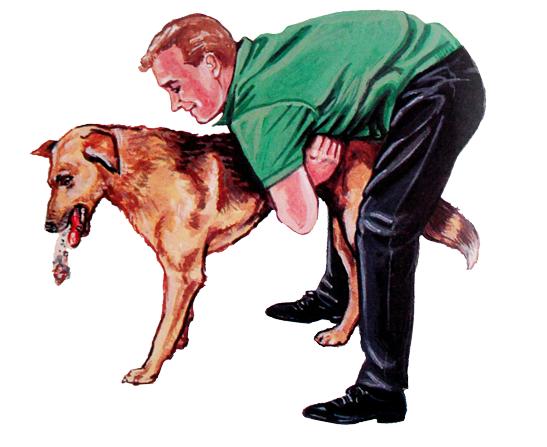
If at all possible, call a vets hospital before performing CPR but do not wait too long to start CPR. If your pet needs CPR, you need to begin compressions within ten minutes. If CPR doesn't start within ten minutes, the brain doesn't have enough oxygen to continue living. And of course, do not do CPR on an animal that doesn't need it. If your dog is not breathing, here is what need to be done. CPR for dogs and humans are similar, but they are life changing differences.

First check to make sure your pet is not breathing. If you are sure your dog is not breathing, you need to first lay your dog on his/her right side. Interlace your fingers and place your hand over the widest part of the ribcage, not over the heart.
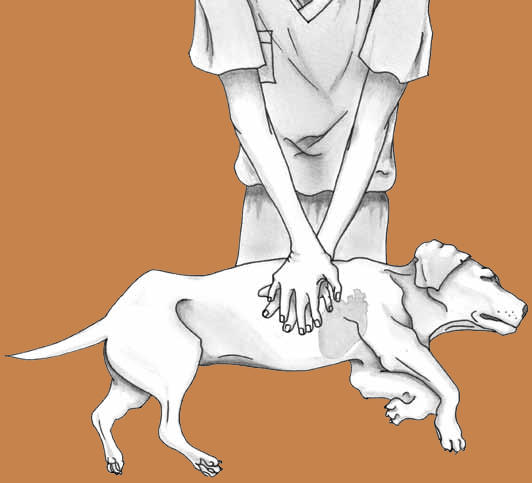
Start compressions. Compressions need to be fast enough that you are giving 100 or 120 compressions per minute. Each compression needs to go 1/4 to a 1/3 of the way through your pets chest. For a small dog or cat, give five compressions for every one breath you give. For a medium or large dog, give ten compressions for every one breath you give.
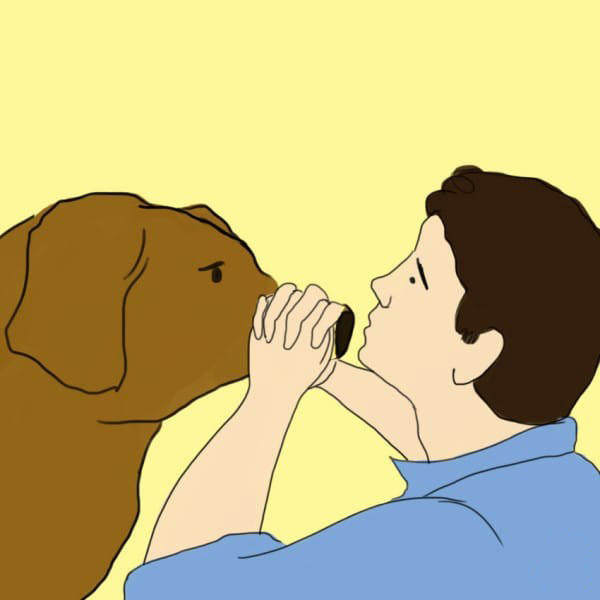
Next is breathing. Firmly close your dogs mouth and give two breaths in, through the snout. Enough to make the chest rise. Then begin compressions again. Check for a pulse every four cycles that you do compressions and breathing. When I got my CPR certification, I found giving breaths to be harder than compressions. Thats okay. Compressions is actually more important than giving breaths, that's why compressions are done first.
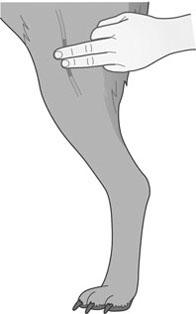
You can check your dogs pulse on its femoral artery. Which is located on the inside of its lower legs.
If you have a cat or a small dog, its slightly different. Compressions for a cat or small dog that is under 30 pounds, needs to 1/2 to 1 inch deep. For a small dog or cat, give five compressions for every breath of air. Also for a small dog or cat, you need to use one hand instead of both.

A medium to large dog, compression needs to be 1 inch to 3 inches deep. For a medium to large dog, give ten compressions for every one breath of air.
If your pets chest is not rising when you give it air, the airway is blocked and your pet needs to heimleched.
After your pet is resuscitated, check its pulse, respirations, and then bring it to the vet. Normal respirations for a dog is anywhere from 10 to 30. And for a cat, its 20 to 30. Normal pulse for dogs is 60 to 140. And for cats, its 160 to 240.
I hope that no one ever has to do this. But if needed, you know what to do.
















Most Helpful Opinions