
Are Northern Italians rich while Southern Italians are poor?

Are Northern Italians rich while Southern Italians are poor?
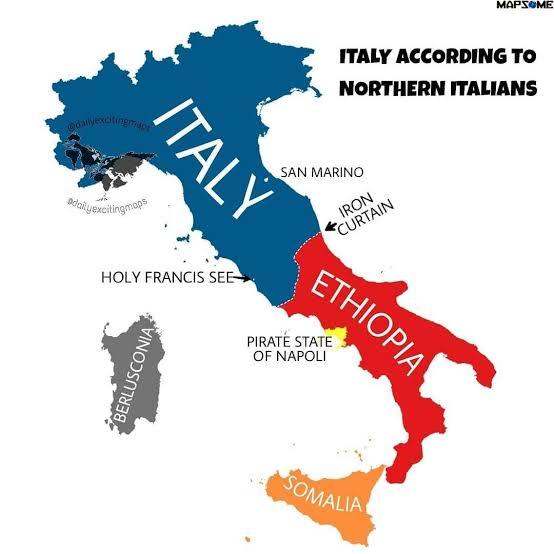

Numerous books have been written about the "southern question"—why southern Italy is as underdeveloped as former Soviet bloc countries like Romania, Bulgaria, and Moldova despite receiving funds from the north for over 70 years.
At the time of Italy's unification in 1861, structural and social concerns caused the development gap. The old kingdom of the two Sicilies was a very agriculturally backward country, where feudalism ended de facto in 1860 and de jure in 1812. For instance, northern and central Italian feudalism ended in 1176.
The kingdom of the two Sicilies was immobile, with no public debt, no infrastructure, and few train lines, especially those connecting southern Italy to Italy and Europe. This state's economy relied on significant agricultural protectionism, which collapsed in the 1870s when the Italian government supported liberal industry policies. This led to huge southern Italian emigration to the US.
For over a century, the north had a robust textile industry and a steel and metalworking industry, but the south remained agricultural.
War directives favoured northern industry-based development throughout WWI. In contrast, young people in the south ignored fields, starving their families. As opposed to center-north peasant women, southern women were not used to working the soil without men. Southern women could not have done both household chores and farming at the same time, unlike in Northern and Central Italy, where farmers lived in farmhouses a few metres from their land. After the war, the northern entrepreneurial bourgeoisie gained from market expansion and war reparations. Also because the First World War had mostly damaged the north-eastern part of the country bordering Austria.
To cement expansionist policy, fascist governments desired economic prosperity. He promoted public works through IRI and IMI to provide infrastructure to the South's poorest districts. Naples and Taranto were renovated; roads, railways, canals, the Tavoliere Pugliese aqueduct, and a reclamation plan were developed. These investments only partially met local needs, had a small impact on employment, and were distributed to produce or consolidate population consensus for the regime without harming the South's fascist core, landowners, or petty bourgeois.
Mussolini's agrarian programme, aimed at enhancing primary sector productivity, devastated some southern regions. The South's fertile and developed regions emphasised wheat (the war of wheat) above more profitable and specialty crops. Southern industry stagnated during the "black twenty years" and hurt jobs.
The Second World War caused political and economic inequality. In 1943, US-based Mafia groups helped the Allies invade Italy from Sicily by providing strategic intelligence and moral legitimacy in exchange for the civilian rule of South Italy. The Allied command's approval helped the mafia clans strengthen their military power (the fascists nearly wiped them out).
Instead of suppressing the socially neutral movement, the provisional administration misled it. Large amounts of the Marshall Plan were diverted to difficult areas, preventing protests. After being paid to lay down their guns, some surviving gangs were convinced to target civilians, isolating the armed groups.
After the war, Sicily, Calabria, and Campania became mafia strongholds. Article 119 of the Constitution states that "to provide for specific purposes, and particularly to enhance the South and the Islands, by law the State assigns special contributions to individual regions" to emphasise the national and constitutional nature of the southern question, which the Constituent Assembly extensively discussed.
The Italian government established Cassa del Mezzogiorno to manage the South Development Funds. The mafia used unlawful profits legally. These movements stole public funding and laundered illicit gains, not supporting productive industries. Big public and private organisations in the north exploited state investments to develop industrial units with management headquarters far from production plants, taking advantage of vast public money in poor infrastructural areas.
State subsidies enabled several northern industrial groups to establish themselves in the south, but several failed shortly as the subsidies ended, making them uneconomical. Large enterprises and political organisations that pushed these initiatives took advantage of the challenging circumstances by recruiting through patronage without evaluating productivity or entrepreneurial value.
From the "economic boom" to the mid-1970s, the South's private economy grew rapidly, reversing the trend and bringing it closer to the north after over a century. The early 1970s oil shock reversed this tendency, and North-South dualism returned. Data suggests the southern economy has been bridging the gap again since 2000. The government again prioritised northern industries in legislation and international economic negotiations. Italian emigrants, especially from the south, flocked to Belgian coal mines in the 1940s and 1950s, and the Italian government wanted a ton of coal per worker. Northern factories received this supply, not emigrant miners' homes.
Export-driven "Italian" miracle in industrialized areas during the 1960s and 1970s. The phenomenon attracted Southern labour and shaped the South for decades, but the living standard discrepancy became visible and argued. Emigrants sent remittances to their families in the south, and the state finally dedicated significant resources to developing essential services, but these resources could not be reinvested in productive circles and only raised southern emigrant families' standard of living.
In the 1980s, courts turned to organised crime. Individualism and public life's spectacularization broke the ruling class's control. One law strengthened the fight against corruption and crime by confirming the separation of judicial and executive power, giving accused persons who cooperate with investigations sentence discounts and other benefits, and making mafia membership a more serious crime than criminal association.
Define poor. Southern Italia is just less developed and less industrialised.
Italians, never even saw themselves outside of their provincial identities. A unified Italy is a late concept and I've heard a lot of Italians refusing the call themselves Italians, particularly when they're from South
They're Sicilians, Napolitans, Milanese before Italians
Northern Italy has Milano, Northern Italy had developed more under foreign invaders, Northern Italy is quarter German, quarter French
Southern Italy has a different set of identity and Napoli is still a very good city
You just need to beware pickpockets haha
So what? When state is not strong, provincial organisations assume power.
State is organised legal mafia,
A poor person is someone who receives an income equal to 60% of the equivalent median family income. In 2021, the percentage of families in absolute poverty in southern Italy was 10.8%, and in the islands, absolute poverty stood at 8.4%, compared to 6.7% in the north-east, 6.7% in the north-east, and 5.6% in the centre.
In the central north, the majority of families in absolute poverty are of immigrant origin; in the south and on the islands, they are of local origin.
Opinion
2Opinion
Works that way though virtually all of Asia , usually its driven by farming in the North , not sure about Italy , it maybe the same , but just like here the old money will be held central and Southern.
Use google
Be the first girl to share an opinion
and earn 3 more Xper points!

You can also add your opinion below!