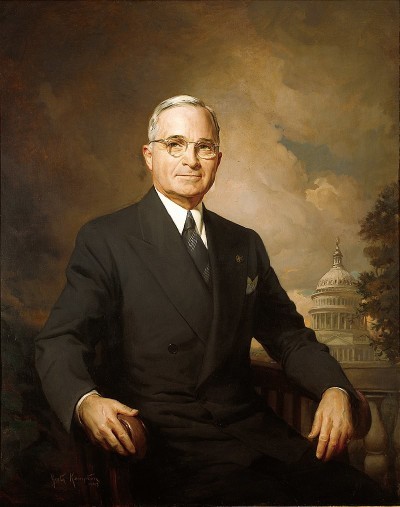
The question is a bit oddly phrased. Did President Truman "enable" American "hegemony"?
To start, President Truman certainly was the architect of American foreign policy at a propitious moment in history. Europe and much of Asia were in flaming ruins after the Second World War. The great European powers - see also the UK, France, Germany (by that point defeated, divided and occupied, Italy (also defeated and occupied) plus Japan (defeated and occupied) - were trying to hold their empires and much of their infrastructure and economies were a rubble heap.
Throw in war weary populations and the old great powers were in no shape to resist the pressure coming from the Soviet Union. The USSR itself having been damaged by the war, but Stalin saw his moment and was able, as a totalitarian dictator, to act aggressively on the world stage.
Into this vacuum stepped the United States. The American population was war weary, but the war had not damaged the USA's infrastructure and thus Washington had the resources to build alliances and defend that part of Europe and the Far East not under Soviet rule.
Would that have happened anyhow, given that great powers tend to secure their interests? There is no way to definitively answer that question as it is a counterfactual. Yet likely any other President would have done the same.
Then again, Americans after two world wars, a global pandemic, a "forgotten" economic depression and the Great Depression were themselves war weary and ready to turn inward. Isolationism was not entirely dead. Plus the immediate post-war economy was somewhat rocky, with plenty of labor unrest after the initial glow of victory and wartime unity had worn off.
In that sense, Truman - albeit as an inheritor of the late President Roosevelt's foreign and defense policy traditions - was the creator of the post-WWII/pre-Cold War consensus. He help to found NATO. He created the "Truman Doctrine" of resistance to communist insurgency - applying it to post-war Greece and Turkey particularly.
If that can be called an "American hegemony" then yes. However, it was a hegemony built in a power vacuum. There simply were no other powers in any shape to resist Soviet dominance in the early post-WWII years.
As to Truman being a good President, history generally says "Yes." Not without controversy - see also Hiroshima and Nagasaki. Though at the time the families of thousands of American servicemen (including my own) were filled with gratitude that they did not have to have their father's and son's lives risked in an invasion of Japan.
Even then, Truman left office quite unpopular. The Korean War had bogged down in stalemate and Truman had fired General MacArthur - a popular WWII war hero. Thus he opted not to seek re-election. (See also my answer to this question for some context: What do you know about Korea War in 1950? )
A prophet may not be honored in his own time and that seems to have been Truman's fate. Again, it being arguable that - the pressure for a return to isolationism then prevalent in the USA in the immediate aftermath of WWII - any President might have taken the same general course that Truman did.
In terms of his domestic policy, Truman's handling of race relations was not inspired, but not without its virtues. His handling of the economy - with his "Fair Deal" - was the application of "New Deal" principles down to the almost microeconomic level. By the early 1950s, though, the American economy was not doing brilliantly, and thus the stage was set for President Eisenhower and the economic boom of the 1950s.
It is not an unmixed record, but put it all together and Truman can fairly be called a good - and to some extent even "great" - President. Not without his flaws, but certainly a critical figure at a critical moment in time - and he rose to the moment.
No one person allowed for American hegemony. The overwhelming majority of the work on the atomic bomb occured when Truman was out of the loop, in other words vice president. Indeed, such was his station throughout much of the war.
Yes, overall he was a good president. He made a command decision to end the war sooner, knowing full well it would cost the lives of innocent children. No one, and I mean *no one* would envy that position. By almost all accounts he was a n honest and honorable person.
An interesting side note; the purple hearts awarded today were mostly minted in 1945 in anticipation of the casualties of the invasions of Kyushu and Honshu. Think of it. All the death and misery of the Korean War, the War in Vietnam, the first and second Gulf Wars, Afghanistan, and other military operations would not have equaled the deaths incurred in the years 1945 and '46. And that is to say nothing of the ginormous number of deaths suffered by Japan, from combat, disease, and the inevitable starvation (Japan relied almost entirely on its merchant fleet, which at war's end was almost completely at the bottom of the Pacific, to transport food).
I don't think you can narrow it down to just one person. Europe had blasted itself to pieces, and pretty much the only empire left by the end of the war was Portugal's, and there wasn't of THAT, even (and it fell apart in the 50's and 60's, anyway). There remained only two superpowers, one of which was basically in ruins and followed an inefficient economic ideology that required endless expansion to keep from exploding; it's not like there could've been many alternatives by the time Truman took office.
He DID make the awful decision (as in "the *situation* was awful, not the call he made; it was probably the right call, as terrible as it was- he's kinda like Jackson in that he catches flak for doing something horribly destructive that probably prevented something even worse) of using the A-bombs on Japan; I don't think anyone envied him having to do that. I DO like his blunt-spoken, forthright honesty, and his refusing to hide behind formal titles and bureaucracies- he wasn't the diplomat that Roosevelt was, but he was more of a leader.
Honestly? It was inevitable, given the Soviet Menace, the British Empire bankrupt and on its way to liquidation, and France recovering from its conquest, and the rest of Europe rebuilding from the rubble.
That said, Truman came from a time when Democrats had not gone full blown Marxist. Old Left New Deal had its failures, but unlike the New Left from the 1960s forward, they did not hate this country.
12.3K opinions shared on Society & Politics topic.
Hegemony? Naah. He just stopped the war and begat the Marshall Plan for Germany and Japan, two of our best allies. "And in addition to my first question, has Truman been a good president?" I am a MAGA guy. So was he. The answer is yes.
He was a war criminal. Dropping an atomic bomb twice on other human beings is an act of absolute infamy. I don't give a s*** about all the excuses that were made for this behavior.
(1) Those two atomic bombs actually killed fewer people than did some incendiary raids, but those involved hundreds of planes and somehow that makes it better? (Hamburg, Berlin, Dresden, Tokyo, Osaka)
1. yah, I do. Casualty figures were often 4X higher in a conventional incendiary raid, one that took 800 or more planes rather than just one, but even with delayed radiation effects, a firestorm is a firestorm.
2. Lucky you. Most Americans likely would be, given the "Baby Boom" postwar among veterans.
@Curmudgeon uh-huh - what do you actually know about long-term genetic and radiation effects in large populations? Also, your "more people were killed here so this doesn't count" excuse is just bullshit.
 Girl's Behavior
  Guy's Behavior
  Flirting
  Dating
  Relationships
  Fashion & Beauty
  Health & Fitness
  Marriage & Weddings
  Shopping & Gifts
  Technology & Internet
  Break Up & Divorce
  Education & Career
  Entertainment & Arts
  Family & Friends
  Food & Beverage
  Hobbies & Leisure
  Other
Other  Religion & Spirituality
  Society & Politics
  Sports
  Travel
  Trending & News