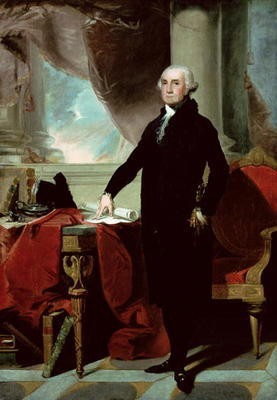
Is George Washington indirectly and involuntarily responsible for the Seven Years' War?


Of course not! That's ridiculous. The Seven Years War was not exclusive to North America and the conditions leading to that war had nothing to do with Washington who was a young man of 35 when the war started.
In the United States, we call the North American component of the Seven Years War as The French and Indian War. After that war ended, conditions and events led to the American Revolution. In short, colonists in North America were disappointed and disrespected after having helped the British (and they were British too, keep in mind) win. Perhaps the first of these events was the Stamp Act in 1765. I'll let the UK Parliament discuss that...
The Stamp Act and the American colonies 1763-67
Relations between the American colonists and the British government came to a head after the British success against France in the Seven Years War of 1756-63.
Change in policy
It was an expensive war and the French lost all their North American possessions including Quebec in what is now Canada, and all the land they claimed between the Appalachian Mountains and the Mississippi River.
The British needed to station a large army in North America as a consequence and on 22 March 1765 the British Parliament passed the Stamp Act, which sought to raise money to pay for this army through a tax on all legal and official papers and publications circulating in the colonies.
No Taxation without Representation
The Act resulted in violent protests in America and the colonists argued that there should be "No Taxation without Representation" and that it went against the British constitution to be forced to pay a tax to which they had not agreed through representation in Parliament.
The British government argued instead that the colonists enjoyed virtual representation, that they were represented in Parliament in the same way as the thousands of British subjects who did not have the vote, or towns not represented in Parliament, such as Birmingham and Manchester. MPs in the Commons, it said, legislated for all British subjects everywhere.
To this the colonists replied that they were already represented in their own colonial assemblies, elected law-making bodies which had been voting the laws and taxes for each colony from the time of their foundations.
To the colonists these assemblies were the equivalent of Parliament, where they were represented and whose taxes they paid. They did not feel they should pay another unrepresentative tax on top.
Repeal
The Stamp Act became one of the most controversial laws ever passed by Parliament, and after several months of protests and boycotts which damaged British trade, it was repealed on 18 March 1766.
The Act's repeal, however, was followed that same day with the Declaratory Act, which maintained that the British Parliament had the right and authority to legislate for the colonies in all cases whatsoever. The dispute was far from over.
the power to confiscate and communicate! a good read.
* I was wrong. Washington was ___25___ when the Seven Years War started.
However, I think I see your point. The answer to your question may indeed be "Perhaps, yes" because you wrote "indirectly and involuntarily". However, I believe it was bound to happen no matter what because the French and English were both expanding in North America, so conflict was inevitable.
www.mountvernon.org/.../seven-years-war
The Seven Years War was immensely complex diplomatically with much diplomatic bed hopping. Perhaps best summarized by a German princess offing her Czar husband to become sole monarch. Oh and Louise XV having secret royal objectives under the official French objectives.
Both France and Britain might have had the objective of sorting out their slices of the Americas and India, but I would have thought Frederick the Great breaking his borders was more the moment that ignited the conflict.
I'd have thought India was a bigger bone of contention than the Americas back in the days when real trading companies had really large armies. And addressed commercial rivalries with other trading companies on the battlefield.
(Which is still immortalized in Clive of India curry powder - the only one I will buy).
George Washington politely allowed himself to be beaten by the French so it was just the usual border establishment argy bargy. The British PM was pissed and wanted retaliation but his cabinet said No and immediately leaked his plans to everybody including the French.
So I think that means Britain wasn't keen on fighting for New France. France could have been content with having beaten GW and forcing him to surrender. They had established a point of the border. Cabinet deliberately ruining retaliation would have given some feeling of security.
I therefore rather think George Washington wasn't causal in starting the Seven Years War.
Didn't George Washington acknowledge his responsibility for Jumonville's death? And wasn't it this death that ignited tensions between the English and French in America?
France decided to take action against Fort Necessity following this death, and then one thing led to another, as one historian wrote
"Secondly, the hostilities owed a great deal to the lack of confidence and experience of the young lieutenant-colonel of the Virginian militia, Washington, who had unwittingly unleashed a world war of unprecedented political upheaval".
First I need to admit what I was reading a couple of years back was nearly silent on Jumonville. Possibly out of deference to GW reputation.
Still I am skeptical and am reminded of the War of Jenkins Ear (Austrian Succession war). Slicing Jenkins ear off was the causus belli but it doesn't wash since it happened 7 years earlier. Jumonville was two years earlier.
France and Britain were in strategic competition in the Americas. I would think that more causal. Both needed to shore up their positions in Europe. In central Europe the question was Silesia and Poland.
The hot phase begins with Austria and Russia massing troops on the Prussian border and Frederick the Great invading Saxony in response.
Like Jenkins Ear, the events were possibly more retail politics. Strategic competition between Britain and France was more the bones of the war in my thinking leading to Fort Necessity and forming alliances and reformulating alliances, betrayals etc.
Very convenient to blame an enthusiastic but misguided junior officer and as a French client GW would have said anything for the help doubtless.
France will take the fort necessity following the murder of Jumonville, say you that this murder was a real scandal in France at the time, because he had his brains split. The King of England himself was furious with George Washington.
Now, this moment was a catalyst, as the French and English obviously had too great a rivalry, which would have led to war anyway. But let's not underestimate the clumsiness of George Washington's handling of the situation.
No. The seven years war was a war between the British empire which included the American colonies and Spain, France, Sweden, saxony, austria, russia bengal. Hesse Darmstadt and Britain's allies Portugal, Sweden, brunswick and Hess Kassel.
It was waiting for a spark.
Maybe. There’s a reason tied into the French and Indian War that makes this statement true. I learned it in AP History, but I can’t remember the exact reason at the moment.
Opinion
5Opinion
it's quite safe to say that the USA has indirectly played a part in most wars ever... lol
He's directly responsible for a great deal of the impetus. Read some REAL history, not what comes out of Prager University.
That was the one in Québec right? C'est possible
Seems like actually causes were European royalty wanting bigger empires... Just wait a 120+ years til WW1
At this point who cares
You can also add your opinion below!