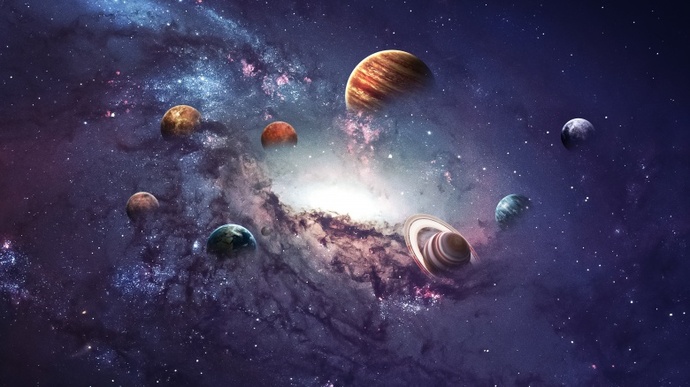
There are an estimated 100 sextillion to 300 sextillion planets (10²³ to 3 × 10²³) in the observable universe. There are 8 official planets orbiting the Sun. These planets names are Mercury, Venus, Earth, Mars, Jupiter, Saturn, Uranus and Neptune.

Girl's Behavior
Guy's Behavior
Flirting
Dating
Relationships
Fashion & Beauty
Health & Fitness
Marriage & Weddings
Shopping & Gifts
Technology & Internet
Break Up & Divorce
Education & Career
Entertainment & Arts
Family & Friends
Food & Beverage
Hobbies & Leisure
Other
Religion & Spirituality
Society & Politics
Sports
Travel
Trending & News 
There are an estimated 100 sextillion to 300 sextillion planets (10²³ to 3 × 10²³) in the observable universe. There are 8 official planets orbiting the Sun. These planets names are Mercury, Venus, Earth, Mars, Jupiter, Saturn, Uranus and Neptune.
Yes. I think it is extremely likely that life exists elsewhere in the universe. In fact, I would be considerably more surprised if Earth were the only planet harboring life than if we eventually discovered life elsewhere.
My reasoning rests on several considerations.
1. The sheer number of planets. There are probably hundreds of billions of planets in the Milky Way alone, and hundreds of billions of galaxies in the observable universe. Even if the probability of life emerging on any particular suitable planet were extraordinarily small, the number of opportunities is enormous.
2. The chemistry of life is widespread. Organic molecules, water, and many of the chemical ingredients necessary for life have been detected throughout space. The chemistry that made terrestrial life possible does not appear to be unique to Earth.
3. Life appeared relatively early on Earth. The geological evidence suggests that life existed by approximately 3.5–3.8 billion years ago, possibly earlier. This raises the possibility that life emerges relatively readily when environmental conditions permit it.
4. Life is remarkably adaptable. On Earth, organisms survive in extreme heat, intense cold, highly acidic environments, and locations almost entirely without sunlight. This greatly expands the range of environments in which extraterrestrial life might exist.
However, I make an important distinction between simple life and intelligent life.
I suspect microbial life may be relatively common. Complex multicellular life could be much less common, and technological civilizations might be extraordinarily rare.
There is also a fundamental scientific uncertainty: we still do not know how frequently nonliving chemistry produces living systems. We have only one confirmed example—Earth. Consequently, we cannot calculate a scientifically defensible probability that extraterrestrial life exists.
And despite decades of searching, we have not yet obtained scientifically confirmed evidence of life beyond Earth.
If I had to make a prediction, I would say that humanity will eventually discover extraterrestrial microbial life, quite possibly within our own solar system.
But I find another question even more fascinating.
If intelligent life is reasonably common in the universe, why haven't we encountered any convincing evidence of it?
That's the essence of the Fermi paradox, and I think it is one of the most interesting unresolved questions in science.
Some people ask:
" If there really is intelligent life out there, why haven't they contacted us?"
I reply:
" Because they're intelligent life".
Opinion
8Opinion
They can’t even count how many stars are in our galaxy, and they can’t even count how many galaxies there are. The European space agency has a satellite or something counting stars, and they have counted over 2 billion in our galaxy. Scientists estimate there are over 200 billion stars in our galaxy, and at least that many galaxies out there. Many could be much bigger than ours. So if just one planet in each galaxy of millions or billions of solar systems had life on it, that would still be hundreds of billions of planets that could have life on them. The universe is on such a ridiculously large scale that we can’t even begin to comprehend its size. It’s like we’re standing on the beach in the fog and trying to see across the ocean, but we’re half blind and don’t even have our glasses on. We’re all just hairless apes working on mysteries without any clues. We know approximately jack about shit.
sure there is... there isn't "that much" needed for life to exist somewhere else in space, and it's probably been found already over there at Mars, but it's way too expensive for now, to go and get those samples back
"intelligent" life like ours? that I don't know... or even superior, don't know either
the thing is... maybe it existed before but not anymore, and we would not have ways to find out either so... who knows
Yes. It's likely plenty of life in universe and life on earth came very likely with meteorites and comets to earth 4,1 Billion years back. Panspermia theory.
Chances are good that some micro organisms exist on Mars, or moons around Jupiter or Saturn. Maybe even in higher layers of Venus atmosphere where pressure and temperature is more benevolent to amino acids, peptides and proteins.
I do and and don't. life is easy.
There is definite evidence of life 3.5 billion years ago and evidence that suggests life 3.7 to 4.1 billion years ago. The earth formed 4.5 billion years ago.
So it didn't tale that long.
After that more complex life proceeds at the speed of random genetic changes. That takes a long time.
So intelligent life - like humans - is most likely quite rare. For example planet earth only has another 4 billion years left.
I think there are other plants and animals on other worlds that are probably much different from ours, but I don't believe there is what we call any "intelligent" life out there like aliens or other humans.
Well life on other planets hasn't said anything to me yet. So I have nothing to believe or disbelieve. I'll let you know when they start talking.
It's mathematically almost 100% guaranteed that there is other life out there. The again is just what does it look like and how intelligent is it.
I'd be surprised if there's not at least single cell organisms out there.
I do, and they already walk among us. Some are on GaG.
Not yet. Because we haven't colonized them yet.
Im mprmon so yeah
Yeap.
Nope
Nope
You can also add your opinion below!

Most Helpful Opinions