A very difficult question to answer. However, when I was studying physics in high school, one of my favourites was Willebrord Snell (a. k. a. Snellius), who discovered the law that is named after him (Snell's Law of Refraction), and which is one of the more interesting discoveries that were made prior to the time of Newton. I also like Eratosthenes (3rd century B. C.), because he demonstrated that the Earth is actually a sphere, via an experiment that anyone can perform.
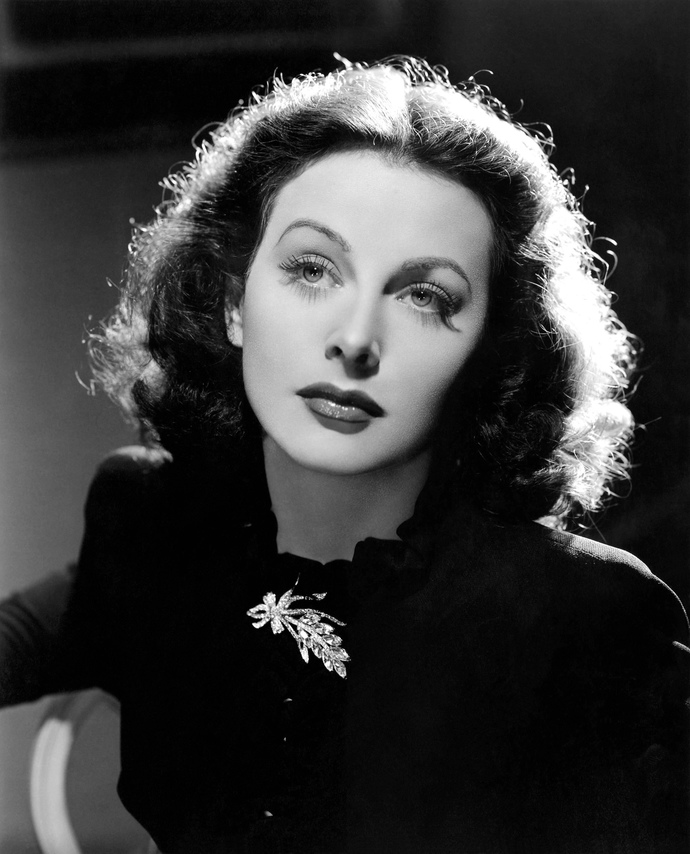
Hedy Lamarr played much more than "the most beautiful woman in the world" as an Austrian-American actress during Hollywood's Golden Age. The mathematically-minded inventor first learned about military technology from dinner party conversations between her arms-manufacturer husband and Nazi German generals, before escaping to America where she eventually invented a new torpedo guidance system for the U. S. Navy.
The actress-inventor's life almost seems like a no-brainer for a Hollywood action hero makeover, given her brush with Nazis and behind-the-scenes efforts to aid the U. S. war effort during World War II. But her life is also fitting as a tragic drama — the glamour of the silver screen blinded most people to her inventor's passion that would lead to a patented "frequency hopping" breakthrough still used in civilian and military technologies today.
"The reason she set up inventor's room in her house and pursued inventing as a hobby was that she didn't drink, didn't smoke and didn't like parties," said Richard Rhodes, author of "Hedy's Folly: The Life and Breakthrough Inventions of Hedy Lamarr, the Most Beautiful Woman in the World" (Doubleday, 2011).
Any inventors willing to look beyond Lamarr's beauty would have found a kindred spirit, Rhodes said. She embodied the stereotype of the classic inventor who loved to tinker — her lesser-known inventions include an instant fizzy soda cube and a trash receptacle attached to tissue boxes.
Her most recognized work came from co-inventing a frequency-hopping wireless signal for guiding U. S. Navy torpedoes to their targets. But even after Lamarr enlisted the help of fellow inventor George Antheil and received a "Secret Communications System" patent in 1942, the U. S. Navy ignored the breakthrough until its engineers rediscovered the patent in the mid-1950s.
Lamarr's motivation for frequency-hopping likely first arose during the Viennese dinner parties held by her first husband, the Austrian arms manufacturer Fritz Mandal, in the years leading up to World War II. Guests at such parties often included German generals or admirals. [Secret Weapons of the Third Reich]
"She was perfectly positioned as Mandal's wife — as an arm piece at the fancy dinners they gave — to hear discussions about what technology the Germans were developing, how they worked and what their problems were," Rhodes told InnovationNewsDaily.
After Lamarr escaped her obsessive husband and headed for a new acting career in Hollywood, she grew furious over reports of German submarines torpedoing ships filled with refugees. She first suggested going to Washington, D. C., to testify about her knowledge of German technology before the National Inventor's Council, but nobody took her seriously.
Luckily, Lamarr met and recruited Antheil to help develop her idea for frequency hopping (also known as spread spectrum) — a concept for having wireless radio signals switch quickly among many different frequency channels so that enemies could not jam the signal. Antheil's background as a musician and tinkerer came in handy when he came up with a workable concept similar to player-piano rolls that could synchronize the switching among 88 frequencies.
The Germans had their own wire-guided system for torpedoes, but Lamarr's wireless technology never saw action during World War II. Still, the U. S. Navy eventually applied the jamming-proof technology to radios used during the Cuban Missile Crisis, and it went on to shape modern technologies such as GPS, Bluetooth in headsets and phones, and U. S. military guided missiles.
"Most of her ideas were interesting but trivial," Rhodes said. "This one was fundamental."
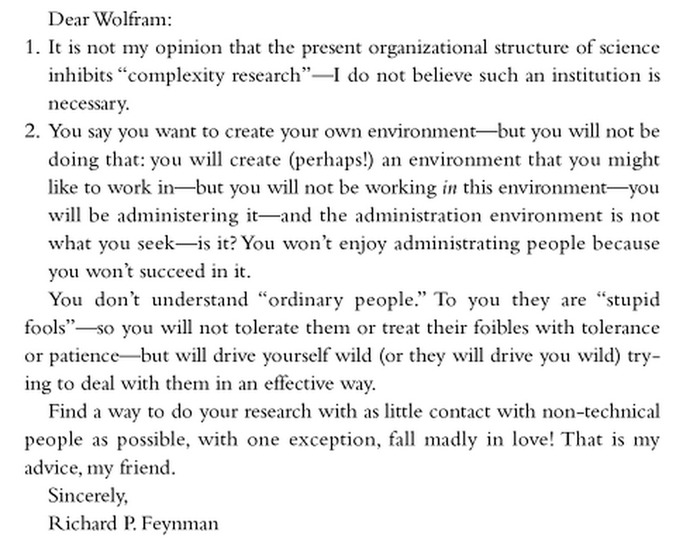
Richard Feynman. I read some of his books like, "Surely You're Joking, Mr. Feynman!" and he had the craziest life that's all over the place... from painting topless women in strip clubs to being a critical code breaker and safe-cracker to suggesting to Wolfram that he fall madly in love in response to his complaints:
I like him though because he's so obviously imperfect but seems to have a larger-than-life character and lifestyle that invites all sorts of crazy adventures.
Richard Feynman, especially in light of how much dogma is called "SCIENCE" today, from "climate change" to how certain diseases were and are handled. To paraphrase Richard Feynman:
"I don't care how elegant your theory or your model is, it doesn't matter how smart you are, if the empirical data doesn't fit your theory or model, then your theory or model is wrong."
I know folks pick Newton because his standards were used for a longer period. He basically invented the math/calculus we use for astronomy.
But we were stuck for a long time in a lot of mythology about the universe until Einstein came alone. People don't know the Planet Vulcan actually comes from the error in Newton's equations. There was a prediction there was another planet closer to the Sun than Mercury.
Of course, that isn't true. But Newton? Of course, he was a bad ass. And there was probably no better pure mathematician in history.
Einstein because his discoveries are mind blowing more than any other scientist. To be a man in the late 1800’s and early 1900’s and discover than time and space are interwoven and are both warped by gravity just sitting at his desk doing math is truly the most enlightening thing since Newton.
There are way too many interesting people! All of these are wonderful, and there are so many more… Maria Gaetana Agnesi, Mary, Somerville, Elena Cornaro Piscopia, Elizabeth Garnett Anderson, Maria Montessori, Rosalind Franklin etc. There are so many intelligent people today working in new fields of science, e. g. gene therapy, neuroscience, etc. It’s an exciting time to be alive.
I like him because he was very sincere and earnest. I like to say that he was the scientist who, in proving himself right, proved himself wrong.
With great reluctance, he faced the fact that his theory about pythagorean solids being the supports for the planetary orbits was ultimately wrong. In proving planets moved in elipses, he proved his previous theory was wrong.
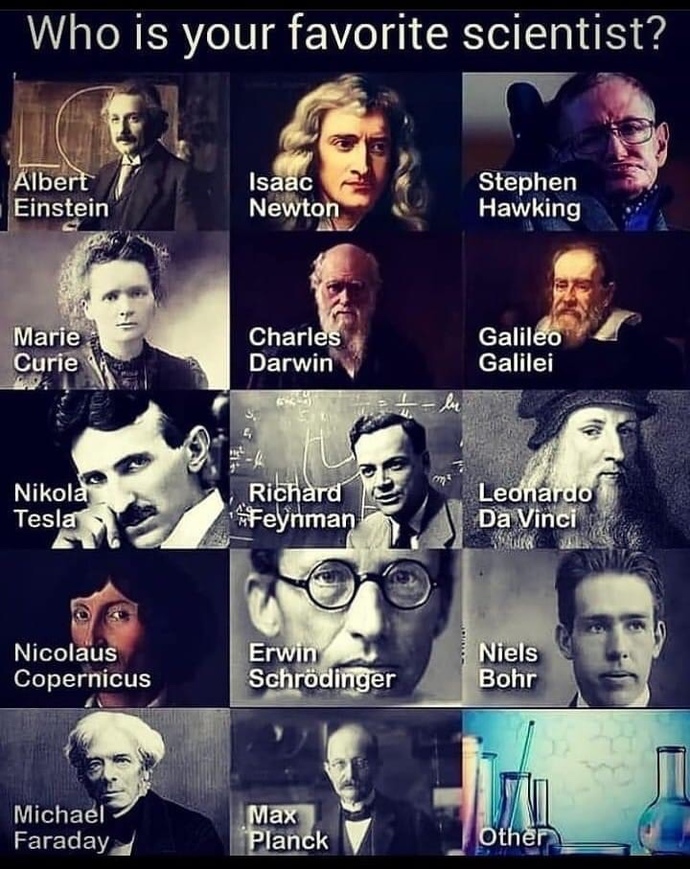
Three way tie Charles Darwin, Galileo Galilei and Stephen Hawking. Though narrowing it down to one would cause a internal debate that would last might never stop. So I couldn't decide on one and I settled on those three to shut down the internal debate before it started really going.
Sheldon Solomon (who is mostly known for finding a way to put into better words the work of Ernest Becker).
Also, Griffiths writes a hilarious textbook book on quantum mechanics. It is odd how the quality of a scientist is really the science they do - anyone can do that- it is in the quality of their presentation of that work. That's how they get everyone else able to do it, too: which is the entire point of science.
586 opinions shared on Technology & Internet topic.
This is the best question I've seen in some time.
It should really be broken down at least a bit by specialties.
Pure mathematician: Gauss Applied mathematician: Archimedes Physicist: Newton Chemist: Marie Curie Astronomer: Einstein Biologist: Darwin Geologist: Wegner Engineer: Tesla
That guy was far more intelligent and creative then all the others.
He’s engineering was considered crazy and fantasy at the time... they were correct about one thing. It was crazy. Crazy because it wouldn’t be made possible for half a decade. He proposed a design for a helicopter and it wasn’t till after ww2 helicopters were put in use.
Einstein comes in at second, but it’s a distant second. Everyone else was smart, but not as great as these two
I like anyone who "outkicks their coverage", so-to-speak:
"As an engineer, Leonardo Da Vinci conceived ideas vastly ahead of his own time, conceptually inventing the parachute, the helicopter, an armored fighting vehicle, the use of concentrated solar power, a calculator, a rudimentary theory on plate tectonics, and the double hull."
@Bluemax Yeah Da Vinci was an extremely brilliant and fascinating guy. The things he conceptualized and memorialized in his notes were centuries ahead of their time. For example, Da Vinci lived from 1459 to 1519. Zacharias Janssen (1585 to 1638) invented the microscope around 1590, and most historians agree that Hans Lipperhey/Lippershey (1570 to 1619) and/or Galileo Galilei (1564 to 1642) invented the telescope in 1608 or 1609 (I stated "most", because there were a number of scientists involved with the invention of the telescope... to what degree can be debated forever). Both are brilliant accomplishments, but they were all able to realize their visions in their lifetimes, so that makes them brilliant people for their time. Meanwhile, Da Vinci had clear schematics for his visions and many of them weren't realized by mankind until the 20th century, and he lived decades before Zacharias Janssen, Hans Lipperhey/Lippershey, and Galileo Galilei. Based on all of this, Leonardo Da Vinci was brilliant for the ages.
I knew who Gregor Mendel was, but I admit that I had to Google "Gregor Mendel green peas". Very cool. I guess Astronomy, chemistry, meteorology, and physics always grabbed my attention more than biology and botany. That's just me.
@NYCQuestions1976 If you "knew who he was" why did you have to Google what he had to do with peas? That's who he was. The dude grew thousands of peas, developed pure breeding lines in them. He recognized that some traits are dominant and some are recessive giving rise to idea of an unseen genetic unit that gets past down from generation to generation and has an observable impact on the organism. Or as we typically refer to them as geans. All thanks to the fact that he grew a shit load of peas, and took careful notes.
I meant I knew he was a scientist, but I couldn't tell you anything about him before I Googled him. I barely got through biology by the skin of my teeth. So you're correct. I should've been far more specific. My bad.
Daniel Bernoulli, who identified the mathematics of the mechanism in the fluid dynamics which is underlying the operation the airplane wing. I wanted to be a pilot!
Imhotep... He beats anyone on that list by a mile. But 99% of people have no clue who he even is and so much that he did is credited to others aka europeans but not surprising that is where the credit usually goes. Even on things silly as tiktok.
Nicolae Paulescu - descover the insulin Ana Aslan - invented the treetment who slow the proces of geting old Ion Cantacuzino - descover the vaccine for holera
413 opinions shared on Technology & Internet topic.
Alan Turing from his silver stashing to presence on the new £50 note, got a few now from my latest run in to Hatton Garden and they are as great as ever
307 opinions shared on Technology & Internet topic.
I don't really have a favourite. You probably have to hand the award to Albert Einstein though. Basically all the technology we use is thanks to his discoveries.
 Girl's Behavior
  Guy's Behavior
  Flirting
  Dating
  Relationships
  Fashion & Beauty
  Health & Fitness
  Marriage & Weddings
  Shopping & Gifts
  Technology & Internet
  Break Up & Divorce
  Education & Career
  Entertainment & Arts
  Family & Friends
  Food & Beverage
  Hobbies & Leisure
  Other
Other  Religion & Spirituality
  Society & Politics
  Sports
  Travel
  Trending & News








































Most Helpful Opinions