 Girl's Behavior
  Guy's Behavior
  Flirting
  Dating
  Relationships
  Fashion & Beauty
  Health & Fitness
  Marriage & Weddings
  Shopping & Gifts
  Technology & Internet
  Break Up & Divorce
  Education & Career
  Entertainment & Arts
  Family & Friends
  Food & Beverage
  Hobbies & Leisure
  Other
Other  Religion & Spirituality
  Society & Politics
  Sports
  Travel
  Trending & News


Geoffrey Chaucer was an English poet and writer, considered the greatest poet of the middle ages, he is most famous for the Canterbury Tales and considered to be 'Father of English Literature'.
He was actually the first English man who thought that English was decent enough a language to be writing in. Before that, everything was written in latin. He lived from 1343 - 1400.
The Canterbury tales is about pilgrims on a pilgrimage, competing over who can tell the best story. Chaucer never finished the full series, he died before he finished.
I'm currently studying 'The Merchant's Tale' for English Literature. A highly cynical and interesting tale about a knight called Januarie.
One theme I notice running right throughout the tale is the idea of women, of marriage and of love. There are many perspectives on love throughout the poem. Partly interesting, because the whole story is written by a man, about man who tells a story about a man.
Here is a rough storyline:
1. Merchant - hates women, only been married for 2 months. He says love is 'Childish vanitee' and that is 'love is blind alday'
2. The knight, Januarie has lived for 60 years, sleeping with as many women as he likes. He is now desperate to get married. Considers marriage a paradise, even though he's never been married. Insists on marrying a beautiful girl, no older than 20. Says that a wife will be like a slave. Has sexual dreams about (non existent) bride to be every single night.
3. Placebo takes the opinion of whoever is speaking. Justinus cautions Januarie of marrying. Suggests she may be 'goddes whippe' and that she'll likely cheat as he won't be able to satisfy her sexually. Januarie gets furious at this and insists on finding his dream wife. He says that young women can be moulded like 'warm wex'
4. Januarie finds his wife May, and marries her. The evening of their wedding, his squire, Damyan, falls in love with her. It's so extreme that he becomes sick. Januarie and May have their wedding night, and it's described quite gruesomely with a brutal description of Januarie's incompetence, with May lying there 'Still as stoon.'
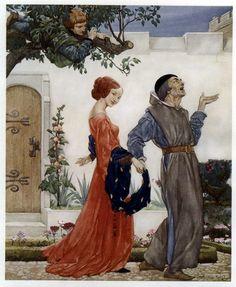
5. May is sent to see Damyan and they exchange love letters. Januarie suddenly turns blind, and is so scared of May cheating that he has a hand on her at all times.
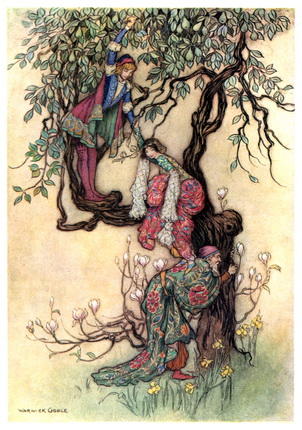
6. One day, Januarie awakens May with a romantic speech and they go to a garden, Damyan also creeps inside and climbs up a pear tree. Persephone(goddess of spring) and Hades(god of death) are also watching and having a conversation about infidelity. Hades says women are more likely to cheat and refers to the scene in the garden, saying he must help the man. Persephone disagrees and says men are more likely to cheat, she says she will help May if Hades helps Januarie.
7. May says she's hungry and wants a pear. Januarie bends over to let May stand on his back and get a pear. She goes into the pear tree and just as Damyan and May have sex, Hades gives Januarie his sight back and he gets extremely angry. At this point, Persephone gifts may with wit and she argues her way out of it. Januarie and May go back to their castle together.
Many modern day readers believe this is a story about women cheating and why you shouldn't trust them.
But it's not. It's actually a depiction of a fool who got what he deserved: a cheating wife.
From the start, Januarie is depicted as a complete fool. His literal and metaphorical blindness is symbol of his foolishness and stupidity. His ridiculous ideals about marriage and inability to accept any criticism demonstrate his similarity to the stereotype of the 'senex amans' which is what young men in England would have called a dirty old man usually shown in paintings of an old man holding a naked girl. Januarie is also a fool on the most basic sense, men in his time that had cheating wives were called cuckolds, and they were mad to wear horns and believed to be idiots (they also usually executed their wives). Not to mention, the clown Chaucer creates out of Januarie's physical appearance, which is what is gruesome about the wedding night, because Chaucer describes Januarie's neck flapping etc. (this scene is highly disturbing, my whole English class was like omg too much detail Chaucer)
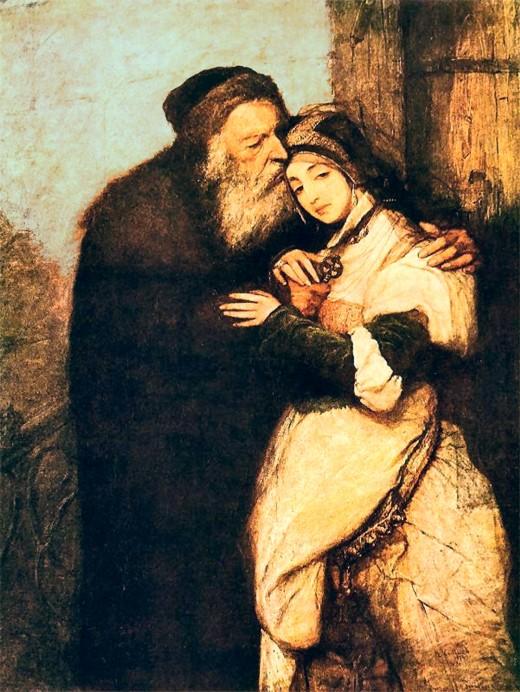
The point I'm making about Januarie being a fool is that it was his personal mistake in marrying someone like May, his own foolishness and his own 'childish vanitee'. An idiot who believes he can satisfy a young woman, who thinks he can control her. And in doing so, she gets control over him. Chaucer's depiction of May is quite comical too, with the traditional fabilaux pear tree he always describes her beauty. But in this instance, though cunning, she's not supposed to be a villain.
This is why Chaucer is a genius. In a society where a lot of men believed that marrying a young woman was better because you could mould them to be however you wanted (sexual servant is implied) Chaucer in a way produced a little more equality.
Of course cheating is not right, but the way in which it's described as Januarie's blindness being the main cause of her infidelity, as he's a fool and didn't choose the right wife is very interesting. May did the morally incorrect thing, and at that time punishable by death, yet Chaucer justified it, and did not present her as a villain.
So you can see it as a story about women's deception if you want to, but that's was not Chaucer's intention. It was meant to be story about a foolish man, who felt God's whip, just a Justinus said he would. (Notice Justinus for Justice)
I can already feel the hate I'm going to get about creating Feminist propoganda blah blah blah. No. Nope. That's not what I'm trying to do. Women have come so far from the days when we were purchased for marriage for sexual gain and treated as pretty ornaments. This is a celebration of a man representing fairly across the sexes when no one else could, or had the imagination too. Chaucer has many other stories equally representational. There is no writing by women from this time and you'll find most stories either represent women as perfect, fluffy angels or the devil's creation, where as here, Chaucer presents May as a real person. One other text we read was a lewd collection of stories him taking advantage of a thirteen year old and her worshipping him every night. Which was an experience to the whole class... to say the least.



















Most Helpful Opinions