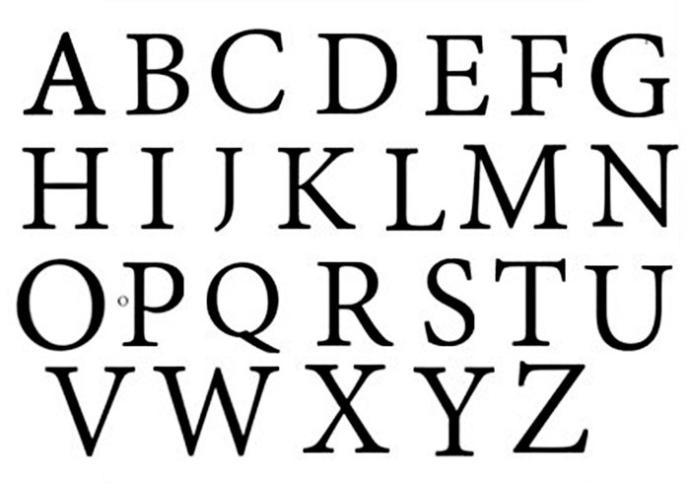
Want to hear your opinion. These pictures are just examples. You can mention other alphabets which isn't pictured here too. #Alphabet#Language#EasyVsHard The Latin alphabet used in the English language for example. In Norway we've Æ, Ø and Å too in addition to the "English" letters. Chinese signs. Arabic letters.
Speaking as a linguist, I feel uneasy about the words "easiest" and "hardest". Easiest to whom? Easiest in what way? It's a very unclear description.
If you ask which script is easiest to learn and grasp intellectually, it's almost certainly Hangeul. The reason for this is quite simple: Hangeul is the only writing system on the planet (and there are hundreds, if not thousands) that has been deliberately crafted in a conscious effort. All other scripts "naturally" evolved over long periods of time. Because of this, Hangeul is very logical and simplistic. It has fewer characters than the Latin alphabet and it is very systematic with almost no exceptions. The characters were even designed in a way that they would picture the physical image of the tongue/mouth as you're making that particular sound. This too, is a very unique feature. King Sejong, who invented Hangeul, is said to have claimed: "Hangeul is so simple that it can be learned by a wise man in half a day and by a fool in ten." I can say from my own experience that is pretty accurate. It took me maybe 4-5 days until I got the hang of it and another few days until I could remember all the characters. This is very different from the Japanese script for example. It took me months to know all the Hiragana and Katagana by heart and I never got over the first 50-or-so kanjis.
Now, for the prize of the most difficult script, there is certainly more than one contestant. Personally, I find this video about Tibetan very convincing:
Chinese is just ridiculous, in my opinion. My best friend is Chinese, and he has taught me a little Chinese. I can recognize a few dozen symbols, but there are just too many to memorize! Even my friend (who’s a native Chinese speaker) hates the Chinese writing system, and prefers an alphabet.
And if you’ve never seen a symbol before, there’s not a lot in the way of guessing what it means or how it’s pronounced.
And some symbols sound very similar (at least to non-native Chinese speakers), but mean entirely difference things. For example, 喝 (pinyin: Hē) means “to drink” and 和 (pinyin: Hé) means “and.”
I really only know the English and German alphabets. I personally think the German alphabet is easier (even though I’m a native English speaker), since German is much more phonetic than English. When I look at a German word I’ve never seen before, I’m 99.9% confident I can pronounce it correctly.
Arabic and English are the same to me in terms of order of letters and difficulty.
I believe Bengali is hard lmao. We have 50 letters and most Bengali people do not remember the the order of the letters lol. We have two different sets of alphabet (11 vowels and 39 consonants) Except for the vowels and first 25 consonants no one really remembers the order of the last alphabets, except for the primary school Bengali teacher. We have some different letters for the same sound but they are different letters because of the way they are pronounced by the position of the tongue. How crazy does that sound? Unless you read a lot of Bengali books you'll never really be able to spell words well. Bengali handwriting is kinda tough as well because some letters look similar and you have to ensure that you make no minor detailed mistake or else it becomes a totally different letter.
Disadvantages include you need to know several thousand characters to read a newspaper, for example.
Advantages include the same characters can be used across a variety of different languages, so that written communication is possible, even if the languages are not mutually intelligible.
It's like we use the symbol 5 to mean 'five' in English, 'cinq' in French, 'fem' in Danish, 'cinco' in Spanish etc - they all sound different, but in each language, the symbol 5 would *mean* the same thing.
I'm one of those people who finds languages pretty easy to pick up, but I don't kid myself I'm speaking them properly, as a local would - my key intention is to understand, and be understood, rather than to get it exactly right.
I get French spoken to me by my gal every day at home, but I reply in English, so my comprehension is pretty good, I speak it and read it well, but my written French is pretty kindergarten, likewise my Spanish.
I understand a fair bit of Portuguese and Italian, via the Spanish, but when I speak either, a lot of the vocabulary I'm using is in fact Spanish, but they get it.
Bits and pieces of others, too, Dutch, Greek, basic stuff in the Slavic languages.
I taught myself the Arabic alphabet (or abjad as it technically is, as it doesn't contain the full set of written vowels), but I don't speak the language. I can read the names on signs, though, which is useful when you're there.
Sometimes I'll pick up the odd spoken phrase or two, but not really, no.
I used to go to Copenhagen a lot for work, and was briefly seeing a Danish girl there, but as soon as you open your mouth, everybody defaults to English. It's hard to pick up a language in those circumstances. You learn a lot faster, when you actually *have* to.
Scandinavians are some of the very few non native-speakers who can pick up English without a discernable accent. Very few others can.
I don't know where you got the Chinese one but it's wrong. There are over 1000 characters and all of them represent a sylabal. Threy're not equivalent to our letters. I think Latin is the easiest and Arabic is the hardest because the symbols all look similar.
I am amazed how close Chinese letters are actually yo English when looking at them... English and Chinese are my choices... my bias is learning English first
I only know the English alphabet so I'm going to have English is the easiest whereas Chinese looks the hardest so I'll go with Chinese being the hardest one
I only know the English/Norwegian alphabet, so therefor I also think it's the easiest one. Chinese and Arabic seem hardest. Chinese because of they've more than thousand signs and Arabic because of the letters looks hard to write down, remember etc.
Ø is being pronunciation "U". Æ is being pronunciation "Ae". Å is being pronunciation like the "O" sound in the words "more" and "door".
Heh arabic is one of the hardest languages ever. Each letter can be spelt in 4 different ways and has different shapes depending on where it lies in the word. Its a really complex language.
 Girl's Behavior
  Guy's Behavior
  Flirting
  Dating
  Relationships
  Fashion & Beauty
  Health & Fitness
  Marriage & Weddings
  Shopping & Gifts
  Technology & Internet
  Break Up & Divorce
  Education & Career
  Entertainment & Arts
  Family & Friends
  Food & Beverage
  Hobbies & Leisure
  Other
Other  Religion & Spirituality
  Society & Politics
  Sports
  Travel
  Trending & News































Most Helpful Opinions