 Girl's Behavior
  Guy's Behavior
  Flirting
  Dating
  Relationships
  Fashion & Beauty
  Health & Fitness
  Marriage & Weddings
  Shopping & Gifts
  Technology & Internet
  Break Up & Divorce
  Education & Career
  Entertainment & Arts
  Family & Friends
  Food & Beverage
  Hobbies & Leisure
  Other
Other  Religion & Spirituality
  Society & Politics
  Sports
  Travel
  Trending & News


It’s a familiar scene, isn’t it? You’re playing a board game at a family gathering. Or perhaps you’re enjoying a casual late-night stroll down a poorly-lit alleyway in the rough part of town, having carelessly donned the jeans you wore last week that have several hundred-dollar bills hanging out the back pocket. Or maybe you’re at, say...oh, I don’t know, your workplace Christmas party.
Then, all of a sudden, something terrible happens.
Your drunk Uncle Harry speaks up. An intimidating figure wearing a hoodie and ski mask holds you up. Or twelve guys (mostly German) burst into the party and raise a ruckus. In each of these situations, the antagonist speaks these most provocative and ominous words...
“Die Hard is NOT a Christmas movie!”
Chaos and panic ensue. I, having heard said commotion on social media, spring into action. Armed with a sense of fun, sarcasm, and undeniable logic, I set out on G@G to fight the battle of *Don’t you dare say it...*
...
...G@G-atomi Plaza...
*Eyeroll, heavy sigh* I hate you...
1) “Ladies and gentlemen, due to Die Hard’s July theatrical release, you will be witnesses to its not being a Christmas movie.” Die Hard was released on July 15, 1988. But guess what? The original Miracle On 34th Street hit theaters on June 11,1947! While You Were Sleeping was released in theaters on April 21st in 1995 (for the record, Easter that year was on...waitforitwaitforitwaitforit...April 16TH!). White Christmas was released in theaters on October 14 ,1954, which is less than a month removed from the Fall Equinox of September 21st, which formally moves us from summer to fall.
The “Summer release date” argument, much like Tony, decks the halls with its face, takes a nasty tumble down a maintenance stairwell, and re-emerges in an elevator donned in gay apparel...
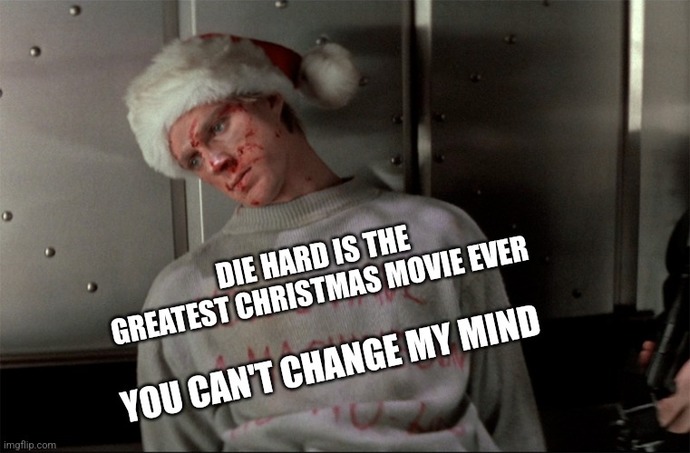
“Wait a minute. Really, dude? Really? You’re writing this MyTake as if it’s the plot to Die Hard?”
I am, dear reader! I am.
2) “G@G is full of bored college students and perverts. No, this is something else we’re dealing with here. He probably doesn’t realize that Christmas is irrelevant to Die Hard’s plot though.” Is it? Is it? Let’s look at the timeline. John McClane, a legal resident of and active police officer in New York City, arrives in Los Angeles on December 24th. He meets his estranged wife Holly, who invited him out to attend her office Christmas party and see his children for...*drumroll*...Christmas.
He discovers that Holly is using her maiden name of Gennaro again, which sparks an argument, during which they recall another argument they’d had in July. This implies that they’d been separated since at least then, if not August or September. Christmas would have been ideal, since it’s a time for estranged family to reconcile, many people tend to use up all of their unused vacation days, and ample time for tensions to settle between John and Holly would have passed.
Finally, quite simply, Hans Gruber & Co. chose to execute their plan on Christmas Eve, December 24th. They would have known that the Nakatomi Corporation’s LA office was having their Christmas party then. Terrorists are known to choose specific locations and dates in order to make statements, as Hans Gruber specifically intended to do. Therefore, the plot for Die Hard is heavily dependent on Christmas.
Thus, like Heinrich and Marco, down goes the “Irrelevant Christmas” argument.
3) “You have me at a loss, Ranger. Haven’t you seen Die Hard too many times? Haven’t you figured out that it’s not a Christmas movie, but an action movie that just takes place on Christmas? If it happened on Easter, July 4th, Passover, Valentine’s Day, St. Patrick’s Day, Cinco de Mayo, or any other holiday, would it be a...any-one-of-those-other-holidays movie? Do you really think you have a chance against us, Mr. Ranger?”
The same argument can also apply to the overwhelming majority of so-called “Christmas movies”. They’re either comedies or dramas, sometimes with romantic undertones, that just happened to be set on Christmas. Just switch the dates and a few other core elements and, like the rhetorical C4 that I’m about to drop down an elevator shaft and baptize this argument in fire, a la James and Alexander...

KA-BOOM! You have a...uh...any-one-of-the-other-above-listed-and-then-some-holidays movie.
Here’s an important hypothetical question. Do bad and ugly things not happen on Christmas?
- Has there never been a battle fought on or around Christmas? George Washington’s crossing of the Delaware, the First Battle of Fort Fisher, the Battle of the Bulge, and the Christmas Battles of 1916 certainly think there have.
- Has there never been a crime of any sort committed on or around Christmas? Do criminals just take Christmas off? The Santa Claus Bank Robbery (yes, you read that right; that is a real thing) in Texas in 1923 wishes they did, and so does this Christmas Day heist in 2016 in Canada.
If the aliens from Independence Day had arrived on November 25th or 26th (Thanksgiving in 1996 was on November 28th), we can reasonably assume that it would have been an Thanksgiving flick requiring only a title change. Take away the Christmas setting of Christmas Vacation and a few other ancillary elements and you have a generic comedy about a family reunion gone wrong. And who on earth takes 15 people from the United States to France on Christmas? Isn’t that more a summer-y thing (lookin’ YOUR way, Home Alone)?
I could go on and on, but alas, I have terrorists in the form of silly arguments to fight and defeat before Christmas fun is ruined forever.
Oh, and speaking of Home Alone...which, having thwarted another attempted surprise attack, this time personified by Fritz and Franco, we will...
4) “Christmas movies don’t have so much violence!” Excuse me, but has ANYONE heard ANYTHING that trauma surgeons say about Marv and Harry’s injuries in Home Alone?!?
This argument is both Dick Thornberg and Ellis.
5) Finally, a key element that truly makes a Christmas movie is that of redemption. Later in the film, while tending to injuries and speaking with Al Powell, we see McClane lamenting his failings as a man and a husband, which resulted in the loss of his marriage. He notes that Holly “heard me say ‘I love you’ thousands of times, but she never heard me say ‘I’m sorry’”. He notes that “She’s the best thing that ever happened to a bum like me.” Then, seriously wounded and still outnumbered and outgunned facing the very real possibility of his own imminent death, having been, he places himself at the providence and mercy of God, saying that it’s “up to the Man Upstairs”, a casual title given to God.
If, therefore, this important aspect is present during a film that takes place on or near Christmas (A Christmas Carol, How The Grinch Stole Christmas, and It’s A Wonderful Life), then whether the film is a comedy, a drama, or even a horror or action film, would certainly allow us to conclude that it is a Christmas movie.
Finally, having dispatched of all the other henchmen, we can now bid the “Die Hard is not a Christmas movie” conspiracy theory...















Most Helpful Opinions