 Girl's Behavior
  Guy's Behavior
  Flirting
  Dating
  Relationships
  Fashion & Beauty
  Health & Fitness
  Marriage & Weddings
  Shopping & Gifts
  Technology & Internet
  Break Up & Divorce
  Education & Career
  Entertainment & Arts
  Family & Friends
  Food & Beverage
  Hobbies & Leisure
  Other
Other  Religion & Spirituality
  Society & Politics
  Sports
  Travel
  Trending & News


What is color blindness?
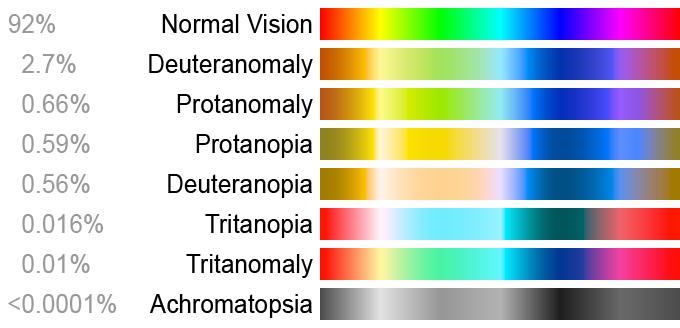
Everyone at some point has probably been presented with the simple test above to determine whether you are colorblind or not. If you can see the images within the circles, you aren't, and if you can't, you are. But color blindness isn't really the correct term because people with so called "color blindness," can see some colors or see colors differently then those that do not have the disorder; a better way of understanding this would be to say that they are "color deficient." Red-green color blindness is the most common, followed by blue-yellow color blindness, and finally the absence of color vision, or total color deficiency (very rare).
Who gets it?
As many as 8 percent of men and 0.5 percent of women with Northern European ancestry have the common form of red-green color blindness. Men are much more likely to be colorblind than women because the genes responsible for the most common, inherited color blindness are on the X chromosome. Males only have one X chromosome, while females have two X chromosomes. In females, a functional gene on only one of the X chromosomes is enough to compensate for the loss on the other. This kind of inheritance pattern is called X-linked, and primarily affects males. Inherited color blindness can be present at birth, begin in childhood, or not appear until the adult years. [National Eye Institute]

A "cure" for color deficiency
A company called EnChroma has developed sets of glasses to help compensate for the viewers color deficiencies. EnChroma says they developed a method called ‘multinotch’ filtering, which cuts out sharp wavelengths of light to enhance specific colors. EnChroma lenses separate the overlapping red and green cones, helping improve vision for people who have difficulty seeing reds and greens. And according to many youtubers and reviews, they work. The one downside is that the glasses are pretty pricey. https://enchroma.com/
I can't tell you what it's like to experience colors for the first time because I don't remember it, but a lot of the videos on YouTube really do give you an idea of what it's like to describe the experience of seeing new colors for the first time---the confusion, the discoveries, the joy--and it is amazing! There are other companies as well that make different types of glasses and contacts to help the wearer to see more color.
Do color deficient people need to be "cured?"
Most people who are color deficient are born with it, so when you mention needing to 'cure them,' it can be a touchy subject for some because it suggests that they are in some way flawed or incapable of doing what most people can do, but there are color deficient actors, artists, teachers, photographers, doctors, etc. who have made due because it is of course for them, the only world they've ever known and not a disability.
The same ongoing debate exists within the deaf community when it comes to "cures" like cochlear implants. One man described his experience with the glasses as being wonderful, but having not seen the additional colors his whole life, it became a distraction because he couldn't focus on anything but the colors, so opted to only sometimes wear them. Obviously at this point color deficiency has not yet been cured. Much like the cochlear implant, once you take these things off or turn them off, they person is still color deficient or in the case of the the implant, still deaf.
















Most Helpful Opinions