 Girl's Behavior
  Guy's Behavior
  Flirting
  Dating
  Relationships
  Fashion & Beauty
  Health & Fitness
  Marriage & Weddings
  Shopping & Gifts
  Technology & Internet
  Break Up & Divorce
  Education & Career
  Entertainment & Arts
  Family & Friends
  Food & Beverage
  Hobbies & Leisure
  Other
Other  Religion & Spirituality
  Society & Politics
  Sports
  Travel
  Trending & News
This will be a mytake of my personal experience with an autoimmune form of hair loss called Alopecia areata from this non approved drug called Xeljanz. There have been a total of 99 patients who were tested with this drug and the reports came out in early 2017 with high success rates. So I wanted to try this drug myself, but I'll get into all that later on. The doctor I went to also is a researcher and is now a famous one who gets lots of patients because of this discovery him and Dr. Angela Christiano made. He had some type of agreement between the company that made the drug where he could give his patients three months of the treatment for free. The drug is very expensive out of pocket $5000 for 60 tablets 5mg which only lasts you for one month. Anyways I only got two months for free. First I will show my before and after pics, then explain how the disease works and how the pill reverses the hair loss.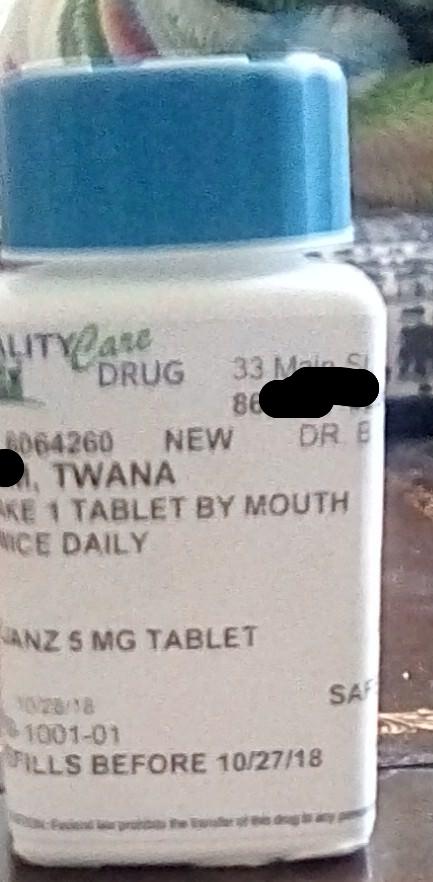
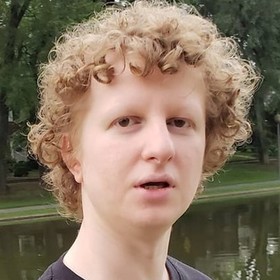
1. How I looked before Alopecia 


That's me in the above picture before I was unpredictably faced with this unpredictable disease. I was 21 when I first got it. Once you notice your first bald spot you are more likely to receive even more bald spots. Although not always. However that was the case with me. When you do get it the hair loss, it spreads like wildfire. It can happen to anyone and at any age. It is hereditary, so if you have had family members with it you are at greater risk. That includes uncles, aunts, cousins, brothers, sister, dads, and moms. "How did they find out it's genetic and what genes cause it?" Well it wasn't until 2010 in a wide genome study they found out what genes cause it and that it was genetic. They also found that it had very similar genetic similarities and same genes of Vitiligo, Type one diabetes, Celiacs disease, and even Thyroid disease. Next I will be showing how my bald spots looked and my before and after pictures. Then lastly I will show how the medicine helps reverse the disease and the whole infrastructure.
2. When I had Alopecia 


I had a lot of pictures of the different phases and levels of patches of hair I had lost, but I wouldn't be able to post all of them on here. So I just put up the ones I felt were most important. If you are interested I will be putting up an imgur album at the very end of my mytake of all my different levels of hair loss and before and after pictures. Here you can see all the different parts of my hairs being affected including my beard and mustache. You can see despite what parts of your hairs are being attacked they all are in a patchy form. You can see the different phases of hair loss I had faced to the point where I had Alopecia areata Universalis. Which is total hair loss in your head and your whole body. Everyone's bald spots forms and amounts are different, that's what makes it so unpredictable. Very few people lose 100% hair like 0.2% of people do. I was one of those unlucky people. However that didn't last long, mainly I was left with very few stubbes of hair on my head. About 2-5% of hair if I had to guess. Those hairs were in what they call "exclamation hairs" cause they are very brittle and stick out. That's what happens when the hairs lay dormant. The worst part was when my hair was long, but there were a couple of bald spots, quickly I lost my hair in clumps. When the hairs get attacked they get attacked very quickly and rapidly. That's when one day it was in like 2014 I had noticed clumps of my hair falling out. This went on for about 3 weeks until before I knew it I lost all my hair, being completely bald. I would go to sleep and after waking up I would have chunks of my hair in my mouth in my bedsheets and pillows. I would climb in the shower and there was so much hair on the bottom of the tub, more than a cat's hairball.
3. Alopecia self-recovery 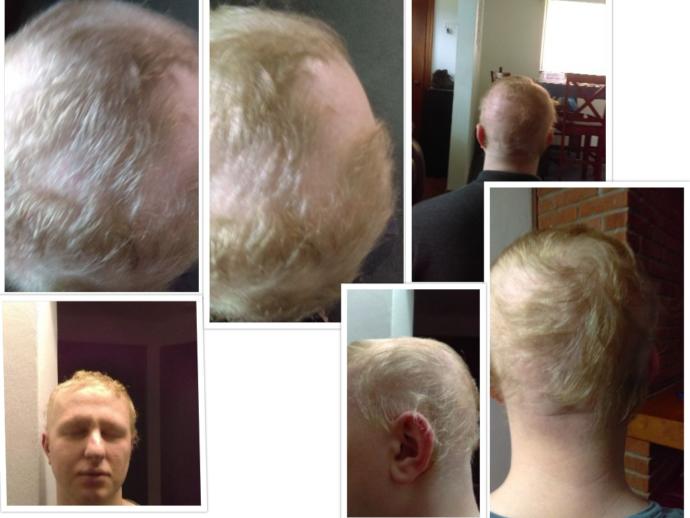

"So how did your hair regrow by itself?" This type of hair loss is much different than the type of hair loss most people know of, which is male or female pattern baldness. Also known as Androgenic alopecia. With Androgenic alopecia the hairs recede due to the hair cells being damaged or completely destroyed. There is much more about it, but I am not going to get into that. Basically the most common way you can tell someone has male or female pattern baldness vs. Alopecia areata is by looking at how the hair loss looks. People who have the typical pattern baldness their hair first starts out by thinning and in a pattern, the same goes for female pattern baldness. Where as people with areata the bald spots are very random looking and you can tell it has no pattern at all. If you took all the 6.5 million people in the U.S. with this condition you will see nobodies hair loss bald spots look exactly the same. I noticed my first bald spot on my eyebrows in March of 2013. That's another thing it can start off attacking any part of your hair not just on your head. That's also the biggest easiest difference to spot between the two diseases. That's part of the disease its so unpredictable, which is what makes it so frustrating. I didn't lose hair on my head until 2014 of January. By 2015 I had lost everything. The first things to go for me was my eyebrows, then my facial hair as you can see in the pictures, then it was hair on my head and at the same time hair on my pubes, legs, and arms. Then my eyelashes were the very last to go. One day out of nowhere some of the hair on my head started to regrow, its so weird how hair growth works it grows without you even truly noticing. It was last year 2017 on a late August. Then more grew back in early October, but then the hair growth stopped again. Thankfully no hair fell out either.
4. Treatment after two weeks 
I know it's difficult to believe that I regrew that much hair within two weeks. It's true though that's just the power of the drug and the power of science. I heard of this doctor three years before meeting him. He's now famous because of this discovery. He was the first to take a chance with this drug called Xeljanz on a patient. He was able to because the male patient had Alopecia and Psoriasis another autoimmune condition. This one was FDA approved so he was able to give him the drug at the time. I am going to show the rest of my after pictures first before explaining how the drug works.
5. Treatment after four weeks 
You can obviously still see the bald spots, but after a month notice the amount of hair growth. I went to that doctor in late October last year. He is from Connecticut and studied from Yale. I was so excited when I finally got to meet him. His name is Dr. Brett Andrew King. He had some sort of deal with the company making the drug "pfizer". So he was able to get me the medicine three months for free. Being monitored of course with blood tests. I could only get two months because by then my health insurance got cut.
6. Treatment after six weeks 
You can still see a few bald spots, but not as many and only a decent amount in the back of my neck. The good thing for me too was that most people don't grow that much hair that fast. The average amount of time to achieve 90% of hair regrowth in the clinical trials was four to five months. Keep in my mind I was only on the drug for two months. Eyelashes really starting to grow back and few eyebrows hair. I will show that in the next set of photos.
7. Treatment after two months 

So this was when I had ran out of the medication. The only difficult part was that every month I would have to take blood tests. As I hate needles with a passion. To me it was still worth it though. This one might not seem that much different than the six weeks pics. Just in case you couldn't pick up on it, I'll point them out to you. You can see the amount of eyebrow hair and even some facial hair regrowth. I really wanted to know how I would have done for five months or even one extra month. I feel like I could have achieved 100% hair regrowth almost everywhere. Still I am very grateful that I was able to take this pill and share it with you girls and guys. I stopped the medication in late January and I still have not lost any hair, at least not anymore than the average human being. Everyone loses hair, it's just that its in such small amounts vs. the amount of hair your growing everyday that you don't even notice. It's common for people to be off the medication and to experience hair loss again. I was more of the lucky ones and still have not lost any hair.
8. My current hair status 


"some of your hairs have grown back, but why are they so light and hard to see?" This is not actually a common question people ask or even think, but when it gets pointed out you notice. This is also part of the disease. Sometimes when the hair grows back, certain parts are a very light color, sometimes even white as you see in some of my above pictures. Those are called vellus hairs. However even those parts regrow its full color. Usually when that happens it takes about three months to a year for full color restoration. Scientists still aren't fully sure why this happens. As you can see from my eyebrows there are what they call terminal hairs, which are the visible hairs and what I explained earlier "vellus hairs." In most of the pictures you can't see much eyebrow hair, but my last pic under the sun, you can see all the eyebrow hairs. They just haven't fully regrown color and enough hair yet to be visible to the naked eye.
9. How the pill works
"How do we know your not just making this all up?" There are pictures and plenty of medicinal journal articles about the positive effects of these class of drugs for people with Alopecia. Not to mention plenty of videos now as well. "So how does this pill work?" There are these group of enzymes called Janus Kinase (JAK) that after being blocked help reverse the condition allowing hair to regrow. First they tested this on a male patient at Yale. There are two types of these drugs that have been tested. Xeljanz which is at Yale dermatology and Ruxolitinib, the one in the video which is at Columbia University. These two drugs are just different brand names, they do the same thing. The generic name is called Tofacitinib Citrate. Think of it like Advil and Tylenol, they do the same thing. In 2015 they tested this on mice, then onto three patients for four months as shown in the video. There are more trials to be done and soon they will be doing trials for the drug in a topical form (cream). This way it could have less side effects as opposed to taking it orally. Because these drugs are immunosuppressants, meaning it will weaken your white blood cells. Although in all the reports for people with this condition there hasn't been one report of any adverse side effects and only about two people got the flu. There are four different JAK proteins that help make this enzyme. An enzyme are just a group of proteins that act as a catalyst, which give a chemical like reaction. They did make a cream form on a teenager in 2017 and it proved to be effective. Within 16 weeks she regrew all of her hair. This also took place at Yale. "So why should I care?" This drug has not only been proven to help reverse this disease, but researchers also tested these drugs on patients with Vitiligo and Eczema. Remember how earlier I mentioned that these diseases had common genetic pathways? Well here is patient with Vitiligo after three months of being on Xeljanz. 
"How come I didn't hear about this in the news?" Because that is how the media is. If it's not about a mass shooting, celebrity screwing up, or rape then the media won't hype it up and people won't really pay attention to it. "Will this work on people with male and female pattern baldness?" 
This had been a question scientists wanted to know as well when they first discovered the effects of this drug on patients with Alopecia areata. Meet Mike Thomas, a 47 year old man who had Alopecia Areata and male pattern baldness. That's super rare, it's seldom for somebody to have both. He was one of the 66 patients on this trial in 2016 who took this drug. Within seven months his hair regrew to what you see from picture B. His hair did not fully grow back to how you would think because he still had receding hairlines from his other condition male pattern baldness (Androgenic alopecia). However according to the scientist who first discovered the genes to this disease and head researcher at Columbia university Dr. Angela Christiano, the drug has potencies to the hair follicles. Meaning it helps create growth factors and nutrients for your hairs. "common assumptions or questions people will be thinking about you." People will think you are a leukemia patient. They will think you shaved your hair like that on purpose. As if anybody would do that to their own hair. They will think your hairs got burned off.
10. What's it like to have Alopecia areata 
It's only common sense to have lack of empathy towards something you have never experienced. Hopefully nobody would get this disease, but for whatever unfortunate circumstance you do, I'll give you an idea of what it feels like. Imagine your looks being changed one day and noticing that in the mirror. We all have looked in the mirror on certain days and maybe we're insecure about something, but imagine the movie White chick or Hot Chick where your body and face completely change. Okay maybe that was an exaggeration, but you get my point. Not only does it make you less attractive, but it makes you feel like you have lost your "identity." Imagine a dog or cat with all that fur or coating of hair. Now imagine you take that all away from them. We've seen what a completely hairless dog or cat looks like. They look like rodents. Your hair not just on your head is like a big protective and attractive mask. Your eyebrows and other hairs in your body are the same. We don't think about someone's eyebrows when we look at them, but when somebody has missing eyebrows we notice it. Most people are even repulsed by it. Hair is important because in evolution we seek people who we think are healthy. Hair also acts as a mirror from the sun. Reflecting a lot of the dangerous UV rays.
#hairlivesmatter
Thanks for reading this mytake and letting me share this story. Hopefully my story has been inspirational for some people on here. I am just glad that after fives years I have regrown my hair. #Curetobaldness





























Most Helpful Opinions