 Girl's Behavior
  Guy's Behavior
  Flirting
  Dating
  Relationships
  Fashion & Beauty
  Health & Fitness
  Marriage & Weddings
  Shopping & Gifts
  Technology & Internet
  Break Up & Divorce
  Education & Career
  Entertainment & Arts
  Family & Friends
  Food & Beverage
  Hobbies & Leisure
  Other
Other  Religion & Spirituality
  Society & Politics
  Sports
  Travel
  Trending & News

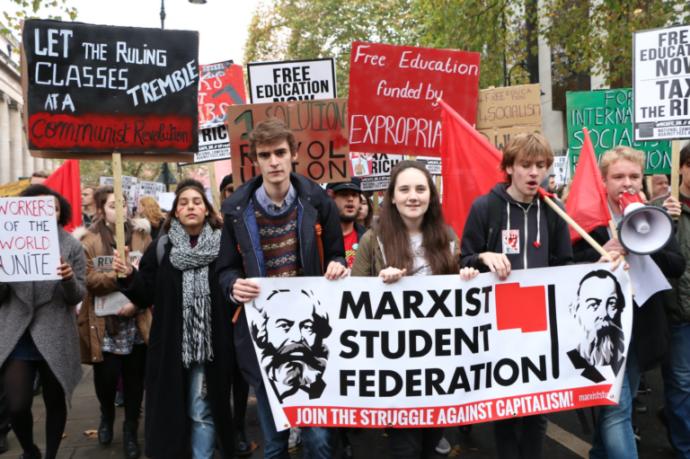
Why socialism now? At a time when the American economy under Trump seems to be chugging along at a nice clip, why are so many hankering for an alternative?
The newfound openness of large numbers of Americans to socialism is, by now, a well-documented phenomenon. According to a Gallup poll from earlier this year, 43 percent of Americans now believe that some form of socialism would be good thing, in contrast to 51 percent who are still against it. A Harris poll found that four in 10 Americans prefer socialism to capitalism.
The trend is particularly apparent in the young: Another Gallup poll showed that, as recently as 2010, 68 percent of people between 18 and 29 approved of capitalism, with only 51 percent approving of socialism, whereas in 2018, while the percentage among this age group favoring socialism was unchanged at 51 percent, those in favor of capitalism had dropped precipitously to 45 percent. The same poll showed that among Democrats, the popularity of socialism now stands at 57 percent, while capitalism is only at 47 percent, a marked departure from 2010 when the two were tied at 53 percent.
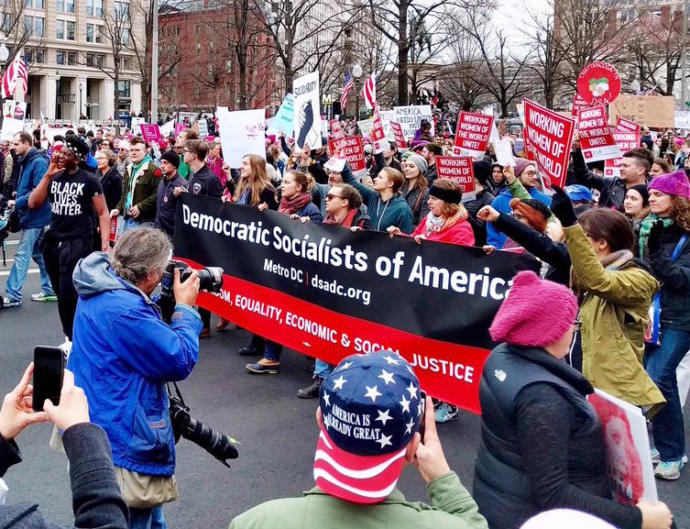
The question is why socialism now? At a time when the American economy under President Trump seems to be chugging along at a nice clip, why are so many hankering for an alternative? I suggest four factors contributing to the situation.
1. Ignorance of History
The first cause of socialism’s popularity, especially among the young, is obvious. Having grown up at a time after the end of the Cold War, the collapse of Europe’s Eastern Bloc and China’s transition to authoritarian capitalism, “these kids today” — the 18- to 29-year-olds who were born around the last decade of the 20th century — don’t know what socialism is all about. When they think socialism, they don’t think Stalin; they think Scandinavia.
Americans’ — especially young Americans’ — ignorance of history is well-documented and profound. As of 2018, only one in three Americans could pass a basic citizenship test, and of test-takers under the age of 45, that number dropped to 19 percent. That included such lowlights as having no clue why American colonists fought the British and believing that Dwight Eisenhower led the troops during the Civil War. Speaking of the war during which he actually led the troops, many millennials don’t know much about that either.
They don’t know what Auschwitz was (66 percent of millennials could not identify it). Twenty-two percent of them had not heard of the Holocaust. The Battle of the Bulge? Forget it. Go back further in time, and the cluelessness just keeps deepening.
2. Government Bungling
When we try to explain the socialist urge, we cannot lose sight of the fact that our government keeps interfering in the economy in ways that give people every reason to think the system is corrupt and needs to be trashed.
Take the skyrocketing cost of college, for instance. On the surface, this looks like greedy capitalist universities just continuing to raise tuition, and since most college kids and their parents can’t pay the sticker price, two-thirds take out loans, saddling young people trying to start their careers with a mountain of debt (almost $30,000 on average). This makes all those socialist promises of free college or loan forgiveness sound dandy.
Underneath the surface, however, a huge part of the problem is federal grants and subsidized loans. If the government stopped footing a large part of their bill, more students and parents would be forced to pony up, which would mean, in turn, that colleges would not be able to keep hiking prices without a precipitous drop in enrollment. They would, instead, be forced to price themselves at some level that applicants could realistically pay, making college more affordable for a large segment of the American middle class.
Another simple example of the problem is Obama’s Emergency Economic Stabilization Act of 2008, colloquially known as the big bank “bailout.” When kids grow up seeing government tossing out free lifelines to businesses that get themselves in dire straits, cause a massive financial crisis, and, in the process, lose ordinary folks lots of jobs and homes, we can’t blame them for concluding the system is rigged.
3. Universities’ Ideological Monoculture
The supporters of socialism are not simply the young, but they’re disproportionately young people who are college-educated. The more college they have, the hotter for socialism they get. According to a 2015 poll, support for socialism grows from 48 percent among those with a high school diploma or less, to 62 percent among college graduates, to 78 percent among those with post-graduate degrees.
Those on the left probably jump immediately to the conclusion that support for socialism is just a natural outgrowth of big brains and elite educations. But there is, in fact, a less obvious but ultimately far more compelling explanation: Something — something bad — is happening at universities to pull students toward the (far) left.
We have already seen above that what’s not happening at even elite universities today is a whole lot of education in important subjects such as history. What we are getting instead is a lot of groupthink and indoctrination. Universities have always skewed a bit left. But beginning in the early to mid 1990s (for reasons I’ve explained in some detail elsewhere), ideological diversity began to vanish entirely, as the leftward deviation turned tidal.
4. Coddled Kids
The young have always been more inclined to embrace pipe dreams. A lack of familiarity with the complicated way the world actually works, coupled with the college fix described above, will do that to most anyone. But there is a reason today’s young’uns are particularly susceptible to the red menace. In last year’s “The Coddling of the American Mind,” the prominent social psychologist Jonathan Haidt and the Foundation for Individual Rights in Education’s Greg Lukianoff describe a prevailing trend among kids growing up in the ’90s and ’00s. Their overprotective parents and educators instilled in them baseless and uncritical self-esteem.
When kids are raised to believe they are wonderful just as they are and get used to elders sheltering them from many of life’s ordinary difficulties and stresses and giving them trophies just for showing up, they never learn the critical life skills of self-soothing, working through anxiety, facing obstacles, and overcoming adversity. The predictable result, as Haidt and Lukianoff observe, is a demand to be safeguarded through safe spaces, free speech crackdowns, and so on.
But the result is also the propensity to blame others for personal failures. When people can’t compete with others on a level playing field, they simply call for the playing field to be tilted in their favor, saying the system is compromised by discrimination, institutional racism, sexism, etc. When they can’t compete in the capitalist marketplace, they call for socialism, which they imagine will result in a warm, fuzzy, and caring mommy-state that tends to their physical and emotional needs.
Taking on the Socialism Tsunami
If these four are the primary causes of socialism’s rapid surge in our midst, then the next logical question is what to do about it. There is no easy answer, of course, but I suggest the radicalization of academia is the linchpin issue. If we could succeed in reversing that tsunami, many dominoes would fall.
To address the university mono culture that systematically distorts research, sends students veering hard left, and graduates generations of left-orthodox clones would affect journalism, government, education, entertainment, and other influential sectors these graduates enter. This, in turn, would shape the other three downstream issues factoring into socialism’s rise: government policy, educational philosophy, and the manner in which history is taught.
Many have observed that our universities are in crisis, but that crisis also represents an opportunity to avert the much larger socialist cataclysm that threatens to engulf us all.


























Most Helpful Opinions