The question is problematic. If a party is too exclusive it will not be able to appeal to other voters and will forfeit the chance to gain power. By the same token, if it is too inclusive it will lack any cohesive ideology or other identifying marker to which voters can rally and will again fail to gain power.
In truth, the question is contextual. American political parties are not ideological parties, but are rather lose knit coalitions of various demographic, geographic, ideological, cultural and other groups that have come together in part by historical accident and in part by common interests.
This is how you get a Republican Party that runs from Ted Cruz at one end to Susan Collins at the other, with the libertarian Rand Paul thrown into the mix. This is how you get a Democratic Party that runs from Joe Manchin at one end to Elizabeth Warren at the other.
This being even more complicated by the fact that both parties are experiencing a populist phase as happened in the late 19th century and again in the 1960s and 70s. Populism not being a schematic philosophy, but rather a cultural attitude characterized by distrust of complexity, a disdain for elites, and a belief that the common man is the font of all virtue but that he is oppressed by the elites and the "special interests." This manifesting itself in a mishmash of policies that are more often related by sentiment than any coherent overarching theoretical structure.
Thus, for example, has the Republican party, which was considered the party of the rich and free markets, become the party of the working class and trade protectionism, The Democrats, once the party of the "common man" is now the party of the well to do and advocates free trade with China.
Put simply, these things are not static and will shift with demographic, economic and cultural changes. Further, much depends on the structure of the voting system and more broadly on the nature and history of the country.
Thus do the political parties in Europe tend to be more ideological. Except, for example, in Italy, where the parties are weak and tend to "come and go," so to speak. See, for example, the Christian Democratic party which began as a fairly conservative party but over time became a party of regional interests and thus of no particular philosophy - and dominated Italian politics from the end of World War II until the 1990s.
See also Japan, where the Liberal Democratic party ran EVERY government in Japan from the 1950s through to the 1990s. The party was broadly - in a cultural sense - conservative and what mattered was not the ideology per se, but what faction in the party gained dominance. This period coinciding with Japan's astonishing rise to economic prosperity and dominance - at one point being the 2nd largest economy in he world - in the post-WWII era.
So the answer to the question is cultural and contextual - at least in the context of Western democratic societies. Obviously, in China, an inclusive communist party would be an oxymoron. In many of the countries of Africa and Asia, parties tend to reflect tribal, ethnic, racial or religious identities.
Here again, though, the answer is contextual and historical. The question, as posed, can thus really only be answered in two words. "It depends."
I'm not even sure what that means. The political parties are basically private organizations and can make any rules they want. On the other hand, as far as I know there is nothing to "join".
In primary elections you can register with a party, but that doesn't make you a member. For primary elections I strongly believe they should be closed to only people registered with that party.
I remember donating five bucks to a political thing once. I don't remember what it was, but it wasn't a candidate. I will never donate to a political candidate. Shortly after that I got a membership card for the national committee. In other words, even being on the Democrat/Republican National Committee is meaningless.
Other than that, I don't know what you mean by inclusive or exclusive.
Good points. And @exitseven brings up an interesting angle. Should parties try to be more closely aligned to specific members rather try to be a big wide tent?
Dems do have a harder time pleasing smaller minorities whom they need to vote but don’t need to pass laws for.
The "party line" has definitely narrowed. It's part of the larger trend of a split country and the attitude that "If you aren't with us you're against us."
Not too long ago the conventional wisdom was to win an election you had to capture the hearts and minds of the middle. Neither major party does that any more. They take a hard stance on the right or left, and rely on voter turnout from the respective hard right or hard left. They no longer care about the middle, which is actually quite large.
There are a lot of moderate politicians around. But when they get in office there is so much pressure to align with whatever party they happen to belong to. Moderate politicians virtually always shift toward the party line. They might not shift all the way to the hard right or left, but they do shift.
If this is the definition of inclusive and exclusive, I think they should be inclusive. I think they should make room for that crowd in the middle. I don't know if there is a corresponding word for a Democrat, but the Republicans call a moderate conservative a RINO, and from their point of view it's very derogatory.
Both parties are shooting themselves in the foot by doing that. What's worse is they are shooting the country in the foot and it's tearing the country apart.
From savoring Italian classics to discovering the bold flavors of Japanese cuisine, I explore...
Fashionista Amy
I'm here to inspire and guide you with a touch of latest trends or advice on personal style.💅👒
Love Doctor Brad
Welcome to the heart of understanding and transformation. I am your guide on this journey to...
Cinematic Lily
With my rich background and passion for the arts, I share insights on films, TV shows, and...
Gamer Bella
With my passion and experience in hobbies and leisure activities, I'm here to offer personalized...
Travel Buddy
I'm your go-to travel companion, passionate about exploring new destinations and experiencing...
Advisor Smith
With years of experience guiding individuals in their education and career paths, I'm here to...
Laura
Have questions about GirlsAskGuys? I'm here to help!
Athletic Chloe
Whether you need tips on improving your game, insights on fitness and nutrition, or just want to...
What Girls & Guys Said
1
Opinion
10
Opinion
Anonymous
(30-35)
+1 y
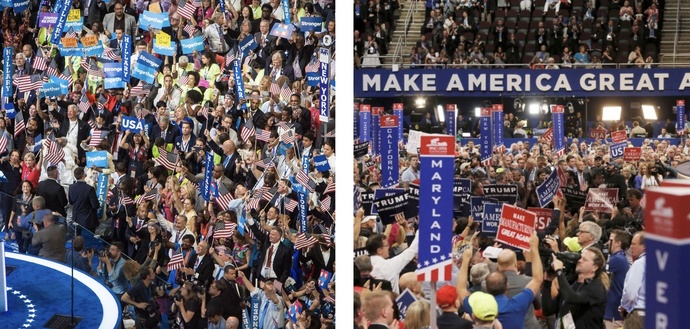
Inclusive of course. Its better to not drive away people by claiming they can't be black unless they vote for you, suggest race based hurrican aid, have a online security expert that threatens justices just because they made a decision she did not like or other things like that. Better to support the inclusive guy who wants to make his country great again. A dislike to this comment is a dislike to the idea that the Roe V Wade verdict was bad and the BLM "protests" (riots) were necessary. If they were not USA would have been great, right?
They are WAAAAAAAAAAAAAAY too narrow and "pure" and all or nothing.
Too bad there aren't 4 or 5 parties so that peoples' views on matters could be more adequately represented instead of 2 and only 2 parties. Everything about this party is good and everything about the other party is evil and we cannot agree on a single thing.
F the parties.
Five or Six parties would be great with more diverse ideas and representation.
28.7K opinions shared on Society & Politics topic.
President Trump re energized the Republican Party by making it more inclusive. Anyone who believed in the American Dream was invited. Even people who were just kicking the tires.

 Girl's Behavior
  Guy's Behavior
  Flirting
  Dating
  Relationships
  Fashion & Beauty
  Health & Fitness
  Marriage & Weddings
  Shopping & Gifts
  Technology & Internet
  Break Up & Divorce
  Education & Career
  Entertainment & Arts
  Family & Friends
  Food & Beverage
  Hobbies & Leisure
  Other
Other  Religion & Spirituality
  Society & Politics
  Sports
  Travel
  Trending & News