Should contempt of court penalties trigger a right to jury trial?


I am not sure what you mean by "Should contempt of court penalties trigger a right to jury trial?".
Do you mean that being in contempt of court should trigger a jury trial? That being in contempt is a "criminal offense" that requires having a trial and conviction?
Please clarify either way...
For the moment, I will assume what I wrote is what you suggest.
In that case, no; no jury trial. I know that this sounds crazy, but, from a logic perspective, this induces a potentially infinite iterative loop.
Let's do an example:
A federal court gives Dan Tramp a "subpoena duces tecum" (*) which is a subpoena to produce artifacts that would be used in a legal setting.
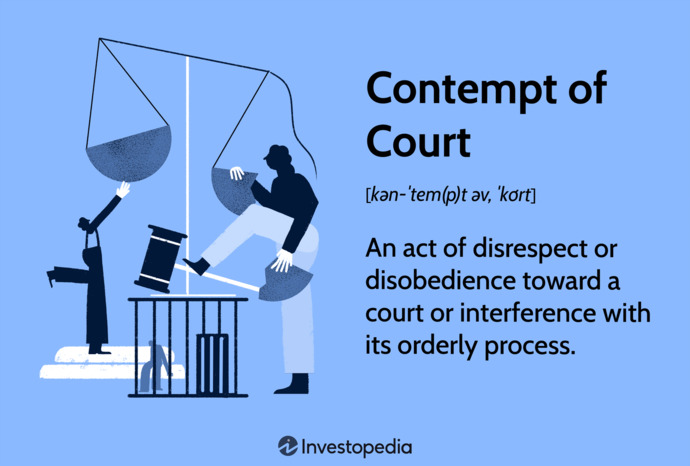
Dan refuses to comply with the subpoena. That's contempt of court.
Now, suppose under your proposed system (if I understand you correctly), Dan is given a trial over the contempt of court offense.
In this trial, Dan commits contempt of court. So, now, Dan is going tiso have a 2nd trial for THAT 2nd contempt of court charge.
This 2nd trial likely must be ended before the 1st trial is completed. Now suppose Dan commits contempt of court during the 2nd trial. So, now, Dan is going to have a 3rd trial for this 3rd contempt of court charge...
Et cetera. So, in theory, this could go on forever and issue would never be resolved.
No, when you commit a "crime" within the judicial process itself, the court is the judge and jury right then and there. This type of "crime" is a crime against the judicial process itself and no one is more qualified than justice professionals such as judges to determine if their own orders are being held in contempt.
Generally, for society to function, we have to have a certain level of fundamental trust for certain groups of citizens. For instance, members of the judicial and law enforcement community, the military, and the medical profession. (**)
Anyway, that's why the court's order is called a "subpoena" - that's Latin for "under penalty". It compels the person receiving the subpoena to act and not acting risks a penalty issued by that court. The person receiving the subpoena understands this so knowingly violating that is an acknowledgement
(*) A subpoena duces tecum is a type of subpoena that requires the witness to produce documents, books, records, or other evidence pertinent to a legal proceeding.
https://www.law.cornell.edu/wex/subpoena_duces_tecum
(**) If we fail to have some trust at some level in our society, then we need to have police for everything and everyone... including the police themselves and then those who police the police need policing themselves... and then THEY need policing... and then THEY need policing, etc. So, like in the earlier example, we'd have an infinite iterative loop.
For societies and pretty much all human activities, we need some foundational principles from which all else follows and relies upon. So, in a society, this means we have to prima facie trust the people engaged in certain basic operations of the society and address infractions as they occur, but we can't assume that everyone is "corrupt". That just induces paranoia and dysfuntion.
This idea trusting certain foundations in a society should remind you of mathematics in which we have with axioms and postulates and develop theorems from there.
Now, I'm going off on a tangent for a bit...
You've likely heard of "non-Euclidean geometry". In Euclidean geometry, there are 5 postulates. The 5th postulate, often called "The Parallel Postulate", is:
If a straight line intersects two other straight lines forming two interior angles on the same side that are less than two right angles, then the two lines, if extended indefinitely, meet on that side on which the angles sum to less than two right angles.
So, intuitively, if the interior angles are both right angles, then those two straight lines are parallel and never meet.
Non-Euclidean geometry is a geometry in which the 5th postulate is not true.
Here's an example: If you take two lines of longitude on a globe, you notice that they are parallel; they make right angles with the equator or any other line of latitude. Yet, the lines of longitude meet at the North and South Poles. That's a violation of Euclid's 5th Postulate. This is the realm of spherical geometry which is a non-Euclidean geometry.
I am not 100% sure I understand you, but I think I do.
First, if it is a criminal trial, Dan will likely be in custody when the trial begins, so he'll show up.
If it is a civil trial, he doesn't need to be there at all except for any testimony (which can be given via a recording entered into the record).
If a person is charged and is never in custody, then, yes, they can be tried "in absentia".
But, your question is about contempt of court and there are many ways to illustrate contempt. For instance, being at a trial and one of the parties to the case says "Fuck you, judge!", that person is going to be hit with a contempt of court charge right there including any punishment.
So, again, I want to make sure I understand your original question...
You wrote:
"Should contempt of court penalties trigger a right to jury trial?"
The word that is confusing me is "penalties". How would "penalties" trigger a jury trial?
Please clarify your question or elaborate (maybe in an update) so I can make sure that I am properly answering it.
Governments are evil and need to be under the control of the people. In the USA, technically, the people have the vote, but in effect, they don't. People wanted term limits. The government did not so the government won. The court is part of the government. With a few exceptions, their rulings favor the government.
Initially, the jury had the right to judge the law and the facts. In effect, the court said otherwise. People used to have the right to remain silent. Now they don't without first expressing it. Initially, there is freedom. Governments chip away until some time in the future, there will be tyranny. We are not North Korea or Cuba, and hopefully never will be. We are not even China, but that is the direction we are headed.
Governments are evil, but so are people. If the people are in control, the majority will oppress the minorities. I believe that is why we are supposed to be a Republic, but instead we are a democracy ruled by the government. I liked every policeman that I have met, but I don't trust the organization.
Penalties are determined in one of two ways.
1. Usually by statute, there are certain minimum and maximum penalties. You will often see that. Pick any federal crime in the United States Code, and you will see that.
2. One of the reasons judges exist is to evaluate what the penalty should be based upon what the statute says. If a penalty is too harsh, the recipient of the penalty can appeal, often on 8th amendment grounds. In criminal cases, a judge will often have to create a sentencing memorandum which both the prosecution and the defense read and get to chime on. Eventually there is a sentencing order.. The purpose of the sentencing memorandum is to explain how the specific sentence was arrived at. That document protects the judge in a sense because the judge is documenting his thought process when rendering the sentence.
I don't know. The whole contempt thing is stupid. The judge can disrespect YOU, but not the other way around.
I would say YES, though seems like a waste of time and resouces. The judge should just be respectful. You can get contempt if you aren't even on trial, or just being interviewed for jury duty. If they're gonna punish people for disrespect in court, the judge should be punished too.
Opinion
9Opinion
The right to jury trial in most places is tied to the right to jury trial as it existed under the common l aw of England on July 4, 1776. If a particular type of case had a right to jury trial back then, that right cannot be taken away from the citizens. For those types of cases which did not exist on July 4, 1776, Congress and the state legislatures are free to make jury trials available, or to make such cases subject to bench trials only.
Under the common law of England on July 4, 1776, jury trials were not allowed for contempt charges.
Certainly should but never will because a jury is likely to conclude the judge was an arsehole and find the person not guilty on principle.
In Australia in the past you could be sentenced to 'At his Majesty's pleasure' which meant you went to jail till you grovelled enough to be released. I doubt the US would have an equivalent sentence but maybe it does.
Correct me if I'm wrong, but isn't the right to a jury trial part of the federal and state constitution (s)? How would a contempt of court charge take that away?
It does not and cannot. People are cited for comtempt when they disrupt the judicial process. It would be counterproductive to give them additional opportunities for disruption. Their attorney can appeal the contempt citation.
No, but that contempt is sketchy. Judges have JUST a little too much power.
no it depends on the case and how big it is
why would it? follow me?
follow me so we can discuss on dm
Nope!
Get new judge
You can also add your opinion below!

Most Helpful Opinions