 Girl's Behavior
  Guy's Behavior
  Flirting
  Dating
  Relationships
  Fashion & Beauty
  Health & Fitness
  Marriage & Weddings
  Shopping & Gifts
  Technology & Internet
  Break Up & Divorce
  Education & Career
  Entertainment & Arts
  Family & Friends
  Food & Beverage
  Hobbies & Leisure
  Other
Other  Religion & Spirituality
  Society & Politics
  Sports
  Travel
  Trending & News

Maths, the one and only thing that's straight in this twisted world. This is the demon which haunts everyone, is present everywhere and you can never get rid of it.
But it has, like everything you see around, has evolved with time.
So set the sail and surf through my take to see the beast in its various forms.
1.Roman Numerals
The numeric system represented by Roman numerals originated in ancient Rome and remained the usual way of writing numbers throughout Europe well into the Late Middle Ages. Numbers in this system are represented by combinations of letters from the Latin alphabet. Roman numerals, as used today, are based on seven symbols
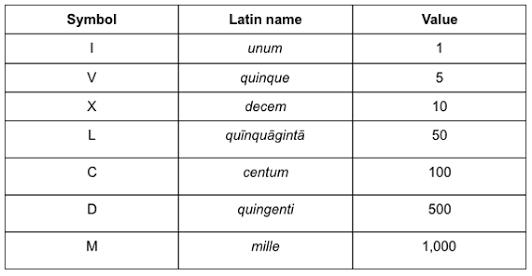
Numbers are formed by combining symbols and adding the values, so II is two (two ones) and XIII is thirteen (a ten and three ones). Because each numeral has a fixed value rather than representing multiples of ten, one hundred and so on, according to position, there is no need for "place keeping" zeros, as in numbers like 207 or 1066; those numbers are written as CCVII (two hundreds, a five and two ones) and MLXVI (a thousand, a fifty, a ten, a five and a one).
Symbols are placed from left to right in order of value, starting with the largest.
2.Chinese Numerals
The Chinese character numeral system consists of the Chinese characters used by the Chinese written language to write spoken numerals.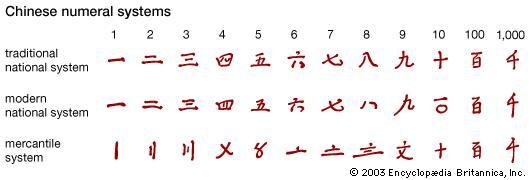
Similar to spelling-out numbers in English (e.g , "one thousand nine hundred forty-five"), it is not an independent system. Since it reflects spoken language, it does not use the positional system as in Arabic numerals, in the same way that spelling out numbers in English does not.
This system is also used by in Japanese although, the Japanese prefer to use the Hindu-Arabic system, the Chinese characters are used in some formal occasions.
The sound of Chinese symbols varies by region. The traditional Mandarin sounds are

The Japanese pronunciations for the same are,
Ichi, Nii, San, Shi/Yo, Go, Roku, Nana, Hachi, Kyuu, Juu, respectively.
The Koreans use the Chinese symbols in their own unique way, but the Korean and sino-korean system will be an other story.
3.Egyptian Numerals
The system of ancient Egyptian numerals was used in Ancient Egypt around 3000 BC until the early first millennium AD. It was a system of numeration based on the scale of ten, often rounded off to the higher power, written in hieroglyphs, but they had no concept of a place-valued system such as the decimal system is. The hieratic form of numerals stressed an exact finite series notation, ciphered one to one onto the Egyptian alphabet. The Ancient Egyptian system used bases of ten.

4.Greek Numerals
Now we get serious! The Greek system was more simplified that the others.
Greek numerals are decimal, based on powers of 10. The units from 1 to 9 are assigned to the first nine letters of the old Ionic alphabet from alpha to theta. Instead of reusing these numbers to form multiples of the higher powers of ten, however, each multiple of ten from 10 to 90 was assigned its own separate letter from the next nine letters of the Ionic alphabet from iota to koppa. Each multiple of one hundred from 100 to 900 was then assigned its own separate letter as well, from rho to sampi.
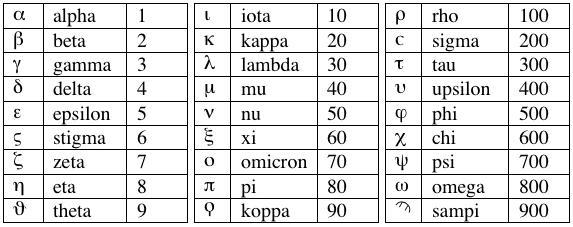
This alphabetic system operates on the additive principle in which the numeric values of the letters are added together to obtain the total.
For example,
π pi
n eta
= 80+8= 88
5. Hindu-Arabic Numeral System
Behold the best system till date.
The Hindu–Arabic numeral system or Hindu numeral system, a positional decimal numeral system, is the most common system for the symbolic representation of numbers in the world.
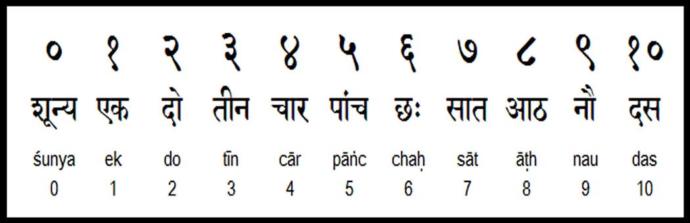
It was invented between the 1st and 4th centuries by Indian mathematicians and introduced to the Persian and Arab traders. The system was adopted by Persian mathematicians by the 9th century.
The glyphs representing the quantities changed as the system made way to
the middle east and to Europe.
It later spread to medieval Europe by the High Middle Ages thanks to the Arab and Turk traders.
The symbols in use today were first seen when the system made its way into north central Europe, in Germania.
In Christian Europe, the first mention and representation of Hindu-Arabic numerals (from one to nine, without zero), is in the Codex Vigilanus, an illuminated compilation of various historical documents from the Visigothic period in Spain, written in the year 976 by three monks of the Riojan monastery of San Martín de Albelda.
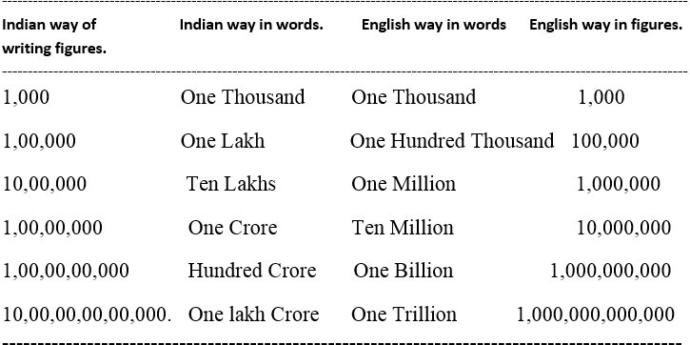
While the Indian system to represent large numbers is by using multiples of hundred, the European system does so by using multiples of thousands.
That's all folks! If you read all the way here, you have my gratitude.
Especially if you are a girl, because












What Girls & Guys Said
Opinion
0Opinion
The number systems featured here are the most known ones. Here are some less-known numerical systems that have served its purpose in their civilizations of origin:
This one's from Ethiopia. The country takes pride in the absence of colonialism in their history.
danramer.altervista.org/ETHIOPIAN_NUMERALS.jpg
The Mayans' numerical system
s-media-cache-ak0.pinimg.com/.../...6b705cf37a.jpg
The Maharlikang system from the Philippines
www.omniglot.com/images/writing/alibatas04.gif
The Aztecs' numerical system
content.ncetm.org.uk/.../38_72.gif
The Chinese numerals, when used in Japanese numbering, also has this "formula" in order to function the similar way the Greek numerals would, especially when the numbers exceed twenty: main number multiplied by power of ten plus main number. The bases would be the powers of ten: 十 (10), 百 (100), 千 (1000), and the ones added and multiplied are first ten main numbers 〇 一 二 三 四 五 六 七 八 九. If I were to write these numbers in Japanese, it would be this:
21 would be 二十 一 (2 multiplied to 10 then 1 will be added afterwards)
36 would be 三十 六 (3 multiplied to 10 then 6 will be added afterwards)
I'd like to say that this is unique and educational because I do not see Takes like this in this site. This is a refreshing contribution, so keep writing! :)
Will do!
ahh I was gna mention the Mayan numbers, but you beat me to it.
Hey, you had a birthday some time recently. Happy bday <3
@redeyemindtricks The Mayan numerical system has the most unique-looking zero! Thank you very much! I didn't really expect for someone to notice the age change, so I feel valued :) <3
ahah no worries bb
What about when Italy owned Ethiopia?
@BigBallerSodaPop It wasn't exclusive to Ethiopia, though, and Ethiopia managed to break free years later. Italy included Eritrea and Somalia beforehand as their "own" which were their colonies.
Everyone managed to break free. It still doesn't mean they didn't lose a war of colonialism against Mussolini.
interesting