 Girl's Behavior
  Guy's Behavior
  Flirting
  Dating
  Relationships
  Fashion & Beauty
  Health & Fitness
  Marriage & Weddings
  Shopping & Gifts
  Technology & Internet
  Break Up & Divorce
  Education & Career
  Entertainment & Arts
  Family & Friends
  Food & Beverage
  Hobbies & Leisure
  Other
Other  Religion & Spirituality
  Society & Politics
  Sports
  Travel
  Trending & News

Why I am Pro-Choice.
1. Fetuses are not beings
Personhood begins after a fetus becomes "viable" (able to survive outside the womb) or after birth, not at conception. Embryos and fetuses are not independent, self-determining beings, and abortion is the termination of a pregnancy, not a baby. A person's age is calculated from birth date, not conception, and fetuses are not counted in the US Census. The majority opinion in Roe v. Wade states that the word 'person,' as used in the Fourteenth Amendment of the US Constitution, does not include the unborn.
2. Fetuses are incapable of feeling pain
According to Britain's Royal College of Obstetricians and Gynaecologists, most neuroscientists believe that the cortex is necessary for pain perception. The cortex does not become functional until at least the 26th week of a fetus' development, long after most abortions are performed.
This finding was endorsed in 2012 by the American College of Obstetricians and Gynecologists, which stated that there is no legitimate scientific information that supports the statement that a fetus experiences pain. A 2005 University of California at San Francisco study said fetuses can't feel pain until the 29th or 30th week of gestation.
Abortions that late into a pregnancy are extremely rare and are often restricted by state laws. According to the University of Birmingham, fetuses cannot be held to experience pain. Not only has the biological development not yet occurred to support pain experience, but the environment after birth, so necessary to the development of pain experience, is also yet to occur. The "flinching" and other reactions seen in fetuses when they detect pain stimuli are mere reflexes, not an indication that the fetus is perceiving or "feeling" anything.

3. Reducing Maternal Injury and Death
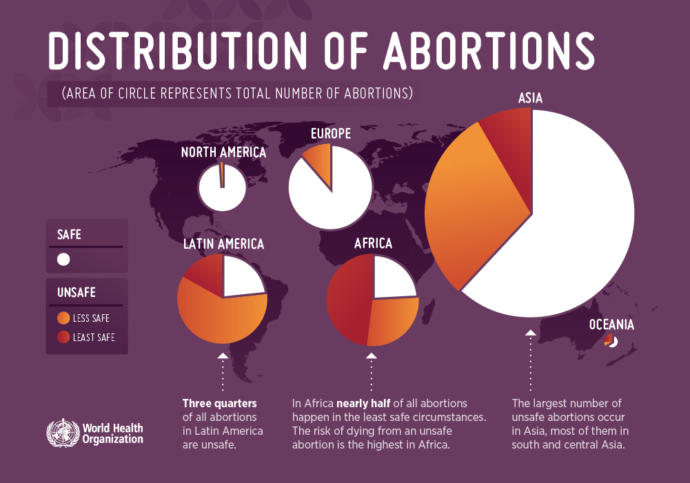
Abortion should always be legal because access to legal, professionally-performed abortions reduces maternal injury and death caused by unsafe, illegal abortions. According to the Keck School of Medicine, before abortion was legalized women would frequently try to induce abortions by using coat hangers, knitting needles, or radiator flush, or by going to unsafe back-alley abortionists. In 1972, there were 39 maternal deaths from illegal abortions. By 1976, after Roe v. Wade had legalized abortion nationwide, this number dropped to two. The World Health Organization estimated in 2004 that unsafe abortions cause 68,000 maternal deaths worldwide each year, many of those in developing countries where safe and legal abortion services are difficult to access.
4. Profound Abnormalities
Abortion gives pregnant women the option to choose not to bring fetuses with profound abnormalities to full term. Some fetuses have such severe disorders that death is guaranteed before or shortly after birth. These include anencephaly, in which the brain is missing, and limb-body wall complex, in which organs develop outside the body cavity. It would be cruel to force women to carry fetuses with fatal congenital defects to term.
5. Financial Disadvantage
Women who are denied abortions are more likely to become unemployed, to be on public welfare, to be below the poverty line, and to become victims of domestic violence. A University of California at San Francisco study found that women who were turned away from abortion clinics were three times more likely to be below the poverty level two years later than women who were able to obtain abortions. The same study found that women unable to obtain abortions were more likely to stay in a relationship with an abusive partner than women who had an abortion, and were more than twice as likely to become victims of domestic violence.
Many women who choose abortion don't have the financial resources to support a child. 42% of women having abortions are below the federal poverty level. A 2005 survey in the Perspectives on Sexual and Reproductive Health asking women why they had an abortion found that 73% of respondents said they could not afford to have a baby, and 38% said giving birth would interfere with their education and career goals.

6. Unwanted Babies
A baby should not come into the world unwanted. Having a child is an important decision that requires consideration, preparation, and planning. The Colorado Department of Public Health and Environment stated that unintended pregnancies are associated with birth defects, low birth weight, maternal depression, increased risk of child abuse, lower educational attainment, delayed entry into prenatal care, a high risk of physical violence during pregnancy, and reduced rates of breastfeeding.

7. In the end,
Reproductive choice empowers women by giving them control over their own bodies. The choice over when and whether to have children is central to a woman's independence and ability to determine her future.

No offence intended! Don't be butthurt and comment your thoughts(:












What Girls & Guys Said
Opinion
2Opinion
If a woman can abort, a man should be able to. Financially, of course, after all it's her body.
Unless it's not ACTUAL equality you want, but a convenient double standard that only serves women.
As for whether abortion is murder, I'll play devil's advocate and say, okay, sure, it's murder. But then, I have no ethical objection to murder. Most people are so god damn worthless and stupid that all they're good for is meat, and not even quality meat given how fuck-awful their diets are; prison grade meat.
I agree