 Girl's Behavior
  Guy's Behavior
  Flirting
  Dating
  Relationships
  Fashion & Beauty
  Health & Fitness
  Marriage & Weddings
  Shopping & Gifts
  Technology & Internet
  Break Up & Divorce
  Education & Career
  Entertainment & Arts
  Family & Friends
  Food & Beverage
  Hobbies & Leisure
  Other
Other  Religion & Spirituality
  Society & Politics
  Sports
  Travel
  Trending & News

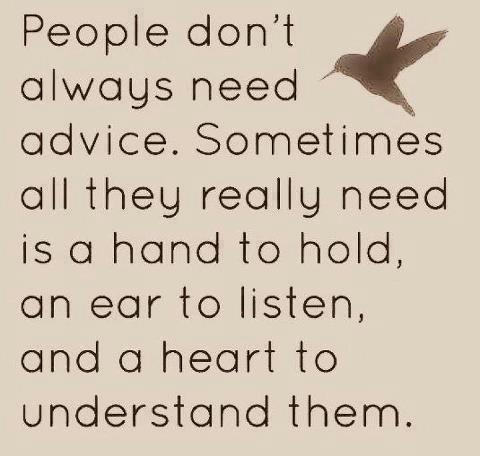
Sometimes giving unsolicited advice is not the best thing in the world to do when a friend or family member has a problem. Sometimes that advice comes from a hypocritical place; we tell them to do the same exact thing we are not doing in our own lives. Sometimes, we just want to hear ourselves talk and not really listen to what our friends are really saying or explaining to us. Other times we are looking out for ourselves and our own best interests if we are going to some how be affected by what our friend or family is doing, so we tailor that advice to fit our own needs, rather than giving fair and unbiased opinions. So what should you do the next time a friend approaches you with something they need to tell you?

Open your ears, not your mouth
Just let your friend talk to you and don't butt in with everything you feel you need to say at every juncture. So many times, even the best of us will just yammer on and never let the other person have a say in their own issue. If they are all talked out and they are asking you for advice, then by all means, but try just to really listen and support them in anyway you can without telling them what they "have to do. "
Try being empathetic and supportive
If your friend is going through some rough stuff, be empathetic first and foremost. Don't jump in and invalidate their experiences by saying "someone else has it worse," or "that's nothing, I went through that." No one wants to hear that when they are dealing with their own situation. They want to at least hear initially that you get it and understand to the best of your ability, what they are going through without making their situation, all about you. The support comes in the form of being there for them as they are working through their situation. You can listen first, you can empathize, but then back it up by being there.
Lend a helping hand
Help your friend or family in any way you can. Think of ways you can help ease a bit of their burden like cooking them a hot meal or showing up with one, or offering to babysit for the night, or walking their dog, or offering to go pick up their stuff from an ex so they don't have to.
Help them reach their own conclusion
Rather than just give your friend or family a solution to their problem, help them find their way to their own conclusion. Ask them what they've tried to do to help themselves. Did it work? If not, what other ideas have they come up with to try and fix their own problem? If they haven't thought of any other ideas, help them do that. Sit there and brainstorm ways with them to help themselves deal with their issues.
Help expand upon what they are thinking/saying
Let's say your friend is having issues with his step dad being rude to him. He's tried talking to his mom about it, but that hasn't worked. Expand on that. "yes, you've tried talking to your mom, and that was a great first step, but do you think you can try talking to your mom and step dad together?" This way you're not telling them what to do. You're also making it clear you heard what they said and what they tried before, but are in turn offering up a way to expand on their own first way of dealing with their problem.












What Girls & Guys Said
Opinion
1Opinion
That is so true the initial part of advice is let the other person get it all out serving the dual purpose of giving person a chance to accept what is going on and for you to get the details. You are a facilitator not a driver of any discussion. Use the time you are hearing about the situation to assess what is needed, it can range from a hug to a "I know you can do this".
I totally agree with you. Besides it is not our place to solve everyone's problems
Absolutely!
thats good'